Comprehensive family support program was associated with greater reduction in parental distress
Effectiveness of a comprehensive support program for families with parental cancer (Family-SCOUT): results of a multicenter non-randomized controlled trial
Multicenter non-randomized controlled trialBenefit found
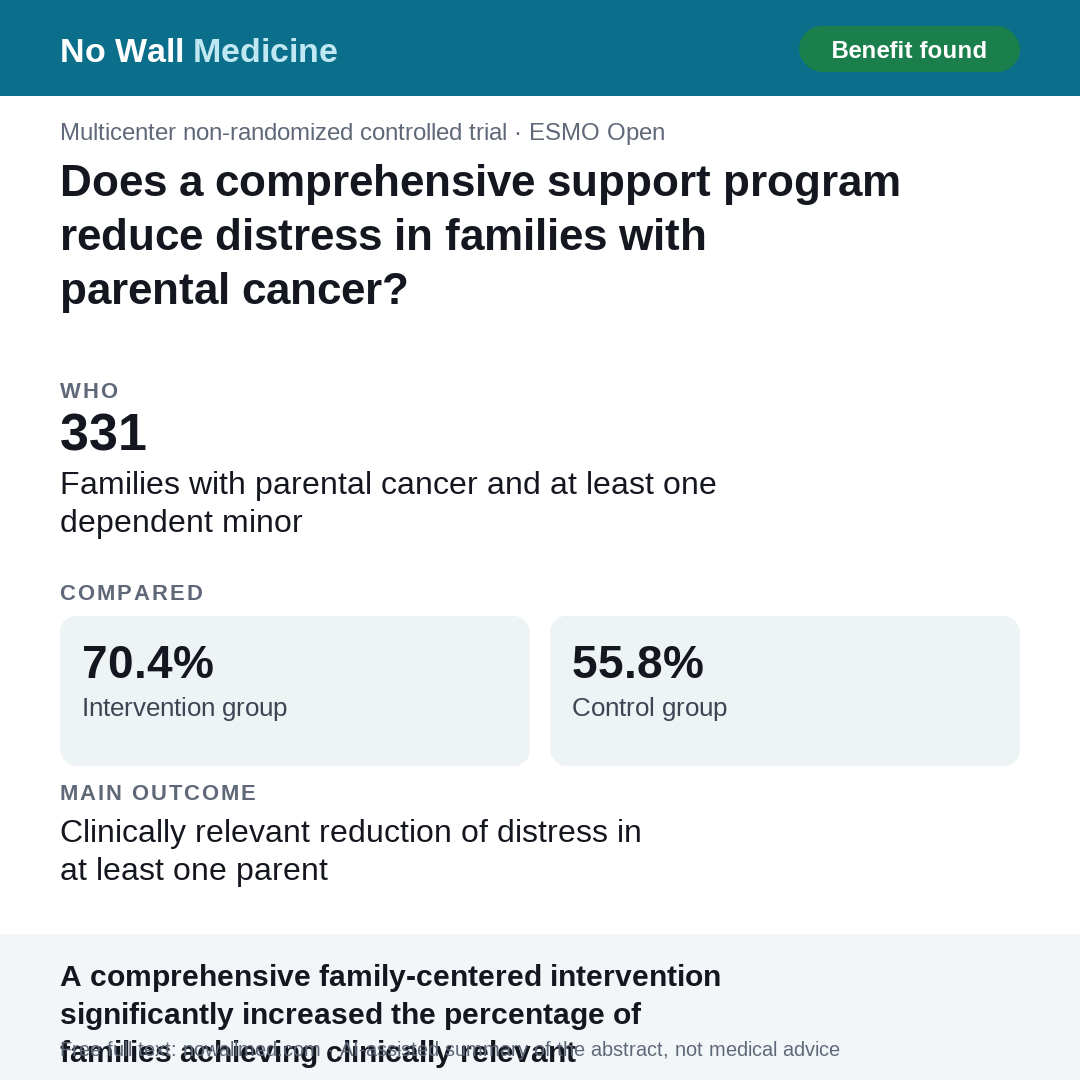
Does a comprehensive support program reduce distress in families with parental cancer?
Who
331
Families with parental cancer and at least one dependent minor
Compared
70.4%Intervention group
55.8%Control group
Main outcome
Clinically relevant reduction of distress in at least one parent
Result: P = 0.008
Bottom line: A comprehensive family-centered intervention significantly increased the percentage of families achieving clinically relevant distress reduction.
Limitation: Bias from other confounders cannot be excluded.
ESMO Open · 2024-06-07Download image
Clinical question: Does a comprehensive support program reduce distress in families with parental cancer?
Why it matters: Systematic interventions for families of cancer patients are rare and often limited by barriers to access.
In absolute numbers
Intervention group: 70.4% · Control group: 55.8% → a difference of 14.6 percentage points, so about 7 people would need the treatment for 1 more to benefit (number needed to treat) over the trial’s follow-up.
Worked out by us from the two group results above, not reported by the authors. Check the paper for the exact outcome and timing.
Key points
- Researchers studied 331 families where parents had cancer and minor children, comparing a nine-month care management program to standard care.
- The intervention group was associated with 70.4% of families achieving a clinically relevant reduction in distress compared to 55.8% in the control group.
- At the start of the study, parents in both groups showed high levels of distress on the Hospital Anxiety and Depression Scale.
Limitation the authors note: Bias from other confounders cannot be excluded.
Headline and key points written with AI from the paper’s abstract, with every number checked against it. Read the paper before relying on them.
Was this summary helpful?
Subject terms
Cite this article
Petermann-Meyer A, Panse JP, Bremen R, Dohmen M, Drueke B, Geiser F. Effectiveness of a comprehensive support program for families with parental cancer (Family-SCOUT): results of a multicenter non-randomized controlled trial. ESMO Open. 2024. doi:10.1016/j.esmoop.2024.103493
Spotted a mistake? Suggest a correction
Top studies every Monday
The week’s key trials and guidelines in your specialties, plus any topics you follow. By email, free.
Get the weekly digest