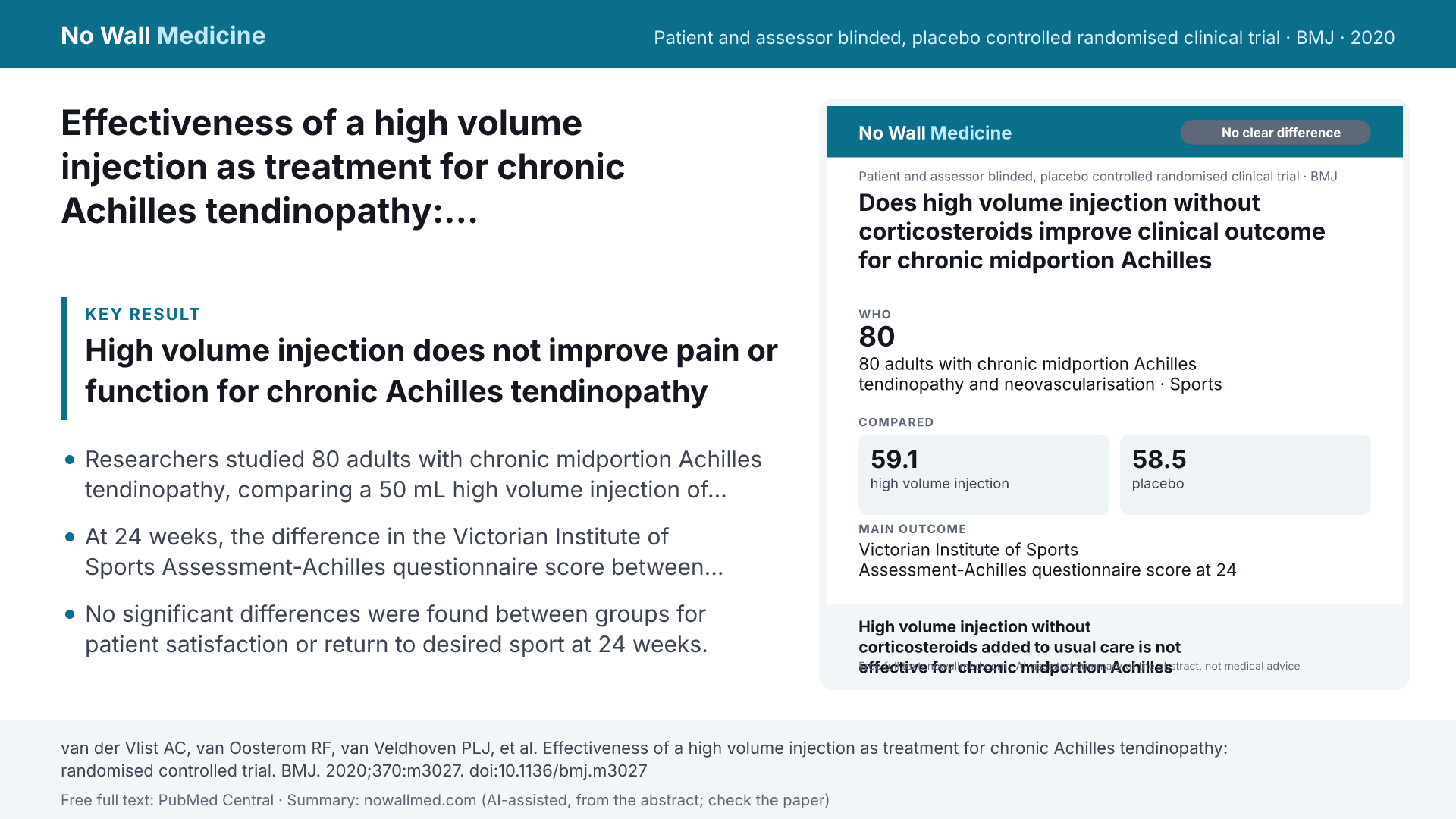
High volume injection does not improve pain or function for chronic Achilles tendinopathy
Effectiveness of a high volume injection as treatment for chronic Achilles tendinopathy: randomised controlled trial
Patient and assessor blinded, placebo controlled randomised clinical trialNo clear difference
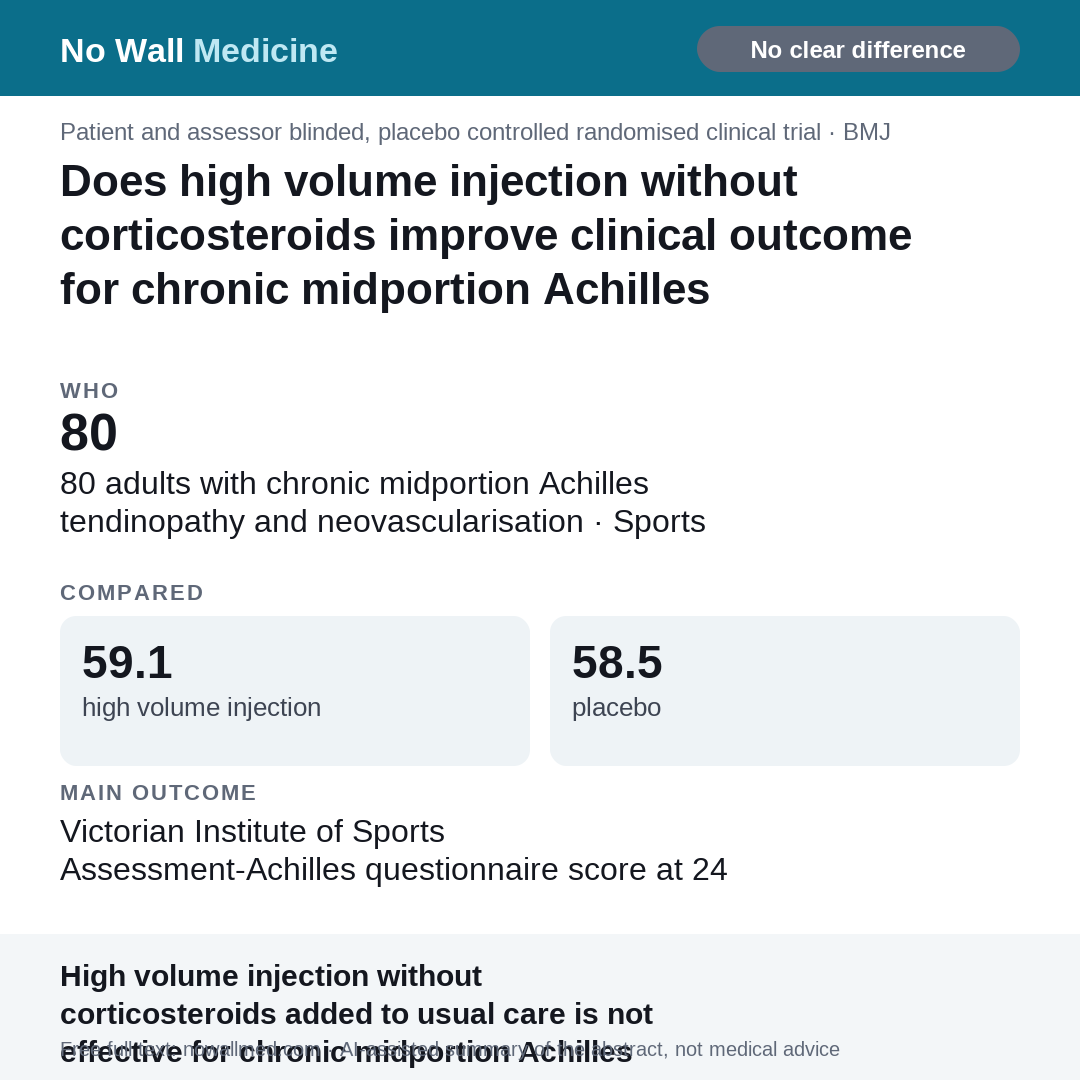
Does high volume injection without corticosteroids improve clinical outcome for chronic midportion Achilles tendinopathy?
Who
80
80 adults with chronic midportion Achilles tendinopathy and neovascularisation · Sports medicine department of a large district general hospital, Netherlands
Compared
59.1high volume injection (50.4 to 67.8)
58.5placebo (47.9 to 69.1)
Main outcome
Victorian Institute of Sports Assessment-Achilles questionnaire score at 24 weeks
Result: adjusted between group difference at 24 weeks 0.5 points, 95% confidence interval -17.8 to 18.8
Bottom line: High volume injection without corticosteroids added to usual care is not effective for chronic midportion Achilles tendinopathy.
BMJ · 2020-09-09Download image
Clinical question: Does high volume injection without corticosteroids improve clinical outcome for chronic midportion Achilles tendinopathy?
Why it matters: It was unknown if adding a high volume injection without corticosteroids to usual care improves clinical outcomes for adults with chronic midportion Achilles tendinopathy.
Key points
- Researchers studied 80 adults with chronic midportion Achilles tendinopathy, comparing a 50 mL high volume injection of saline and lidocaine to a 2 mL placebo injection.
- At 24 weeks, the difference in the Victorian Institute of Sports Assessment-Achilles questionnaire score between groups was 0.5 points (95% confidence interval -17.8 to 18.8).
- No significant differences were found between groups for patient satisfaction or return to desired sport at 24 weeks.
Headline and key points written with AI from the paper’s abstract, with every number checked against it. Read the paper before relying on them.
Was this summary helpful?
Abstract
Objective
To study whether a high volume injection without corticosteroids improves clinical outcome in addition to usual care for adults with chronic midportion Achilles tendinopathy. Design
Patient and assessor blinded, placebo controlled randomised clinical trial. Setting
Sports medicine department of a large district general hospital, the Netherlands. Participants
80 adults (aged 18-70 years) with clinically diagnosed chronic midportion Achilles tendinopathy and neovascularisation on ultrasonography. 39 were randomised to a high volume injection without corticosteroids and 41 to placebo. Interventions
Participants were instructed to perform an exercise programme for 24 weeks (usual care) combined with one 50 mL high volume injection of saline and lidocaine (intervention group) or one 2 mL placebo injection of saline and lidocaine (placebo group) at baseline. Main outcome measures
Primary outcome was pain and function assessed using the validated Victorian Institute of Sports Assessment-Achilles (VISA-A) questionnaire at 24 weeks (analysed using a generalised estimation equations model). Secondary outcomes were patient satisfaction, return to sport, degree of ultrasonographic Doppler flow, visual analogue scale on 10 hop test, power and flexibility of the gastrocnemius and soleus muscles, pain detect questionnaire for neuropathic pain, and pain coping inventory. Participants were evaluated at baseline and at 2, 6, 12, and 24 weeks. Results
Only one participant (1%) was lost to follow-up. The estimated mean VISA-A score improved significantly, from 40.4 (95% confidence interval 32.0 to 48.7) at baseline to 59.1 (50.4 to 67.8) at 24 weeks in the high volume injection group and from 36.9 (27.1 to 46.8) to 58.5 (47.9 to 69.1) in the placebo group. The VISA-A score over time did not differ between the groups (adjusted between group difference at 24 weeks 0.5 points, 95% confidence interval -17.8 to 18.8). No significant between group differences were found for patient satisfaction (21/37 (57%) v 19/39 (49%) patients, P=0.50) and return to desired sport (15/29 (52%) v 19/31 (61%) patients active in sports, P=0.65) at 24 weeks. None of the other secondary outcomes differed between the two groups. Conclusions
A high volume injection without corticosteroids in addition to usual care is not effective for symptom reduction in patients with chronic midportion Achilles tendinopathy. On the basis of our findings, we cannot recommend the use of a high volume injection in this patient group. Trial registration
ClinicalTrials.gov NCT02996409.
Abstract reproduced under the article’s CC BY NC licence.
Subject terms
Cite this article
van der Vlist AC, van Oosterom RF, van Veldhoven PLJ, et al. Effectiveness of a high volume injection as treatment for chronic Achilles tendinopathy: randomised controlled trial. BMJ. 2020. doi:10.1136/bmj.m3027
Spotted a mistake? Suggest a correction