Nature-based social prescribing reduced loneliness but did not improve quality of life in urban adults
Effectiveness of a nature-based social prescribing intervention on loneliness and health-related quality of life among vulnerable urban adults (RECETAS-BCN): an observer-blinded randomised controlled trial
Observer-blinded, parallel randomised controlled trialNo clear difference
Does a nature-based social prescribing intervention reduce loneliness and improve health-related quality of life?
Who
320
Lonely adults from low socioeconomic neighbourhoods in Barcelona, Spain · 12 neighbourhoods in Barcelona metropolitan region, Spain
Compared
Nature-based social prescribing intervention: 10.5 percent loneliness reduction
Active signposting: 10.5 percent loneliness reduction
Main outcome
Loneliness and health-related quality of life
Result: 0.30 (95% CI -0.26 to 0.86; p = 0.296)
Bottom line: Both nature-based social prescribing and active signposting reduced loneliness, but no significant difference was found between groups.
Funded by: European Commission H2020 programme
Lancet Reg Health Eur · 2026-08-18Download image
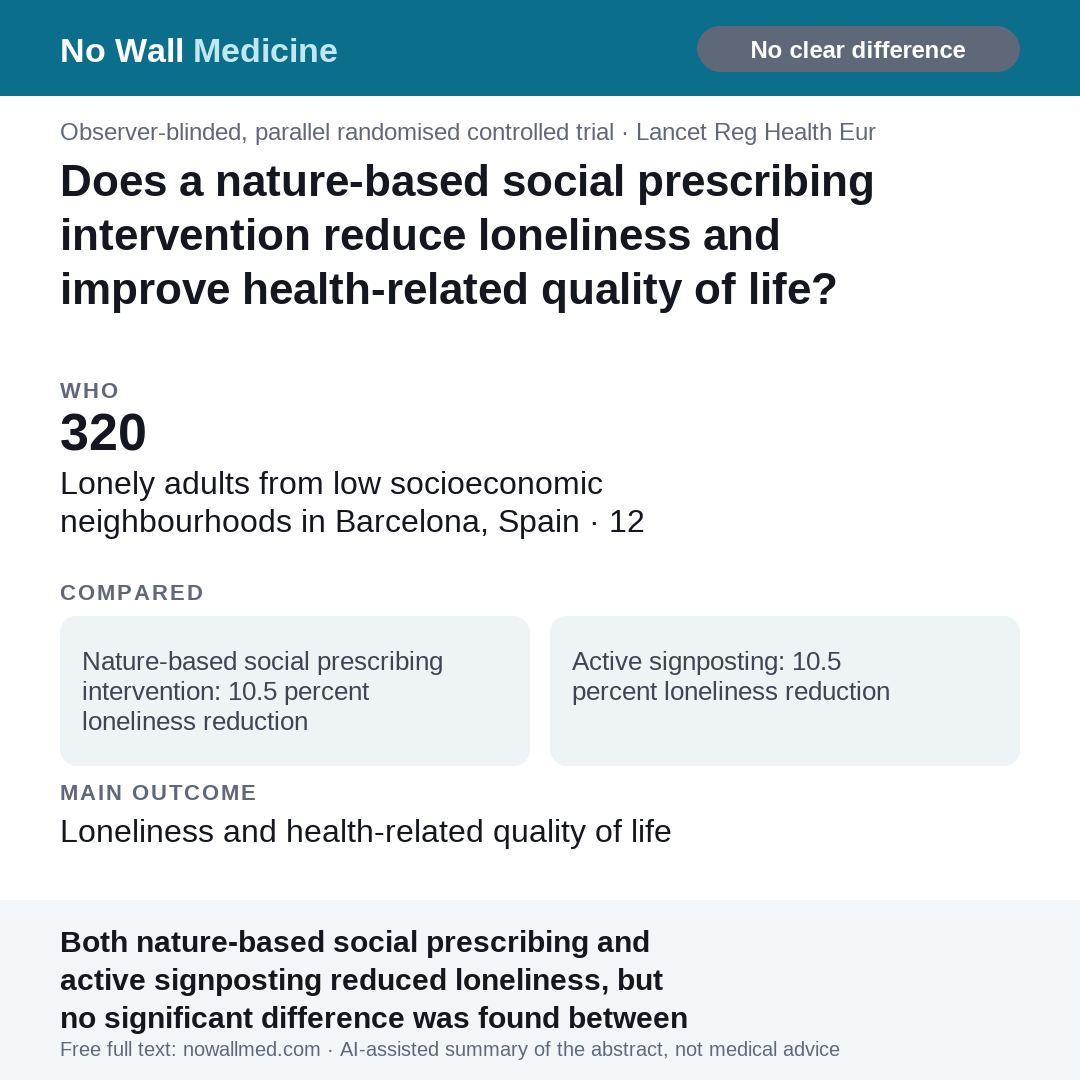
Clinical question: Does a nature-based social prescribing intervention reduce loneliness and improve health-related quality of life?
Why it matters: Loneliness is a major public health problem that disproportionately affects vulnerable populations and has recognized health consequences.
Key points
- Researchers studied 320 lonely adults in Barcelona, comparing nine weeks of nature-based group sessions to an active-control group receiving signposting.
- Both groups showed a 10.5 percent reduction in loneliness at three months, but there was no significant difference between the two groups.
- No significant changes were observed in health-related quality of life, which refers to how a person's health affects their daily functioning.
Headline and key points written with AI from the paper’s abstract, with every number checked against it. Read the paper before relying on them.
Cite this article
Coll-Planas L, Masó-Aguado M, Briones-Buixassa L, Morató A, Mendez S, Carbó A. Effectiveness of a nature-based social prescribing intervention on loneliness and health-related quality of life among vulnerable urban adults (RECETAS-BCN): an observer-blinded randomised controlled trial. Lancet Reg Health Eur. 2026. doi:10.1016/j.lanepe.2026.101821
Spotted a mistake? Suggest a correction