One-year smoking cessation intervention showed higher quit rates for people with severe mental illness
Effectiveness of a one-year smoking cessation intervention for people with severe mental illness: results of the KISMET cluster-randomized controlled trial
Key points
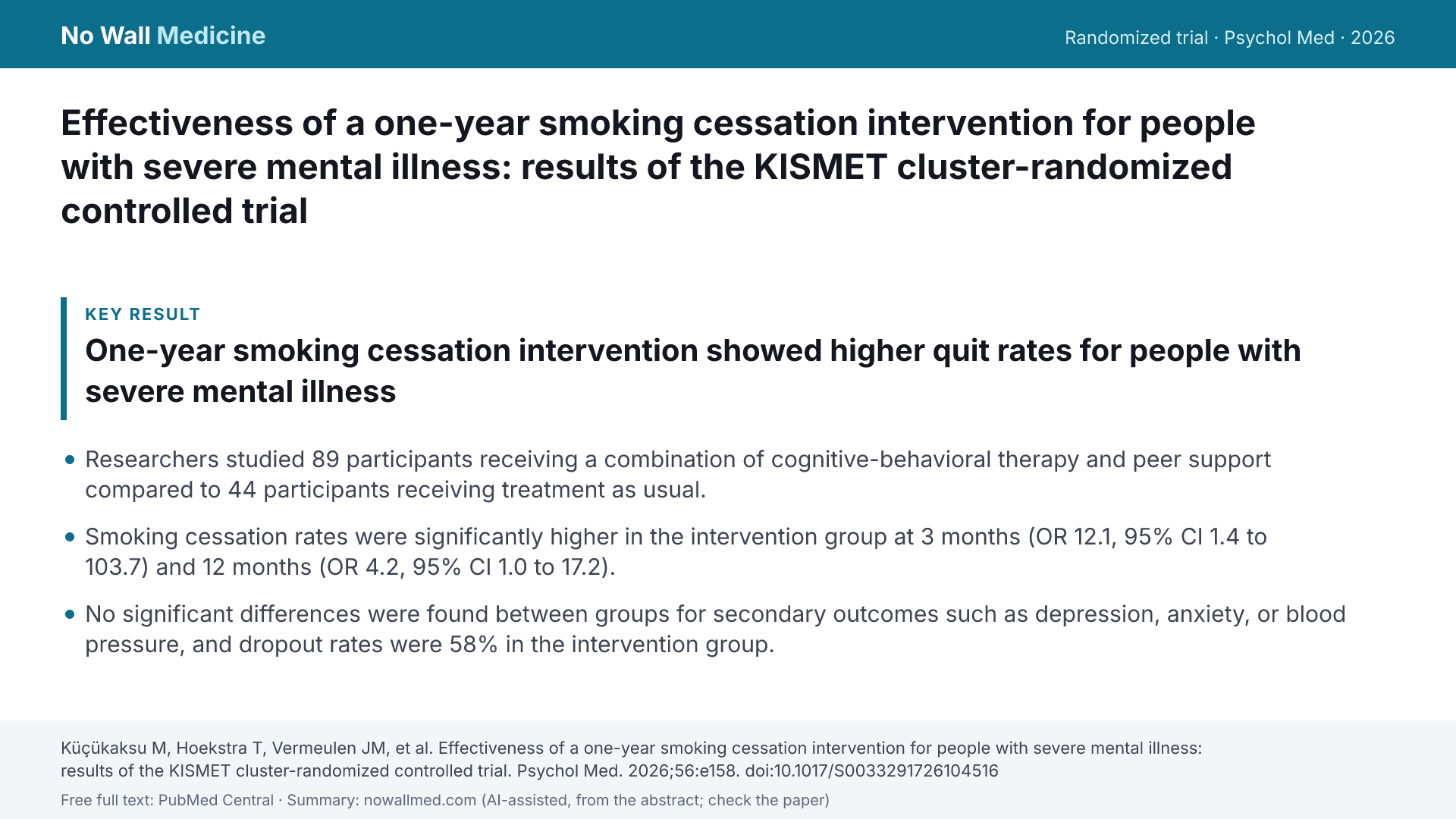
- Researchers studied 89 participants receiving a combination of cognitive-behavioral therapy and peer support compared to 44 participants receiving treatment as usual.
- Smoking cessation rates were significantly higher in the intervention group at 3 months (OR 12.1, 95% CI 1.4 to 103.7) and 12 months (OR 4.2, 95% CI 1.0 to 17.2).
- No significant differences were found between groups for secondary outcomes such as depression, anxiety, or blood pressure, and dropout rates were 58% in the intervention group.
Limitation the authors note: The authors state that results must be interpreted with the high dropout rates in mind.
Headline and key points written with AI from the paper’s abstract, with every number checked against it. Read the paper before relying on them.
Was this summary helpful?
Subject terms
Headline, design, result, key points, caveat and citation as plain text.
Cite this article
Küçükaksu M, Hoekstra T, Vermeulen JM, et al. Effectiveness of a one-year smoking cessation intervention for people with severe mental illness: results of the KISMET cluster-randomized controlled trial. Psychol Med. 2026;56:e158. doi:10.1017/S0033291726104516
Spotted a mistake? Suggest a correction