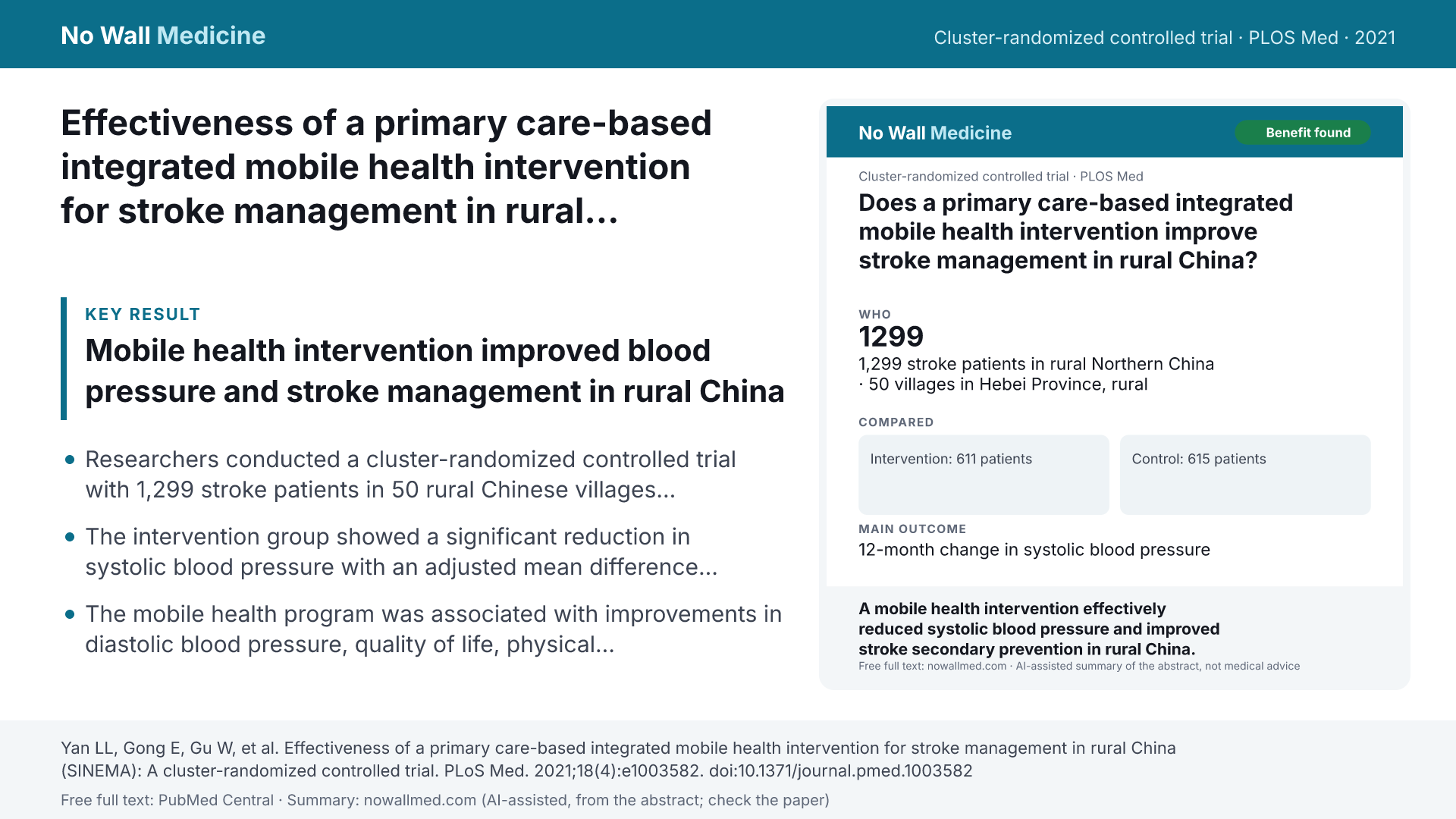
Mobile health intervention improved blood pressure and stroke management in rural China
Effectiveness of a primary care-based integrated mobile health intervention for stroke management in rural China (SINEMA): A cluster-randomized controlled trial
Cluster-randomized controlled trialBenefit found
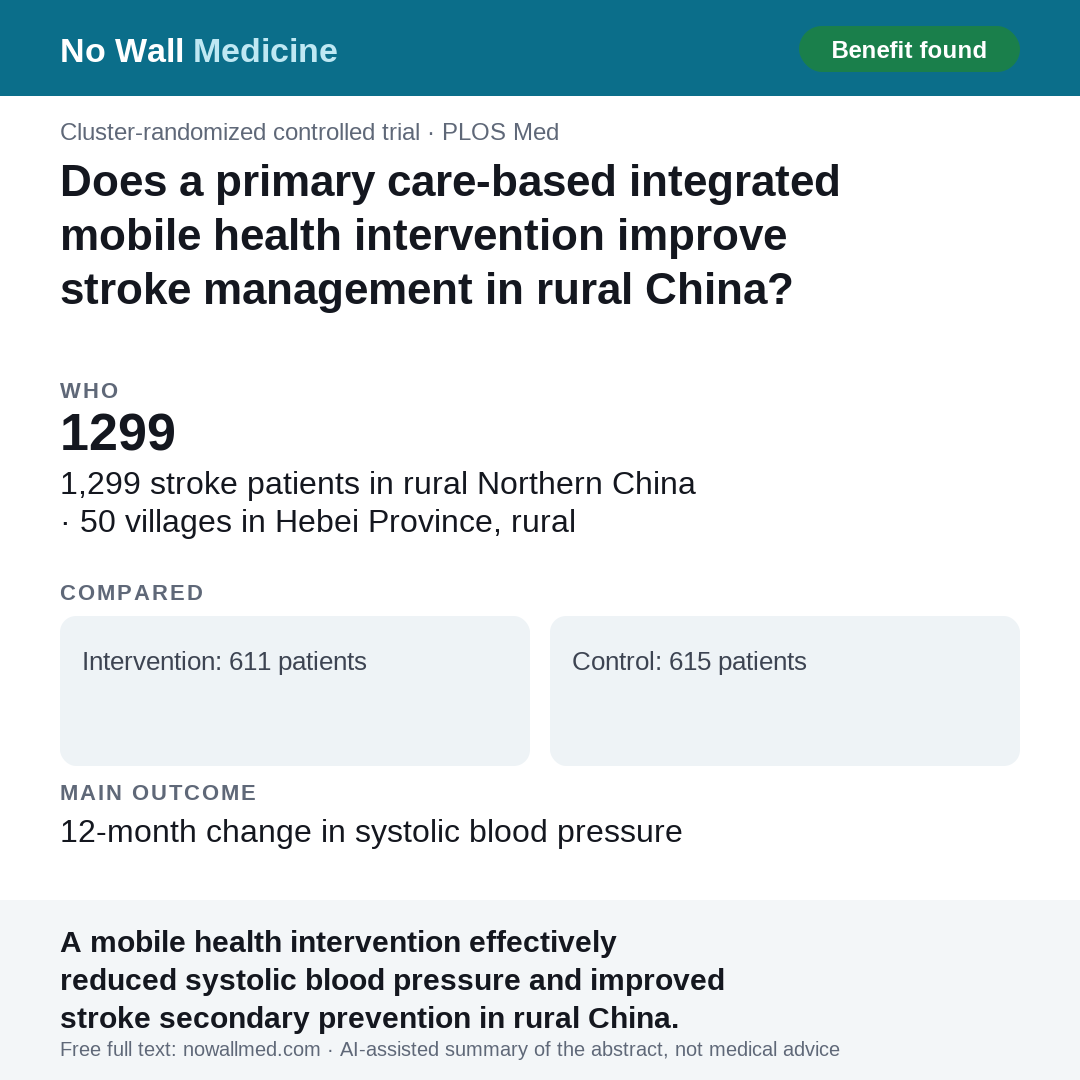
Does a primary care-based integrated mobile health intervention improve stroke management in rural China?
Who
1299
1,299 stroke patients in rural Northern China · 50 villages in Hebei Province, rural Northern China
Compared
Intervention: 611 patients
Control: 615 patients
Main outcome
12-month change in systolic blood pressure
Result: adjusted mean difference: -2.8 mm Hg (95% CI -4.8, -0.9)
Bottom line: A mobile health intervention effectively reduced systolic blood pressure and improved stroke secondary prevention in rural China.
Limitation: Relatively short study duration of 1 year and limited generalizability beyond the study setting.
PLOS Med · 2021-04-28Download image
Clinical question: Does a primary care-based integrated mobile health intervention improve stroke management in rural China?
Why it matters: It was unknown if a primary care-based mobile health intervention could effectively improve stroke management in resource-limited rural settings.
Key points
- Researchers conducted a cluster-randomized controlled trial with 1,299 stroke patients in 50 rural Chinese villages to compare a mobile health intervention against usual care.
- The intervention group showed a significant reduction in systolic blood pressure with an adjusted mean difference of -2.8 mm Hg compared to the control group.
- The mobile health program was associated with improvements in diastolic blood pressure, quality of life, physical activity, medication adherence, and mobility test performance.
Limitation the authors note: The authors stated the study had a relatively short duration of only 1 year and noted concerns regarding the generalizability of findings beyond the study setting.
Headline and key points written with AI from the paper’s abstract, with every number checked against it. Read the paper before relying on them.
Was this summary helpful?
Subject terms
Cite this article
Yan LL, Gong E, Gu W, et al. Effectiveness of a primary care-based integrated mobile health intervention for stroke management in rural China (SINEMA): A cluster-randomized controlled trial. PLOS Med. 2021. doi:10.1371/journal.pmed.1003582
Spotted a mistake? Suggest a correction