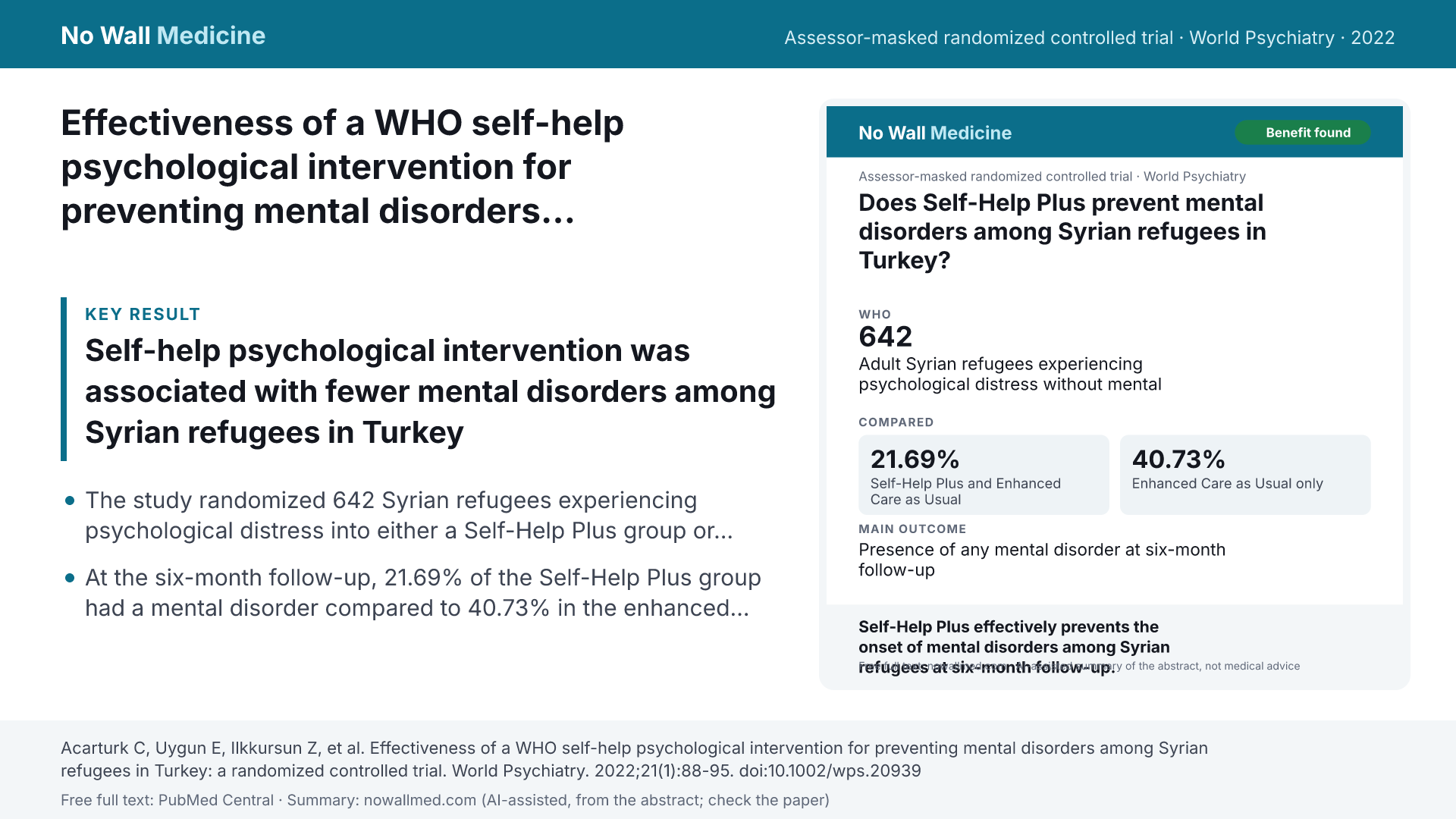
Effectiveness of a WHO self-help psychological intervention for preventing mental disorders among Syrian refugees in Turkey: a randomized controlled trial
Key result: Self-help psychological intervention was associated with fewer mental disorders among Syrian refugees in Turkey
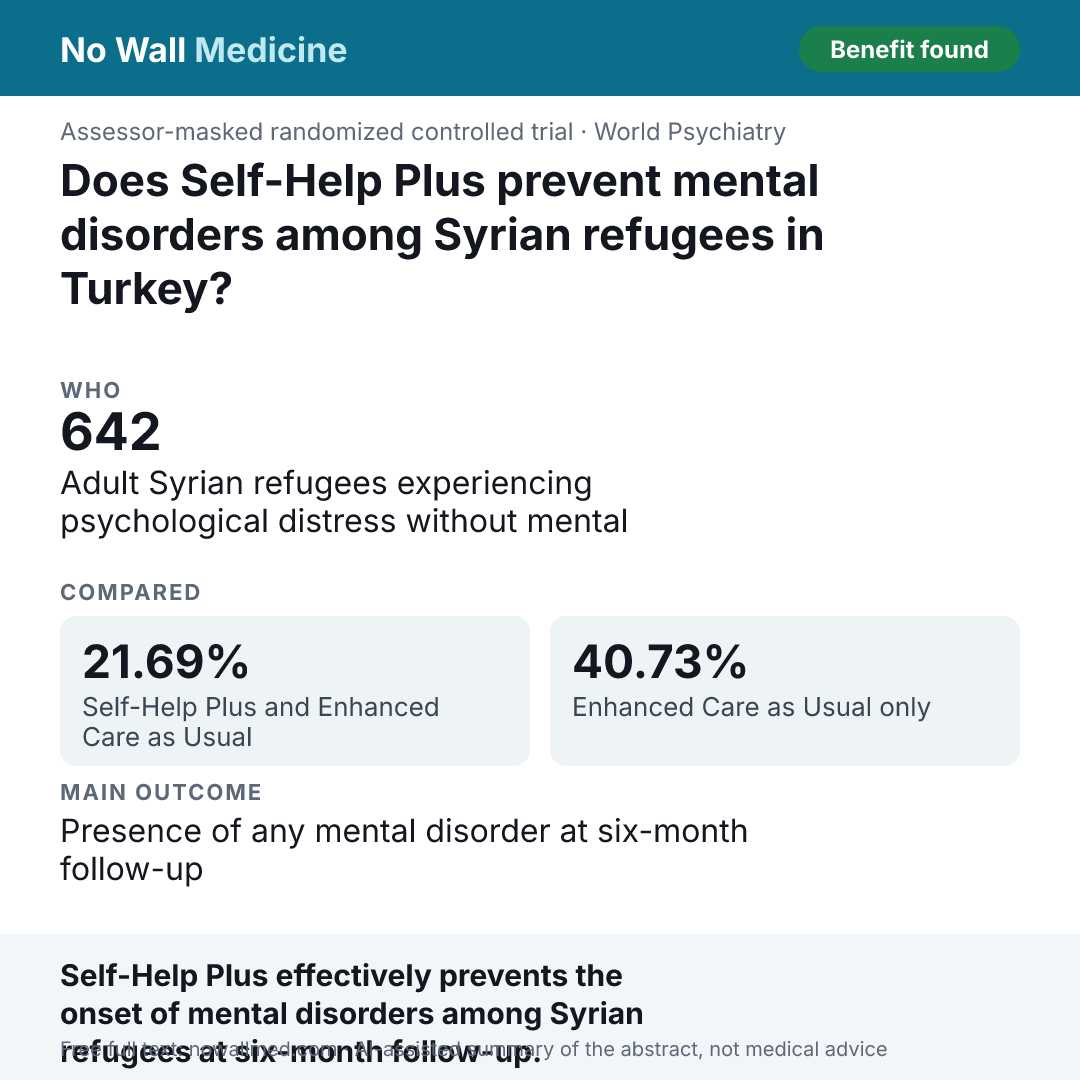
Assessor-masked randomized controlled trialBenefit found
Does Self-Help Plus prevent mental disorders among Syrian refugees in Turkey?
Who
642
Adult Syrian refugees experiencing psychological distress without mental disorders · Two areas in Turkey
Compared
21.69%Self-Help Plus and Enhanced Care as Usual
40.73%Enhanced Care as Usual only
Main outcome
Presence of any mental disorder at six-month follow-up
Result: risk ratio 0.533, 95% CI 0.408-0.696
Bottom line: Self-Help Plus effectively prevents the onset of mental disorders among Syrian refugees at six-month follow-up.
World Psychiatry · 2022-01-11 · Save PNG
Key points
- The study randomized 642 Syrian refugees experiencing psychological distress into either a Self-Help Plus group or an enhanced care as usual group.
- At the six-month follow-up, 21.69% of the Self-Help Plus group had a mental disorder compared to 40.73% in the enhanced care group.
- Self-Help Plus was associated with better depression symptoms, personally identified psychological outcomes, and quality of life at the six-month follow-up.
Discussion prompts
- Would these patients look like yours? Who was left out?
- Is the main outcome one that matters to patients?
- Is the difference large enough to change what you do?
Cite: Acarturk C, Uygun E, Ilkkursun Z, et al. Effectiveness of a WHO self-help psychological intervention for preventing mental disorders among Syrian refugees in Turkey: a randomized controlled trial. World Psychiatry. 2022;21(1):88-95. doi:10.1002/wps.20939
Free full text: PubMed Central · Summary and visual abstract: nowallmed.com/a/effectiveness-of-a-who-self-help-psychological-intervention-for-1ngxmj9/ (AI-assisted from the abstract; check the paper before relying on it).