Self-help psychological intervention was associated with fewer mental disorders among Syrian refugees in Turkey
Effectiveness of a WHO self-help psychological intervention for preventing mental disorders among Syrian refugees in Turkey: a randomized controlled trial
Assessor-masked randomized controlled trialBenefit found
Does Self-Help Plus prevent mental disorders among Syrian refugees in Turkey?
Who
642
Adult Syrian refugees experiencing psychological distress without mental disorders · Two areas in Turkey
Compared
21.69%Self-Help Plus and Enhanced Care as Usual
40.73%Enhanced Care as Usual only
Main outcome
Presence of any mental disorder at six-month follow-up
Result: risk ratio 0.533, 95% CI 0.408-0.696
Bottom line: Self-Help Plus effectively prevents the onset of mental disorders among Syrian refugees at six-month follow-up.
World Psychiatry · 2022-01-11 · Save PNG
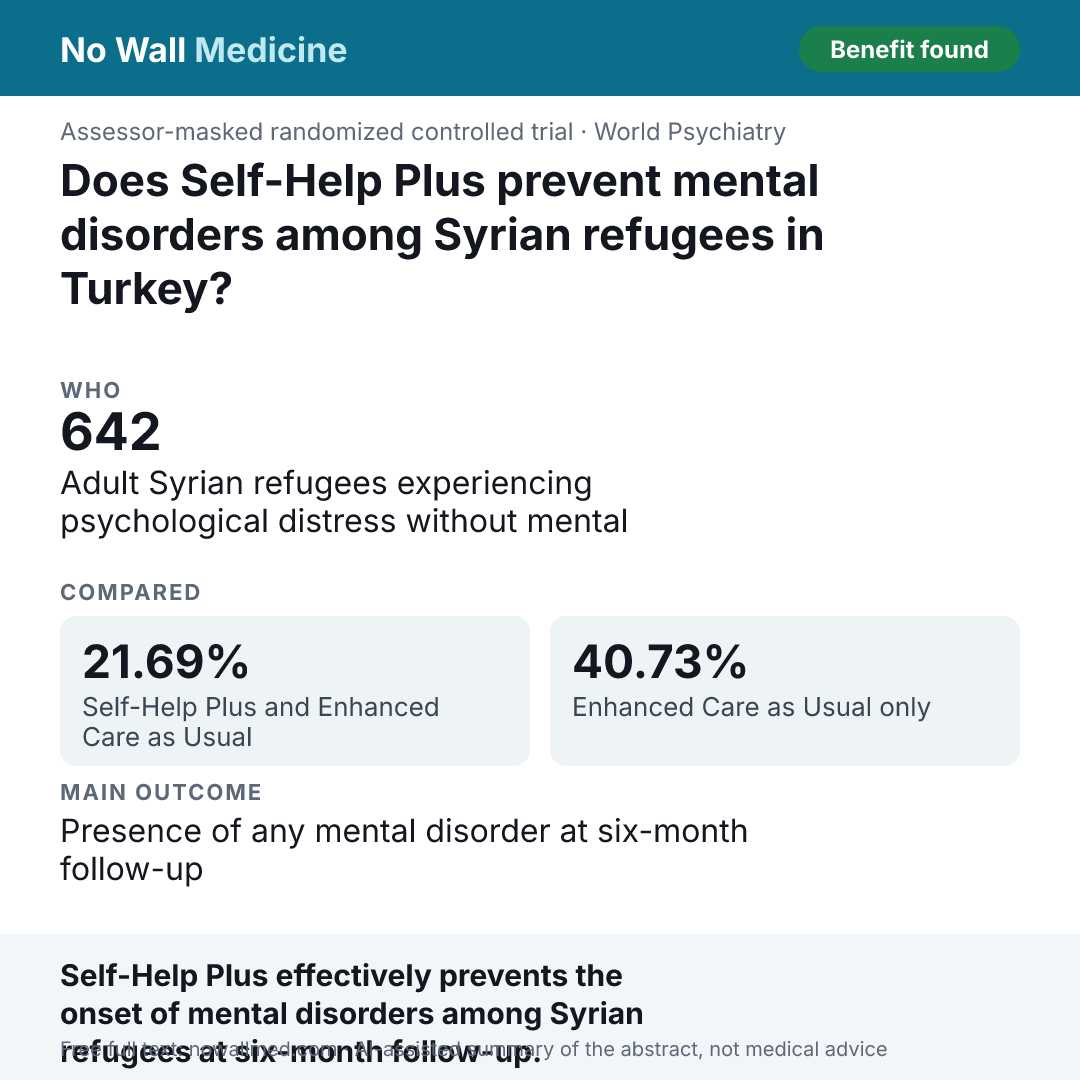
Clinical question: Does Self-Help Plus prevent mental disorders among Syrian refugees in Turkey?
Key points
- The study randomized 642 Syrian refugees experiencing psychological distress into either a Self-Help Plus group or an enhanced care as usual group.
- At the six-month follow-up, 21.69% of the Self-Help Plus group had a mental disorder compared to 40.73% in the enhanced care group.
- Self-Help Plus was associated with better depression symptoms, personally identified psychological outcomes, and quality of life at the six-month follow-up.
Headline and key points written with AI from the paper’s abstract, with every number checked against it. Read the paper before relying on them.
Was this summary helpful?
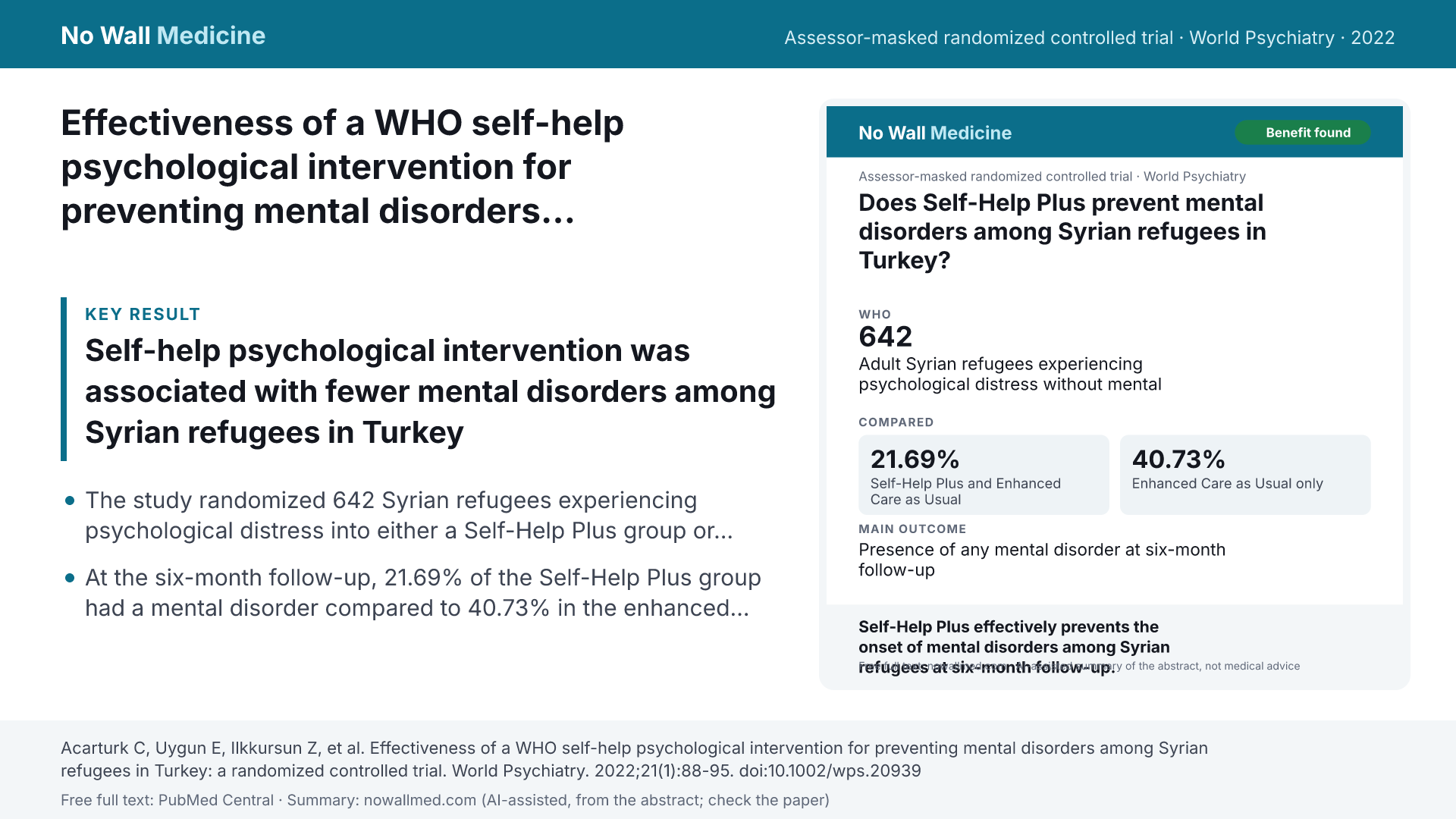
Headline, design, result, key points, caveat and citation as plain text.
Cite this article
Acarturk C, Uygun E, Ilkkursun Z, et al. Effectiveness of a WHO self-help psychological intervention for preventing mental disorders among Syrian refugees in Turkey: a randomized controlled trial. World Psychiatry. 2022. doi:10.1002/wps.20939
Spotted a mistake? Suggest a correction