Educational intervention by professional rugby players did not reduce homophobic language in youth teams
Effectiveness of an educational intervention targeting homophobic language use by young male athletes: a cluster randomised controlled trial
Cluster randomised controlled trialNo clear difference
Does an educational intervention by professional rugby players reduce homophobic language use?
Who
167
Australian youth rugby teams aged 16 to 20 years · 9 clubs in Australia
Compared
Intervention group
Control group
Main outcome
Frequency of homophobic language use
Bottom line: An educational intervention delivered by professional rugby players did not significantly reduce homophobic language use.
Br J Sports Med · 2023-02-10Download image
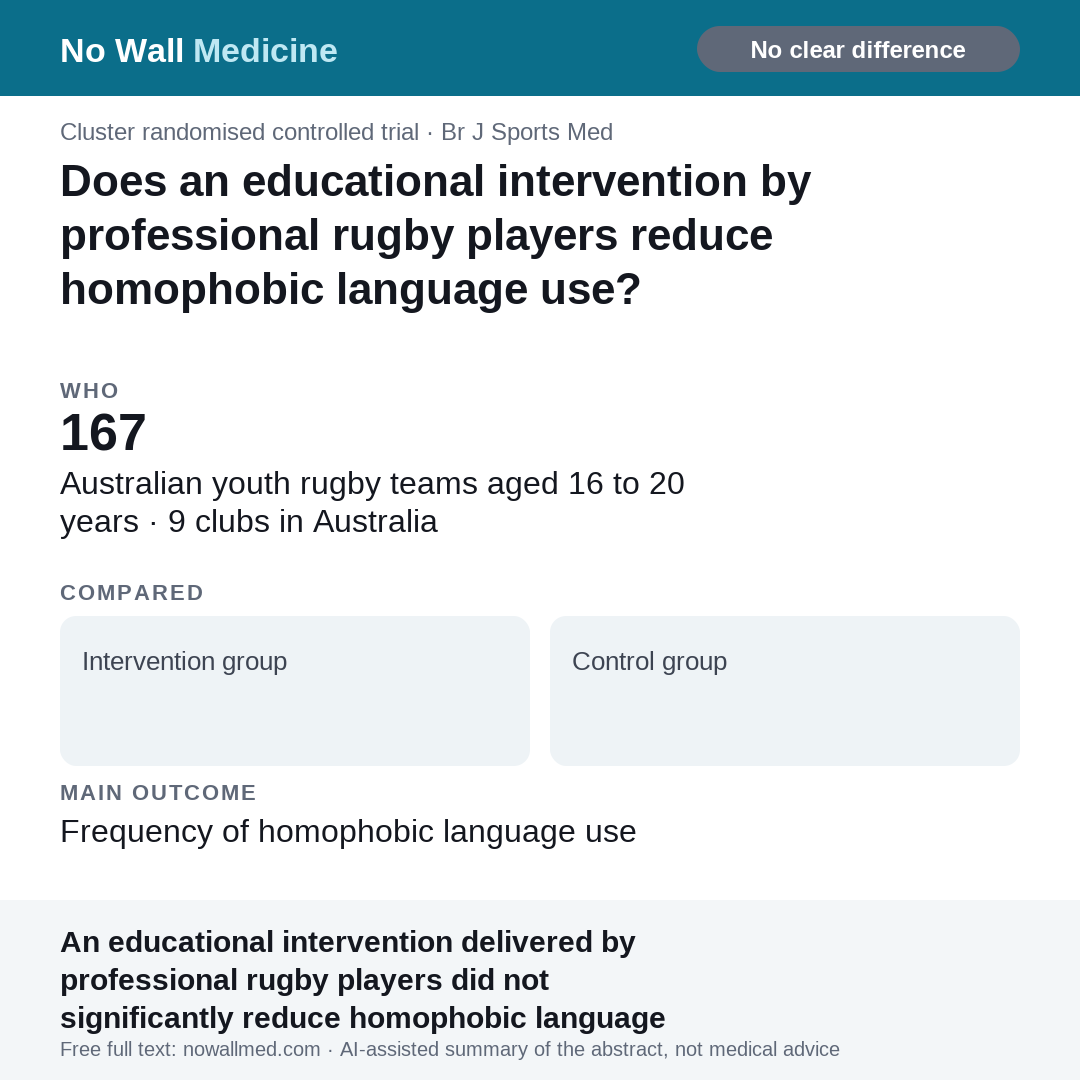
Clinical question: Does an educational intervention by professional rugby players reduce homophobic language use?
Why it matters: It is unknown if a short social-cognitive educational intervention delivered by professional athletes can reduce the use of homophobic language in youth sports.
Key points
- Researchers studied 167 Australian youth rugby players aged 16-20 across 13 teams to test an educational intervention delivered by professional players.
- At the start of the study, 49.1% of participants reported using homophobic language and 72.7% reported teammates used such language.
- The intervention did not significantly reduce the use of homophobic language or change related attitudes and social norms compared to the control group.
Headline and key points written with AI from the paper’s abstract, with every number checked against it. Read the paper before relying on them.
Was this summary helpful?
Abstract
Objective
Homophobic language is common in male sport and associated with negative physical and mental health outcomes for all sport participants, but particularly for gay or bisexual youth populations. Evidence-based interventions are needed to reduce such language and mitigate harm. This study evaluated the effectiveness of a short social-cognitive educational intervention delivered by professional rugby union players in youth sport. Methods
In a two-arm, cluster randomised controlled trial, 13 Australian youth rugby teams from 9 clubs (N=167, ages 16-20, mean 17.9) were randomised into intervention or control groups. Professional rugby players delivered the intervention in-person. Frequency of homophobic language use was measured 2 weeks before and 2 weeks after the intervention. Hypothesised factors underpinning homophobic language were also measured, including descriptive (other people use), prescriptive and proscriptive injunctive norms (approval/disapproval by others), and attitudes towards the acceptability of homophobic language. Results
At baseline, 49.1% of participants self-reported using homophobic language in the past 2 weeks and 72.7% reported teammates using homophobic language. Significant relationships were found between this behaviour and the hypothesised factors targeted by the intervention. However, generalised estimating equations found the intervention did not significantly reduce homophobic language, or alter the associated norms and attitudes, relative to controls. Conclusion
Use of professional rugby athletes to deliver education on homophobic language was not effective. Other approaches to reduce homophobic language (and other forms of discrimination) such as peer-to-peer education, and enforcement of policies prohibiting specific language by coaches, should be explored.
Abstract reproduced under the article’s CC BY NC licence.
Subject terms
Cite this article
Denison E, Faulkner N, O'Brien KS, Jeanes R, Canning M. Effectiveness of an educational intervention targeting homophobic language use by young male athletes: a cluster randomised controlled trial. Br J Sports Med. 2023. doi:10.1136/bjsports-2022-105916
Spotted a mistake? Suggest a correction
Top studies every Monday
The week’s key trials and guidelines in your specialties, plus any topics you follow. By email, free.
Get the weekly digest