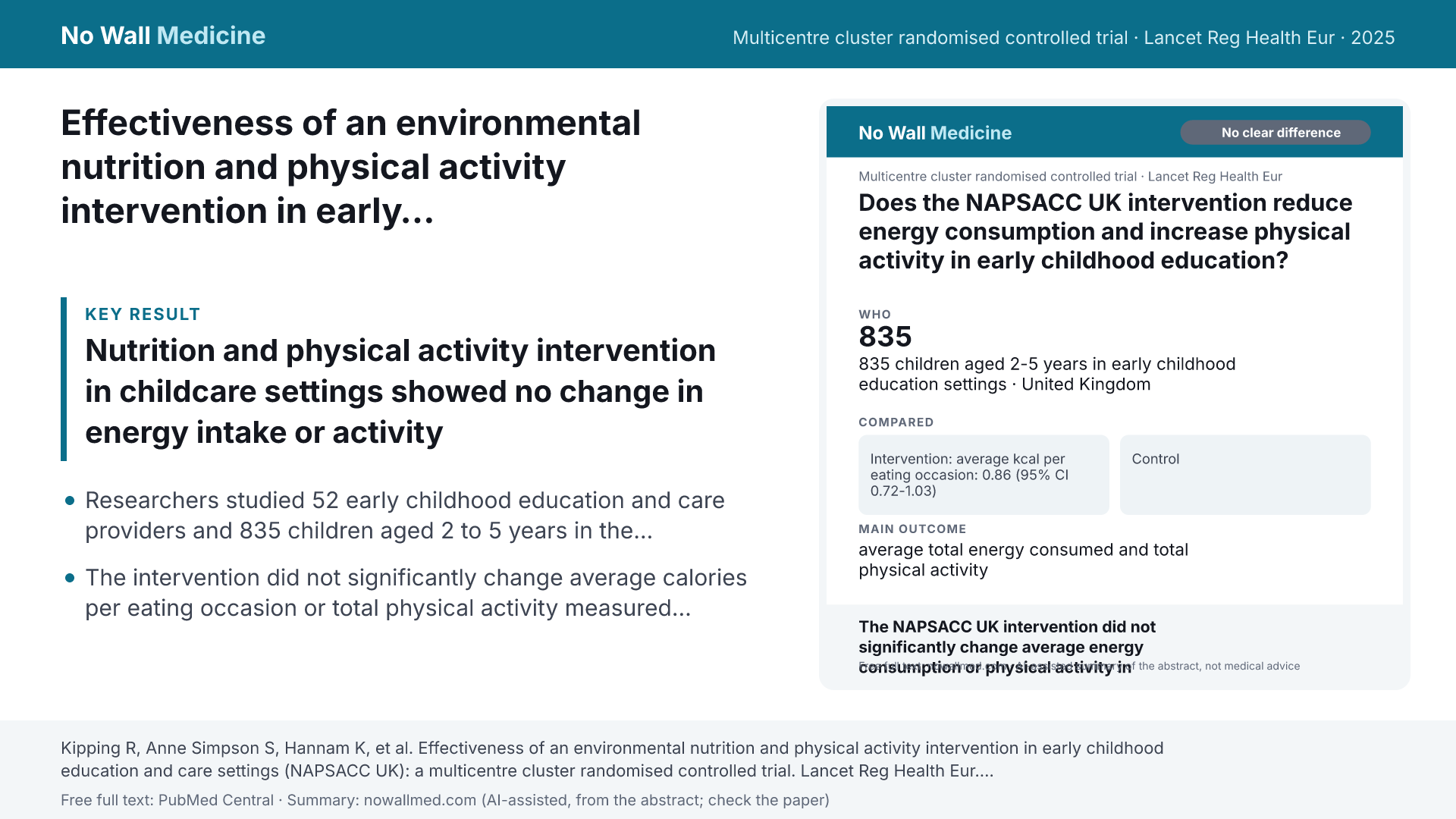
Nutrition and physical activity intervention in childcare settings showed no change in energy intake or activity
Effectiveness of an environmental nutrition and physical activity intervention in early childhood education and care settings (NAPSACC UK): a multicentre cluster randomised controlled trial
Multicentre cluster randomised controlled trialNo clear difference
Does the NAPSACC UK intervention reduce energy consumption and increase physical activity in early childhood education?
Who
835
835 children aged 2-5 years in early childhood education settings · United Kingdom
Compared
Intervention: average kcal per eating occasion: 0.86 (95% CI 0.72-1.03)
Control
Main outcome
average total energy consumed and total physical activity
Result: adjusted geometric mean ratio 0.86 (95% CI 0.72-1.03); adjusted mean difference -2.13 min (95% CI -10.96 to 6.70)
Bottom line: The NAPSACC UK intervention did not significantly change average energy consumption or physical activity in children.
Funded by: National Institute for Health and Care Research
Lancet Reg Health Eur · 2025-12-18Download image
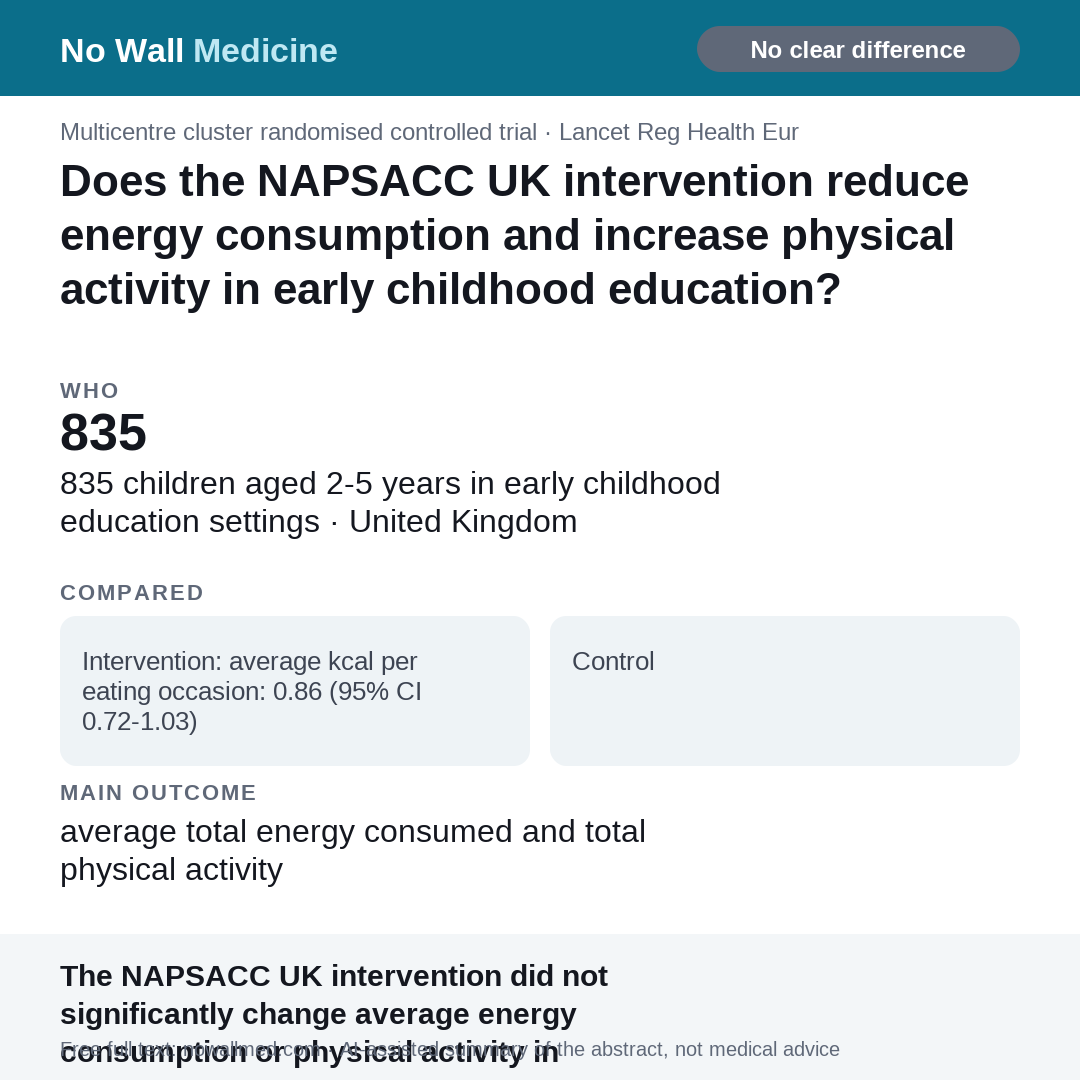
Clinical question: Does the NAPSACC UK intervention reduce energy consumption and increase physical activity in early childhood education?
Why it matters: Researchers wanted to test if an intervention designed to improve nutrition and physical activity policies in childcare settings could reduce energy consumption and increase activity.
Key points
- Researchers studied 52 early childhood education and care providers and 835 children aged 2 to 5 years in the United Kingdom.
- The intervention did not significantly change average calories per eating occasion or total physical activity measured by accelerometers after 12 months.
- The intervention was associated with lower lunch energy served by 69.1 kcal per occasion and lower energy consumed by 67.7 kcal per occasion.
Headline and key points written with AI from the paper’s abstract, with every number checked against it. Read the paper before relying on them.
Was this summary helpful?
Cite this article
Kipping R, Anne Simpson S, Hannam K, et al. Effectiveness of an environmental nutrition and physical activity intervention in early childhood education and care settings (NAPSACC UK): a multicentre cluster randomised controlled trial. Lancet Reg Health Eur. 2025. doi:10.1016/j.lanepe.2025.101550
Spotted a mistake? Suggest a correction