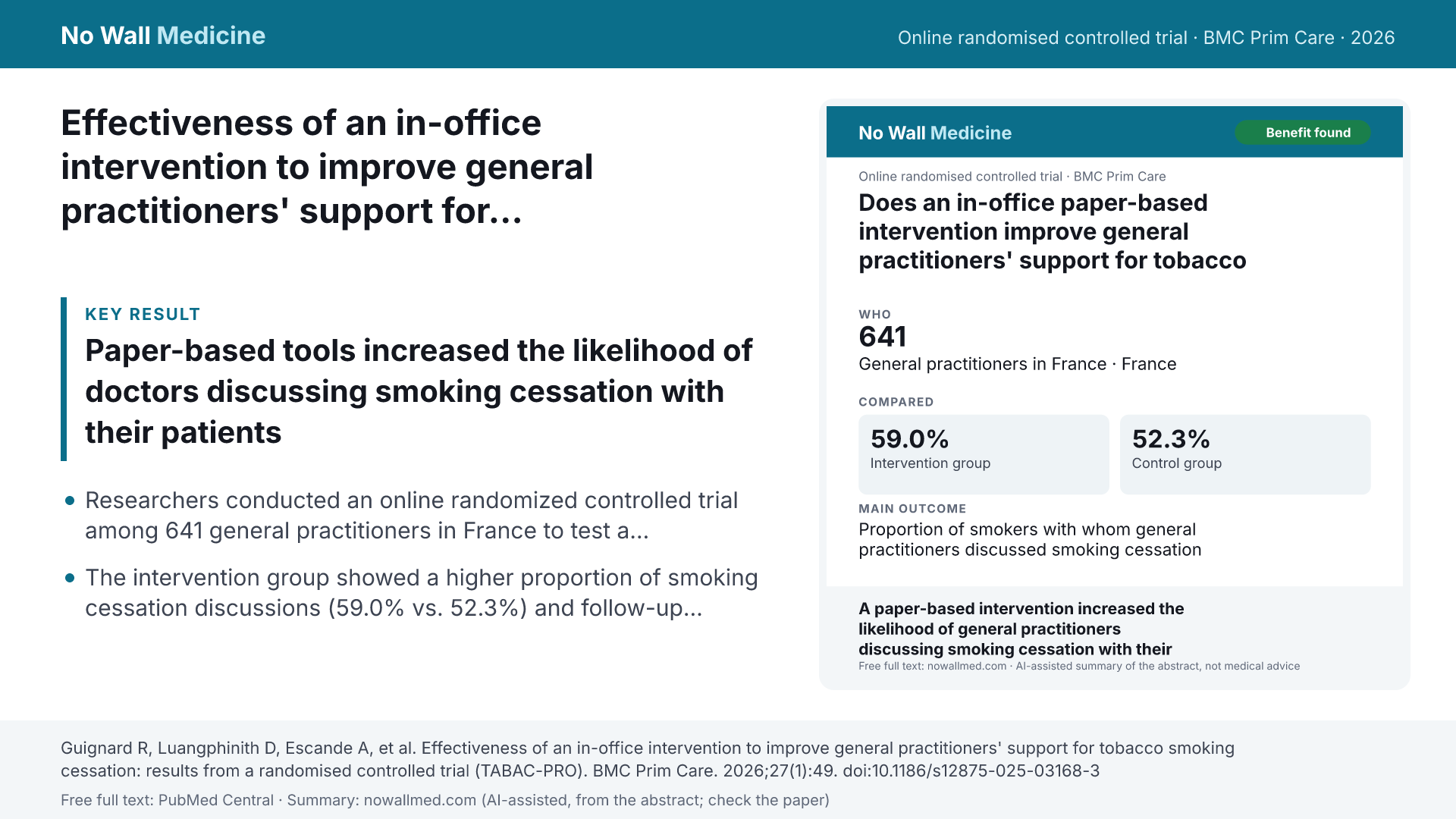
Paper-based tools increased the likelihood of doctors discussing smoking cessation with their patients
Effectiveness of an in-office intervention to improve general practitioners' support for tobacco smoking cessation: results from a randomised controlled trial (TABAC-PRO)
Online randomised controlled trialBenefit found
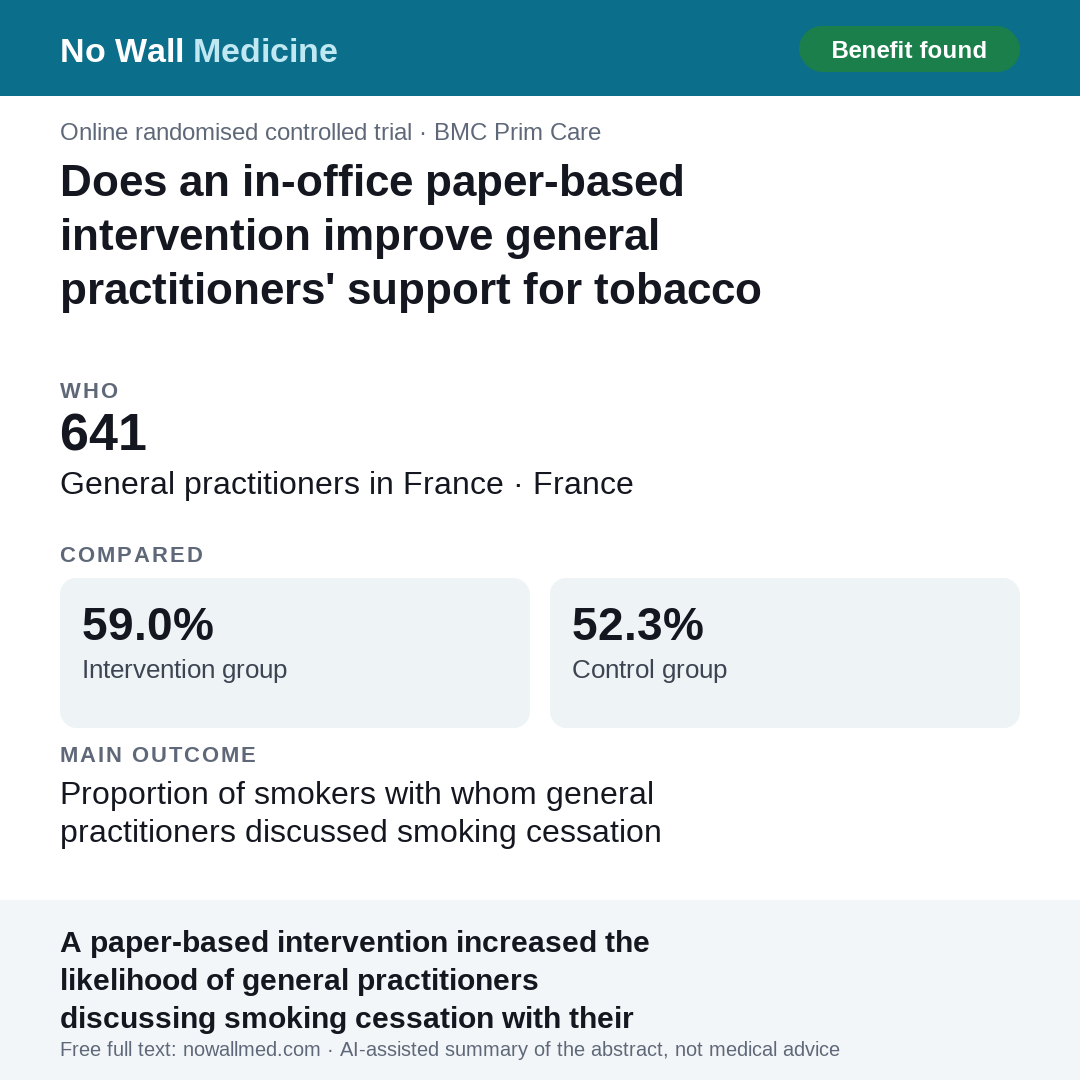
Does an in-office paper-based intervention improve general practitioners' support for tobacco smoking cessation?
Who
641
General practitioners in France · France
Compared
59.0%Intervention group
52.3%Control group
Main outcome
Proportion of smokers with whom general practitioners discussed smoking cessation
Bottom line: A paper-based intervention increased the likelihood of general practitioners discussing smoking cessation with their patients.
BMC Prim Care · 2026-01-09Download image
Clinical question: Does an in-office paper-based intervention improve general practitioners' support for tobacco smoking cessation?
Why it matters: Support for tobacco smoking cessation provided by general practitioners is effective but remains quite rare in clinical practice.
In absolute numbers
Intervention group: 59% · Control group: 52.3% → a difference of 6.7 percentage points, so about 15 people would need the treatment for 1 more to benefit (number needed to treat) over the trial’s follow-up.
Worked out by us from the two group results above, not reported by the authors. Check the paper for the exact outcome and timing.
Key points
- Researchers conducted an online randomized controlled trial among 641 general practitioners in France to test a behavioral science-based intervention kit.
- The intervention group showed a higher proportion of smoking cessation discussions (59.0% vs. 52.3%) and follow-up offers (73.8% vs. 60.3%) compared to the control group.
- There were no significant differences between the groups regarding the prescription of nicotine replacement therapy or referrals to other professionals.
Headline and key points written with AI from the paper’s abstract, with every number checked against it. Read the paper before relying on them.
Was this summary helpful?
Subject terms
Cite this article
Guignard R, Luangphinith D, Escande A, et al. Effectiveness of an in-office intervention to improve general practitioners' support for tobacco smoking cessation: results from a randomised controlled trial (TABAC-PRO). BMC Prim Care. 2026. doi:10.1186/s12875-025-03168-3
Spotted a mistake? Suggest a correction