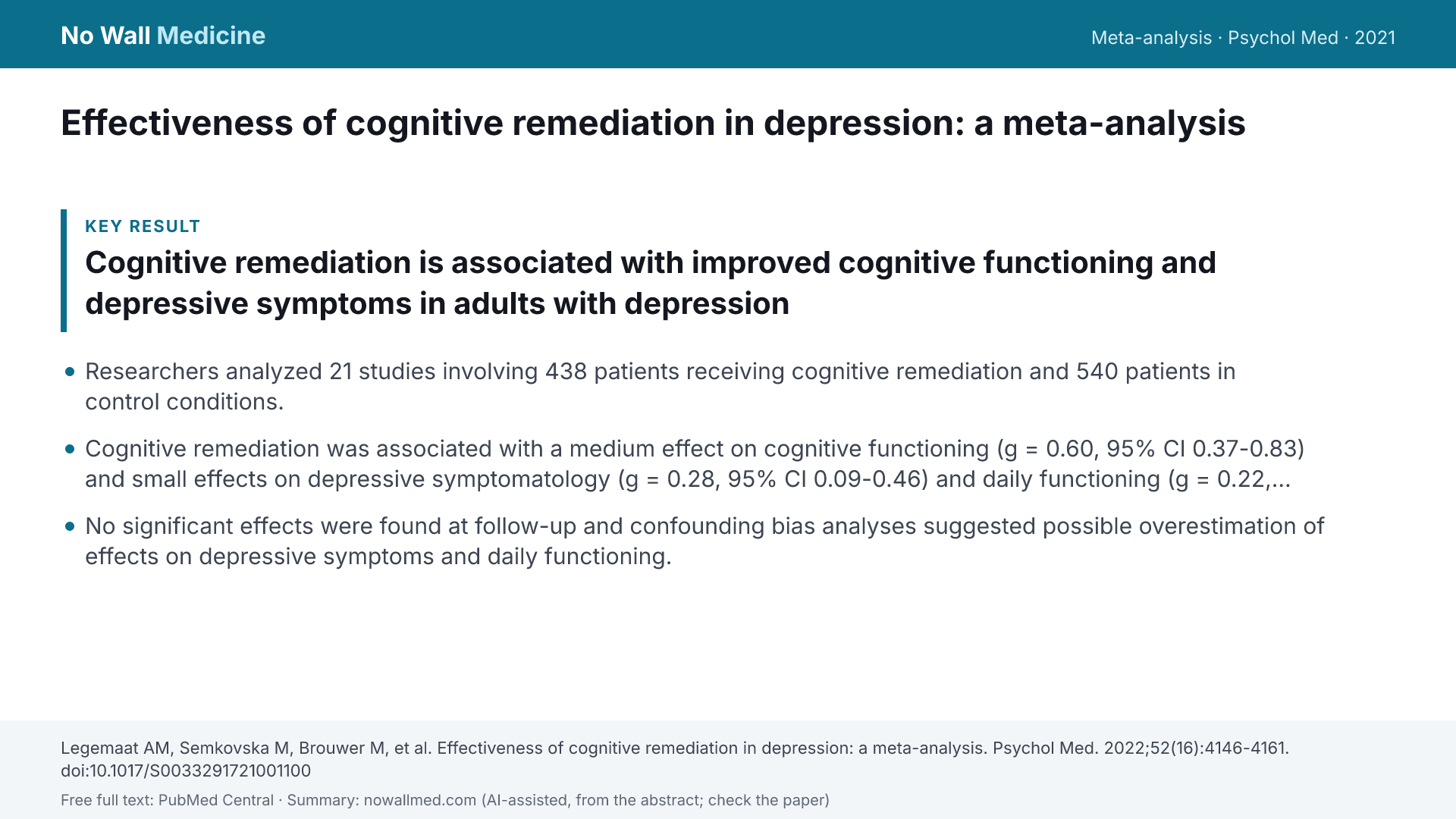
Cognitive remediation is associated with improved cognitive functioning and depressive symptoms in adults with depression
Effectiveness of cognitive remediation in depression: a meta-analysis
Why it matters: An update of the evidence was needed to assess how cognitive remediation affects depressive symptoms, cognitive functioning, and daily functioning in adults with primary depression.
Key points
- Researchers analyzed 21 studies involving 438 patients receiving cognitive remediation and 540 patients in control conditions.
- Cognitive remediation was associated with a medium effect on cognitive functioning (g = 0.60, 95% CI 0.37-0.83) and small effects on depressive symptomatology (g = 0.28, 95% CI 0.09-0.46) and daily functioning (g = 0.22, 95% CI 0.06-0.39).
- No significant effects were found at follow-up and confounding bias analyses suggested possible overestimation of effects on depressive symptoms and daily functioning.
Limitation the authors note: Confounding bias analyses indicated possible overestimation of the depressive symptomatology and daily functioning effects in the original studies.
Headline and key points written with AI from the paper’s abstract, with every number checked against it. Read the paper before relying on them.
Was this summary helpful?
Headline, design, result, key points, caveat and citation as plain text.
Cite this article
Legemaat AM, Semkovska M, Brouwer M, et al. Effectiveness of cognitive remediation in depression: a meta-analysis. Psychol Med. 2021. doi:10.1017/S0033291721001100
Spotted a mistake? Suggest a correction