Collaborative trauma-informed care improved depression symptoms and treatment adherence in Chilean primary care patients
Effectiveness of Collaborative, Trauma-Informed Care on Depression Outcomes in Primary Care: A Cluster Randomized Control Trial in Chile
Cluster randomized controlled trialBenefit found
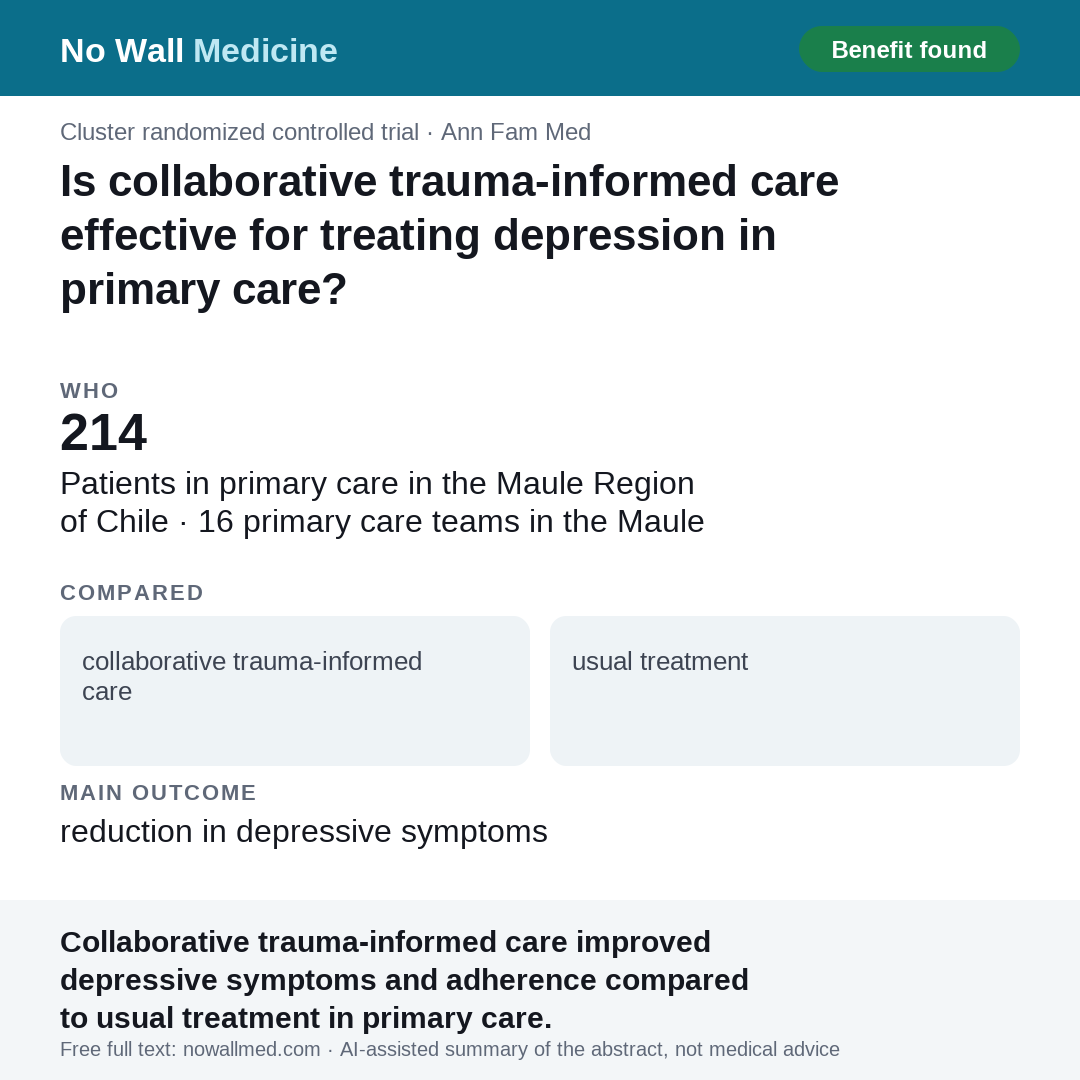
Is collaborative trauma-informed care effective for treating depression in primary care?
Who
214
Patients in primary care in the Maule Region of Chile · 16 primary care teams in the Maule Region, Chile
Compared
collaborative trauma-informed care
usual treatment
Main outcome
reduction in depressive symptoms
Result: adjusted mean difference -3.09 (95% CI, -4.94 to -1.23)
Bottom line: Collaborative trauma-informed care improved depressive symptoms and adherence compared to usual treatment in primary care.
Ann Fam Med · 2024-11-26Download image
Clinical question: Is collaborative trauma-informed care effective for treating depression in primary care?
Why it matters: It was unknown if collaborative trauma-informed care is effective for treating depression in primary care settings.
Key points
- Researchers studied 214 patients, including 85% women and 61% with 4 or more adverse childhood experiences, across 16 primary care teams in Chile.
- At 6 months, depressive symptoms declined significantly in the collaborative trauma-informed care group compared to usual treatment (AMD = -3.09, 95% CI, -4.94 to -1.23).
- The collaborative trauma-informed care group also showed significantly higher treatment adherence compared to the usual treatment group (AMD = 2.59, 95% CI, 1.80-4.99).
Headline and key points written with AI from the paper’s abstract, with every number checked against it. Read the paper before relying on them.
Topics
Cite this article
Vitriol VG, Cancino A, de la Luz Aylwin M, Ballesteros S, Sciolla AF. Effectiveness of Collaborative, Trauma-Informed Care on Depression Outcomes in Primary Care: A Cluster Randomized Control Trial in Chile. Ann Fam Med. 2024. doi:10.1370/afm.3184
Spotted a mistake? Suggest a correction