Effectiveness of Digital Lifestyle Interventions on Depression, Anxiety, Stress, and Well-Being: Systematic Review and Meta-Analysis
Systematic review and meta-analysisMixed results
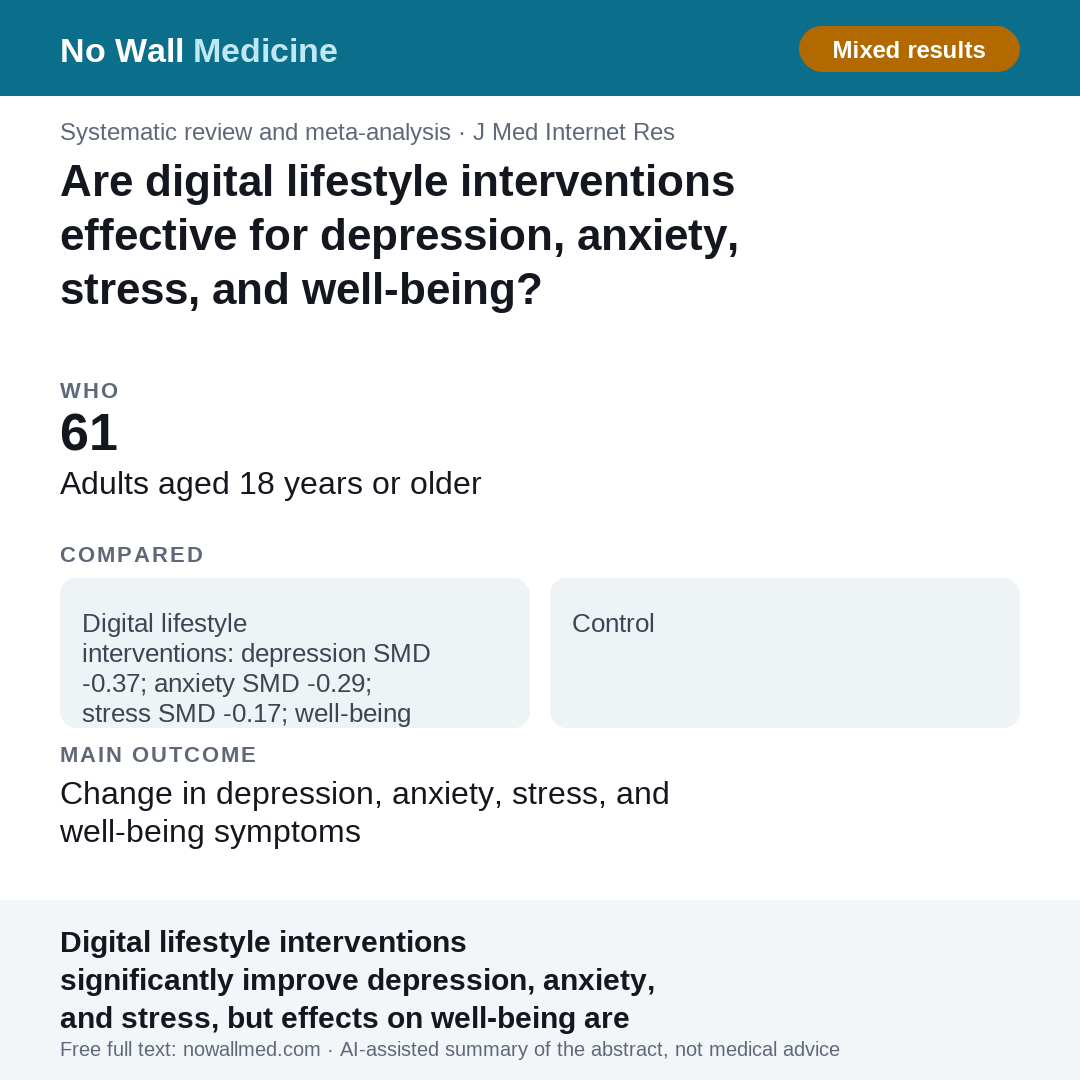
Are digital lifestyle interventions effective for depression, anxiety, stress, and well-being?
Who
61
Adults aged 18 years or older
Compared
Digital lifestyle interventions: depression SMD -0.37; anxiety SMD -0.29; stress SMD -0.17; well-being SMD 0.14
Control
Main outcome
Change in depression, anxiety, stress, and well-being symptoms
Result: SMD -0.37 (depression), SMD -0.29 (anxiety), SMD -0.17 (stress), SMD 0.14 (well-being)
Bottom line: Digital lifestyle interventions significantly improve depression, anxiety, and stress, but effects on well-being are inconclusive.
J Med Internet Res · 2025-03-20Download image
Clinical question: Are digital lifestyle interventions effective for depression, anxiety, stress, and well-being?
Abstract
Background
There is a growing body of robust evidence to show that lifestyle behaviors influence mental health outcomes. Technology offers an accessible and cost-effective implementation method for interventions, yet the study of the effectiveness of interventions to date has been specific to the mode of delivery, population, or behavior. Objective
The primary aim of this review was to comprehensively evaluate the effectiveness of digital lifestyle interventions for improving symptoms of depression, anxiety, stress, and well-being as coprimary outcomes in adults. The secondary aim was to explore the technological, methodological, intervention-specific, and population-specific characteristics that were associated with major changes in mental health outcomes. Methods
A systematic search was conducted across the MEDLINE, CINAHL, Embase, Emcare, PsycINFO, and Scopus databases to identify studies published between January 2013 and January 2023. Randomized controlled trials of lifestyle interventions (physical activity, sleep, and diet) that were delivered digitally; reported changes in symptoms of depression, anxiety, stress, or well-being in adults (aged ≥18 years); and were published in English were included. Multiple authors independently extracted data, which was evaluated using the 2011 Levels of Evidence from the Oxford Centre for Evidence-Based Medicine. Inverse-variance random-effects meta-analyses were used for data analysis. The primary outcome was the change in symptoms of depression, anxiety, stress, and well-being as measured by validated self-report of clinician-administered outcomes from pre- to postintervention. Subgroup analyses were conducted to determine whether results differed based on the target lifestyle behavior, delivery method, digital features, design features, or population characteristics. Results
Of the 14,356 studies identified, 61 (0.42%) were included. Digital lifestyle interventions had a significant small-to-medium effect on depression (standardized mean difference [SMD] -0.37; P<.001), a small effect on anxiety (SMD -0.29; P<.001) and stress (SMD -0.17; P=.04), and no effect on well-being (SMD 0.14; P=.15). Subgroup analyses generally suggested that effects were similar regardless of the delivery method or features used, the duration and frequency of the intervention, the population, or the lifestyle behavior targeted. Conclusions
Overall, these results indicate that delivering lifestyle interventions via a range of digital methods can have significant positive effects on depression (P<.001), anxiety (P<.001), and stress (P=.04) for a broad range of populations, while effects on well-being are inconclusive. Future research should explore how these interventions can be effectively implemented and embedded within health care with a concerted focus on addressing digital health equity. Trial registration
PROSPERO CRD42023428908; https://www.crd.york.ac.uk/PROSPERO/view/CRD42023428908.
Subject terms
Cite this article
Brinsley J, O'Connor EJ, Singh B, McKeon G, Curtis R, Ferguson T. Effectiveness of Digital Lifestyle Interventions on Depression, Anxiety, Stress, and Well-Being: Systematic Review and Meta-Analysis. J Med Internet Res. 2025. doi:10.2196/56975
Spotted a mistake? Suggest a correction
Top studies every Monday
The week’s key trials and guidelines in your specialties, plus any topics you follow. By email, free.
Get the weekly digest