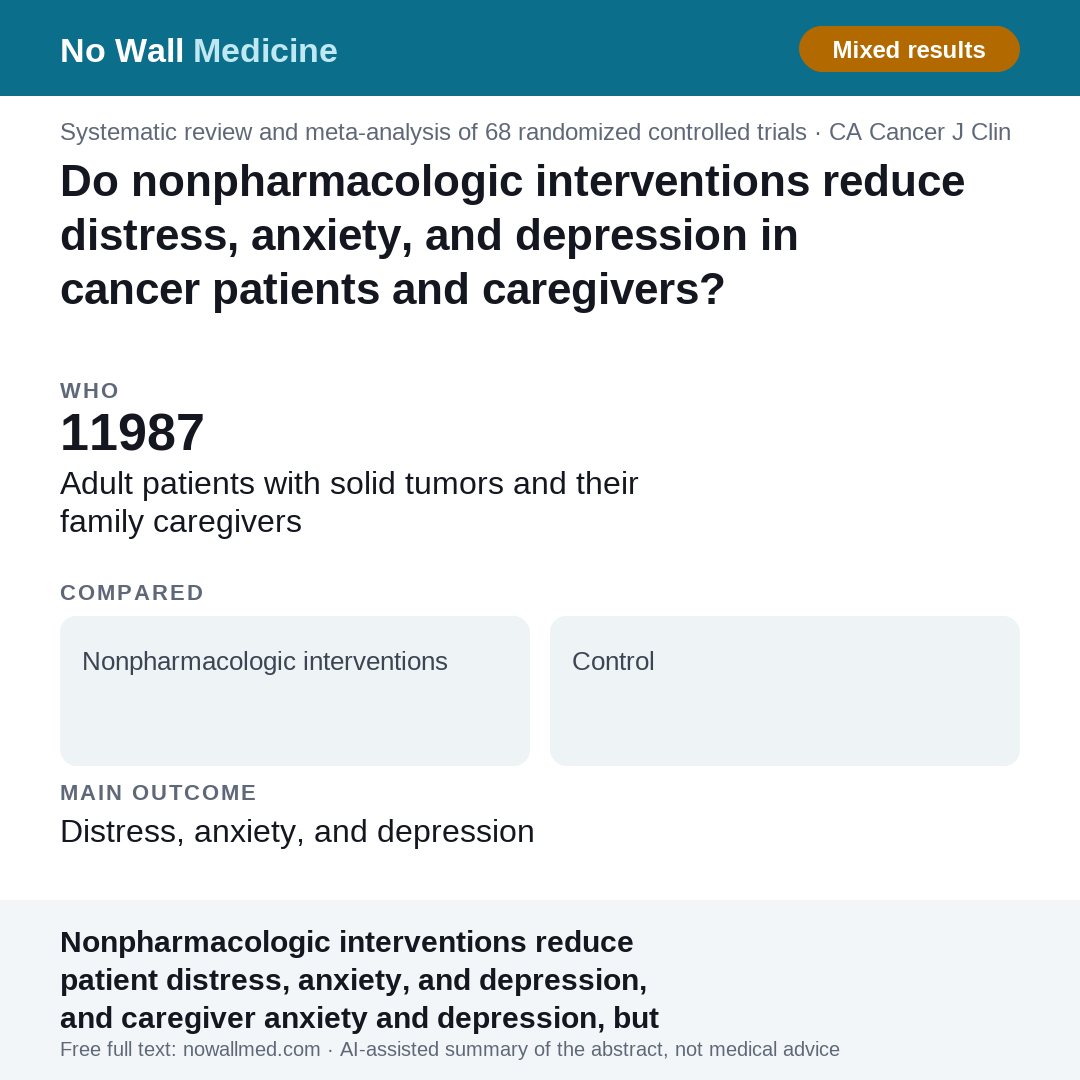
Nonpharmacologic interventions reduce patient distress and anxiety but show no significant effect on caregiver distress
Nonpharmacologic interventions for managing distress, anxiety, and depression for patients with cancer and their family caregivers: A systematic review and meta-analysis
Systematic review and meta-analysis of 68 randomized controlled trialsMixed results
Do nonpharmacologic interventions reduce distress, anxiety, and depression in cancer patients and caregivers?
Who
11987
Adult patients with solid tumors and their family caregivers
Compared
Nonpharmacologic interventions
Control
Main outcome
Distress, anxiety, and depression
Bottom line: Nonpharmacologic interventions reduce patient distress, anxiety, and depression, and caregiver anxiety and depression, but not caregiver distress.
Limitation: Lack of long-term follow-up limits understanding of impact on prolonged or delayed psychological symptoms.
CA Cancer J Clin · 2026-04-14Download image
Clinical question: Do nonpharmacologic interventions reduce distress, anxiety, and depression in cancer patients and caregivers?
Why it matters: Unaddressed psychological distress in cancer patients and their caregivers can lead to worse outcomes as more treatments move to outpatient settings.
Key points
- Researchers analyzed 68 randomized controlled trials involving 11,987 adult patients with solid tumors and their family caregivers.
- Nonpharmacologic interventions, such as counseling or skills training, significantly reduced patient distress at 0.0-3.0 months (g = 0.13) and 3.1-6.0 months (g = 0.18).
- In the short term, these interventions significantly reduced anxiety for patients (g = 0.31) and caregivers (g = 0.15), as well as depression for both groups.
Limitation the authors note: The lack of long-term follow-up limits the understanding of how these interventions impact patients and caregivers with prolonged or delayed psychological symptoms.
Headline and key points written with AI from the paper’s abstract, with every number checked against it. Read the paper before relying on them.
Topics
Cite this article
Schiess LC, Song LL, Schädelin S, Fürst T, Urech C, Friese CR. Nonpharmacologic interventions for managing distress, anxiety, and depression for patients with cancer and their family caregivers: A systematic review and meta-analysis. CA Cancer J Clin. 2026. doi:10.3322/caac.70076
Spotted a mistake? Suggest a correction