Digital psychological interventions were associated with a small reduction in anxiety disorder risk
Effectiveness of digital psychological and psychoeducational interventions to prevent anxiety: Systematic review and meta-analysis of randomized controlled trials
Systematic review and meta-analysis of randomized controlled trialsBenefit found
Are digital psychological and psychoeducational interventions effective to prevent anxiety disorders?
Who
6093
Non-anxious and varied populations
Compared
Digital interventions
Control
Main outcome
Prevention of anxiety disorders
Result: standardized mean difference = -0.32 (95% confidence interval: -0.44 to -0.20)
Bottom line: Digital psychological and psychoeducational interventions show a small effect in preventing anxiety disorders.
Limitation: High heterogeneity and very low quality of evidence according to Grading of Recommendations Assessment, Development, and Evaluation.
Psychol Med · 2025-11-17Download image
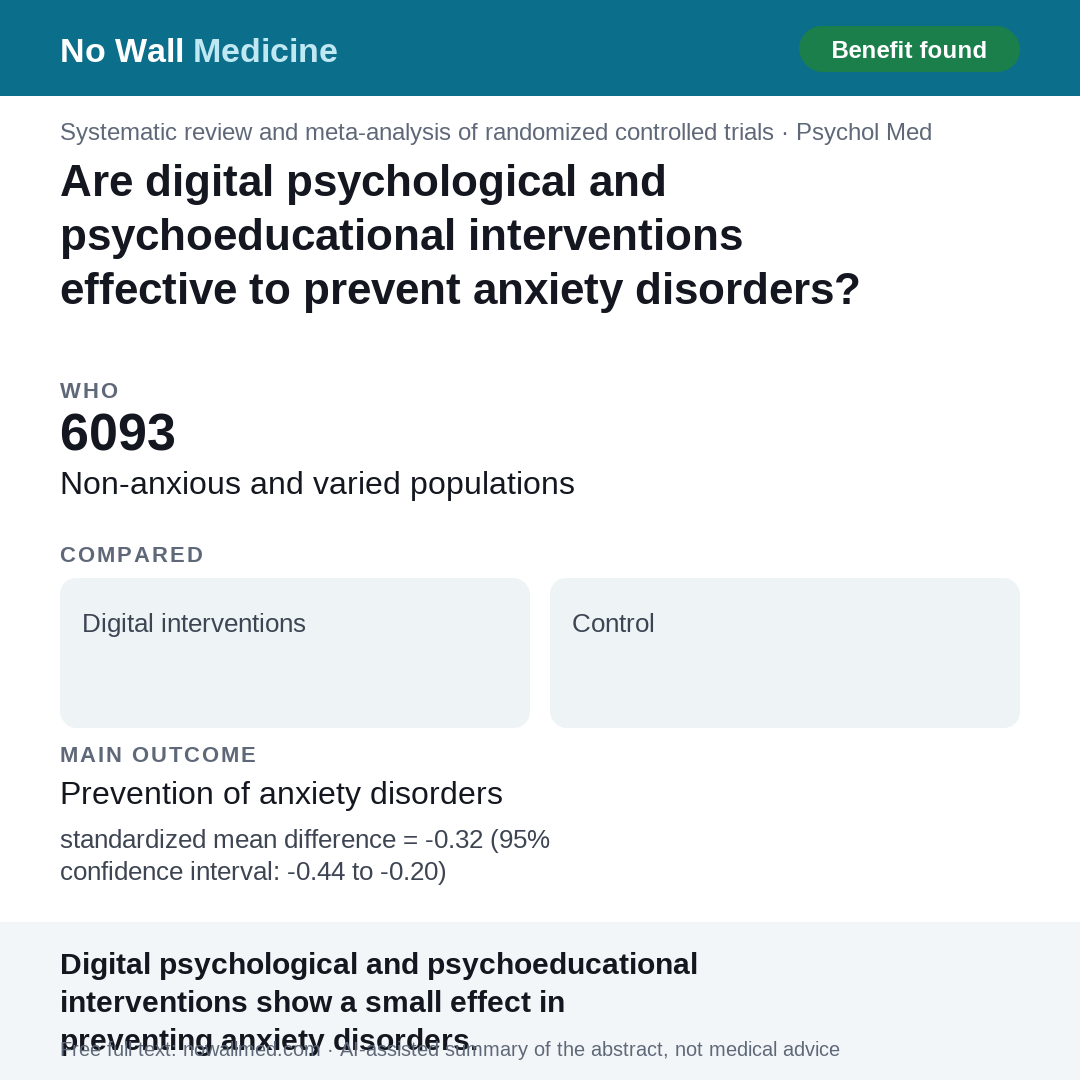
Clinical question: Are digital psychological and psychoeducational interventions effective to prevent anxiety disorders?
Why it matters: No meta-analysis had previously evaluated purely digital preventive interventions for anxiety across all types of populations.
Key points
- Researchers analyzed 15 randomized controlled trials involving 6093 participants to evaluate digital psychological or psychoeducational interventions for preventing anxiety.
- The pooled analysis showed a small effect in favor of these digital preventive interventions with a standardized mean difference of -0.32 (95% confidence interval: -0.44 to -0.20; p < 0.001).
- Most included randomized controlled trials had a high risk of bias and the quality of evidence was rated as very low.
Limitation the authors note: The authors stated that all randomized controlled trials except two had a high risk of bias and the quality of evidence was very low.
Headline and key points written with AI from the paper’s abstract, with every number checked against it. Read the paper before relying on them.
Topics
Cite this article
García-Huércano C, Conejo-Cerón S, Martínez-Vispo C, Bellón JÁ, Rodríguez-Morejón A, Tamayo-Morales O. Effectiveness of digital psychological and psychoeducational interventions to prevent anxiety: Systematic review and meta-analysis of randomized controlled trials. Psychol Med. 2025. doi:10.1017/S0033291725102262
Spotted a mistake? Suggest a correction
Top studies every Monday
The week’s key trials and guidelines in your specialties, plus any topics you follow. By email, free.
Get the weekly digest