Educational interventions showed no significant overall effect on depression or anxiety in older adults with cancer
Educational interventions to reduce depression and anxiety in older adults with cancer in the community: a systematic review, meta-analysis and meta-regression of randomised controlled trials
Systematic review and meta-analysis of randomized controlled trialsMixed results
Do educational interventions reduce depression and anxiety in older adults with cancer?
Who
Older adults with cancer in the community · Community
Compared
Educational interventions
Control
Main outcome
Severity of depression, anxiety and health-related quality-of-life
Result: SMD -0.30 (95%CI: -0.69; 0.09) for depression; SMD -0.30 (95%CI: -0.73; 0.13) for anxiety
Bottom line: Overall effects were statistically insignificant, but interventions were effective for specific subgroups like those aged 60-65.
Age Ageing · 2024-06-01Download image
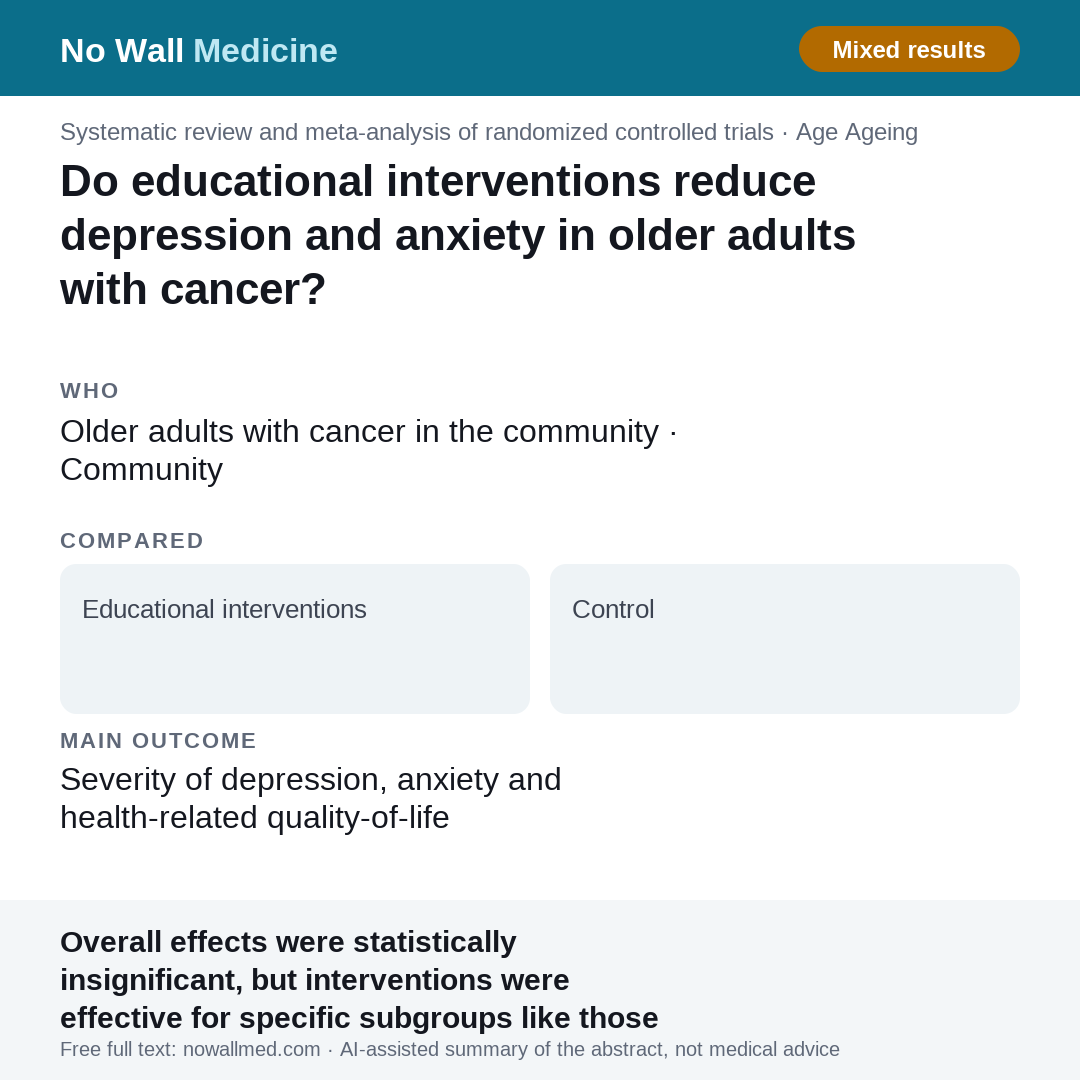
Clinical question: Do educational interventions reduce depression and anxiety in older adults with cancer?
Why it matters: It is unknown if educational interventions effectively reduce the severity of depression, anxiety, and health-related quality-of-life in older adults living with cancer in the community.
Key points
- Researchers analyzed 15 randomized controlled trials to evaluate how educational programs affect depression, anxiety, and health-related quality-of-life in older adults with cancer living in the community.
- The meta-analysis showed no statistically significant changes in depression (SMD = -0.30, 95%CI: -0.69; 0.09), anxiety (SMD = -0.30, 95%CI: -0.73; 0.13), or health-related quality-of-life (SMD = 0.44, 95%CI: -0.16; 1.04).
- Subgroup analyses suggested interventions were effective for people aged 60-65, those with early-stage cancer, those with lung cancer, those treated with chemotherapy, or those with higher education and income.
Headline and key points written with AI from the paper’s abstract, with every number checked against it. Read the paper before relying on them.
Was this summary helpful?
Subject terms
Cite this article
Low CE, Pillay RM, Teo FJJ, Loh CYL, Yau CE, Yan Bin Lee AR. Educational interventions to reduce depression and anxiety in older adults with cancer in the community: a systematic review, meta-analysis and meta-regression of randomised controlled trials. Age Ageing. 2024. doi:10.1093/ageing/afae111
Spotted a mistake? Suggest a correction
Top studies every Monday
The week’s key trials and guidelines in your specialties, plus any topics you follow. By email, free.
Get the weekly digest