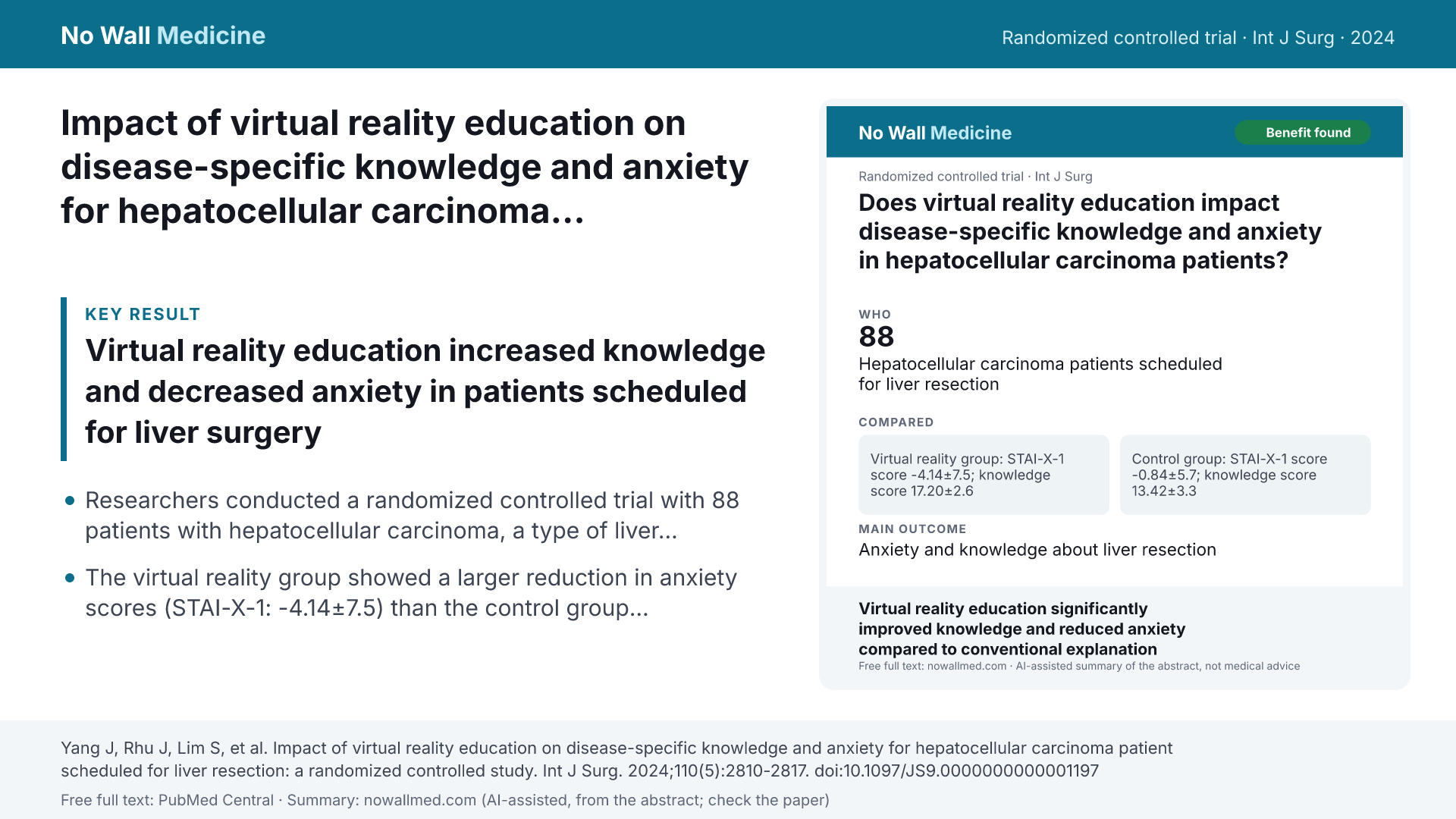
Virtual reality education increased knowledge and decreased anxiety in patients scheduled for liver surgery
Impact of virtual reality education on disease-specific knowledge and anxiety for hepatocellular carcinoma patient scheduled for liver resection: a randomized controlled study
Randomized controlled trialBenefit found
Does virtual reality education impact disease-specific knowledge and anxiety in hepatocellular carcinoma patients?
Who
88
Hepatocellular carcinoma patients scheduled for liver resection
Compared
Virtual reality group: STAI-X-1 score -4.14±7.5; knowledge score 17.20±2.6
Control group: STAI-X-1 score -0.84±5.7; knowledge score 13.42±3.3
Main outcome
Anxiety and knowledge about liver resection
Result: OR=2.902, CI=1.097-7.674
Bottom line: Virtual reality education significantly improved knowledge and reduced anxiety compared to conventional explanation processes in patients.
Int J Surg · 2024-05-01Download image
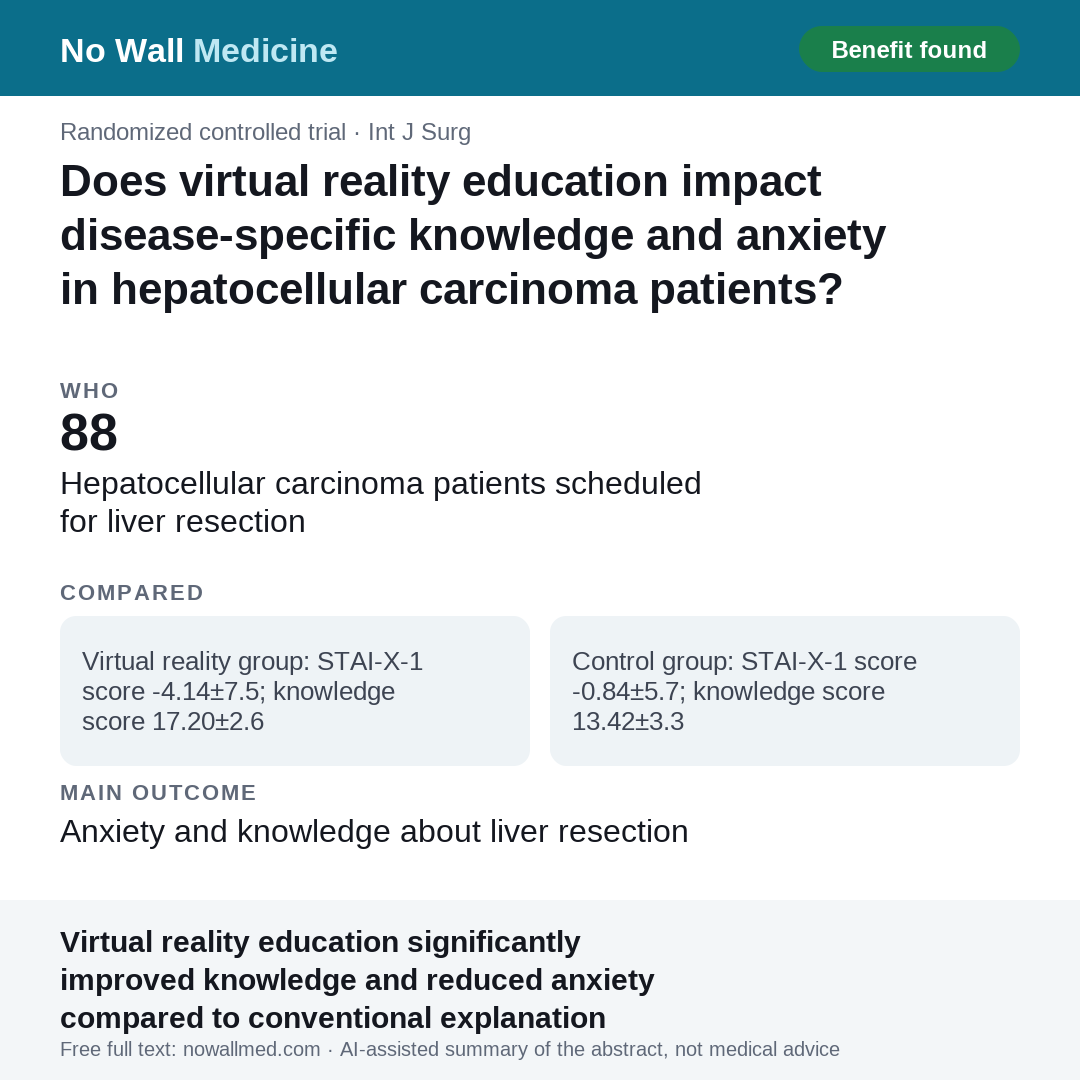
Clinical question: Does virtual reality education impact disease-specific knowledge and anxiety in hepatocellular carcinoma patients?
Why it matters: The complex anatomy of the liver makes it difficult to explain radiologic findings and surgical plans to patients undergoing liver resection.
Key points
- Researchers conducted a randomized controlled trial with 88 patients with hepatocellular carcinoma, a type of liver cancer, comparing virtual reality education to conventional explanation methods.
- The virtual reality group showed a larger reduction in anxiety scores (STAI-X-1: -4.14±7.5) than the control group (-0.84±5.7, P =0.023).
- Knowledge scores were higher in the virtual reality group (17.20±2.6) compared to the control group (13.42±3.3, P <0.001).
Headline and key points written with AI from the paper’s abstract, with every number checked against it. Read the paper before relying on them.
Was this summary helpful?
Subject terms
Cite this article
Yang J, Rhu J, Lim S, et al. Impact of virtual reality education on disease-specific knowledge and anxiety for hepatocellular carcinoma patient scheduled for liver resection: a randomized controlled study. Int J Surg. 2024. doi:10.1097/JS9.0000000000001197
Spotted a mistake? Suggest a correction