Digital serious games improved public health knowledge and attitudes significantly
Effectiveness of Digital Serious Games on Knowledge and Attitudes in Public Health Education: Systematic Review and Bayesian Network Meta-Analysis of Randomized Controlled Trials
Systematic review and Bayesian network meta-analysisBenefit found
Do digital serious games improve public health knowledge and attitudes compared to traditional education?
Who
8764
Nonprofessional participants · 19 countries
Compared
Digital serious games
Traditional or noninteractive education
Main outcome
Public health knowledge and attitudes
Result: knowledge standardized mean difference 0.66 (95% CI 0.32-0.99); attitudes standardized mean difference 0.50 (95% CI 0.27-0.76)
Bottom line: Digital serious games significantly improve public health knowledge and attitudes compared to traditional or noninteractive education methods.
Limitation: Future research requires adequately powered trials, longer follow-up, and standardized frameworks.
J Med Internet Res · 2026-04-24Download image
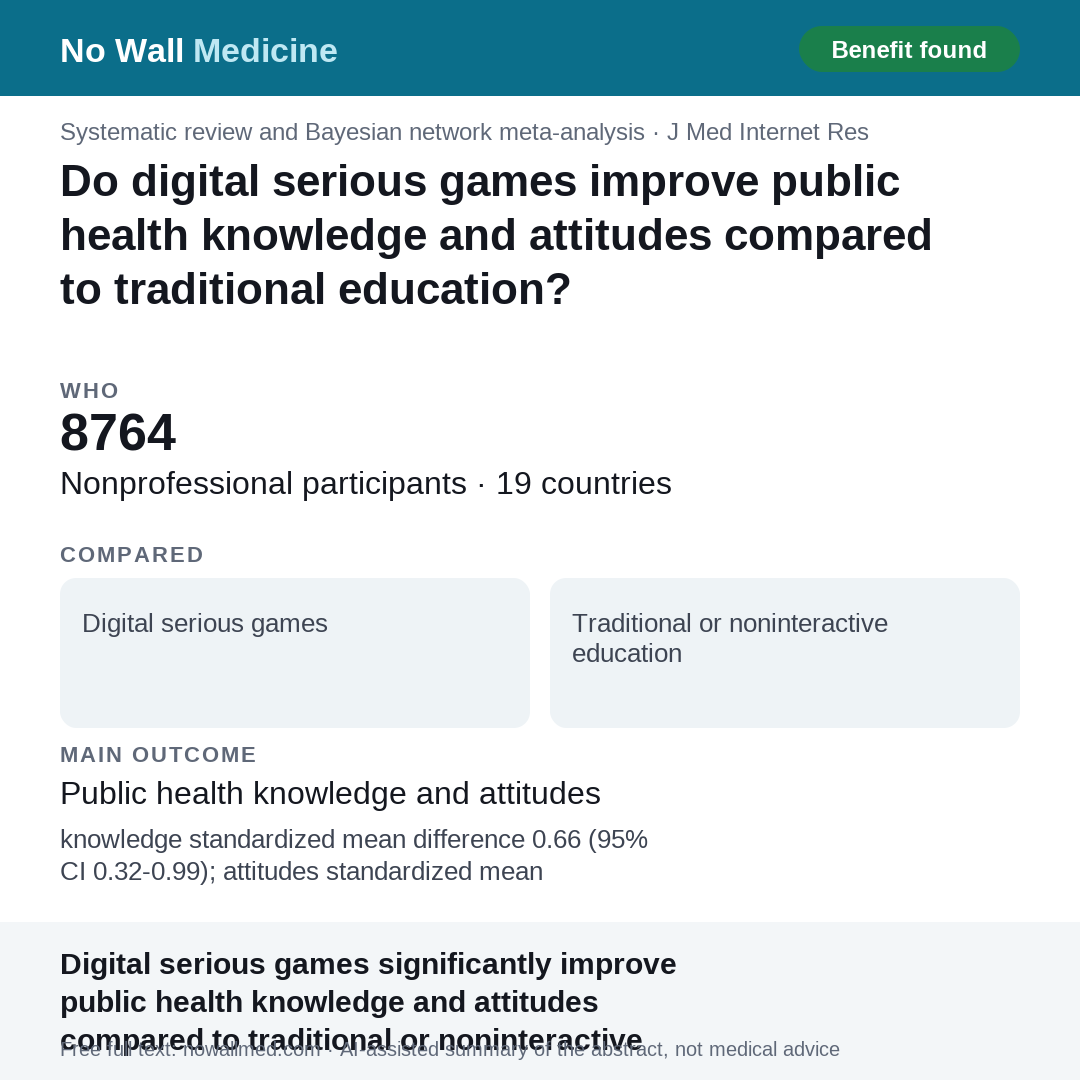
Clinical question: Do digital serious games improve public health knowledge and attitudes compared to traditional education?
Why it matters: Public health education is challenged by inadequate health literacy and low engagement
Key points
- Forty randomized controlled trials with 8764 participants were analyzed.
- Digital serious games improved knowledge and attitudes with standardized mean differences of 0.66 and 0.50.
- Multisession interventions showed larger effects than single-session interventions for knowledge and attitudes.
Limitation the authors note: Evidence certainty was moderate for knowledge and low-to-moderate for attitudes, and future research requires adequately powered trials and longer follow-up
Headline and key points written with AI from the paper’s abstract, with every number checked against it. Read the paper before relying on them.
Topics
Cite this article
Huang D, Wu D, Hexel R, Brown-Wilson C, Zhou J, Moyle W. Effectiveness of Digital Serious Games on Knowledge and Attitudes in Public Health Education: Systematic Review and Bayesian Network Meta-Analysis of Randomized Controlled Trials. J Med Internet Res. 2026. doi:10.2196/89281
Spotted a mistake? Suggest a correction