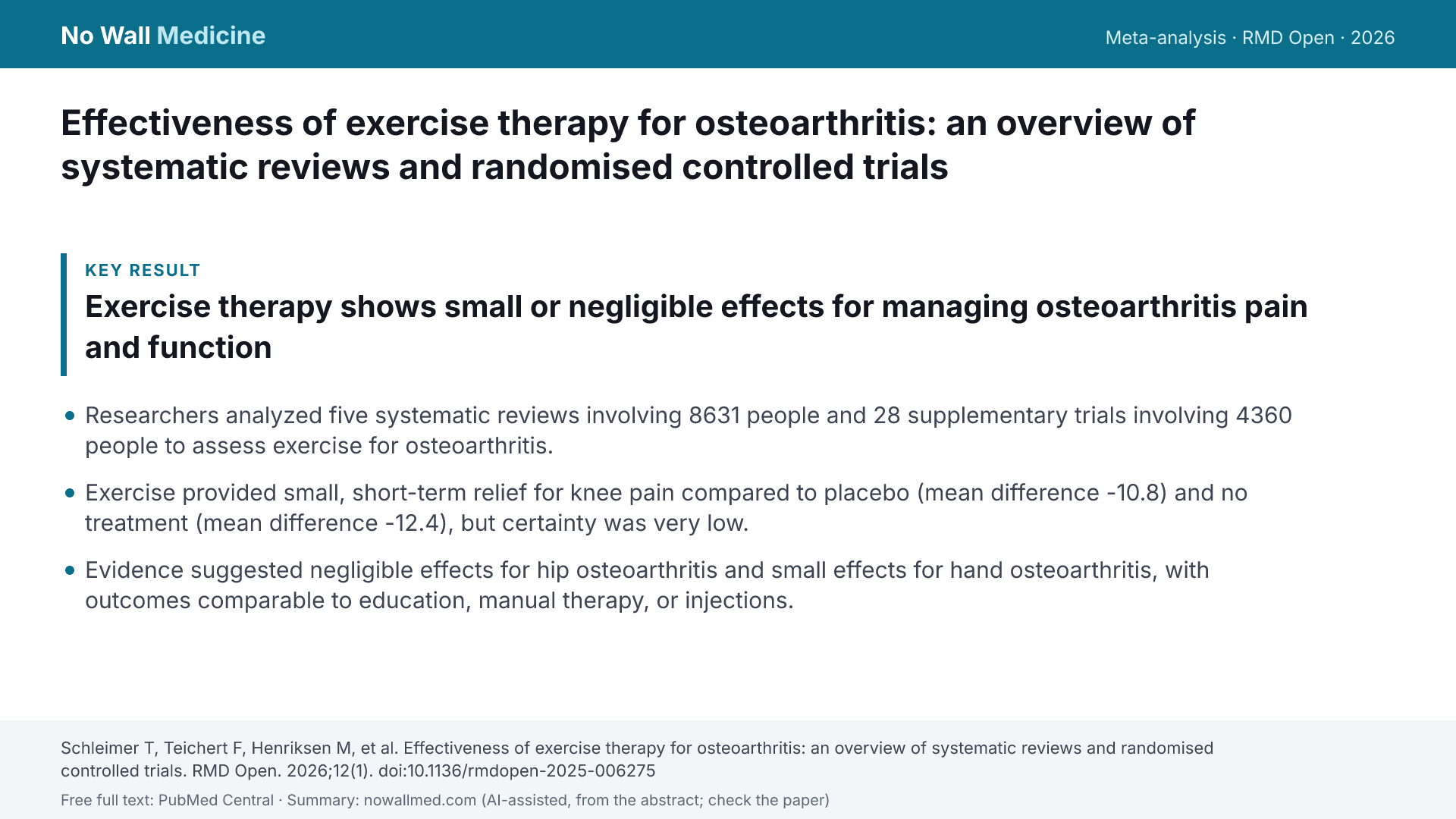
Exercise therapy shows small or negligible effects for managing osteoarthritis pain and function
Effectiveness of exercise therapy for osteoarthritis: an overview of systematic reviews and randomised controlled trials
Key points
- Researchers analyzed five systematic reviews involving 8631 people and 28 supplementary trials involving 4360 people to assess exercise for osteoarthritis.
- Exercise provided small, short-term relief for knee pain compared to placebo (mean difference -10.8) and no treatment (mean difference -12.4), but certainty was very low.
- Evidence suggested negligible effects for hip osteoarthritis and small effects for hand osteoarthritis, with outcomes comparable to education, manual therapy, or injections.
Limitation the authors note: The certainty of evidence for knee osteoarthritis pain relief was very low and effects in larger or longer-term trials were smaller.
Headline and key points written with AI from the paper’s abstract, with every number checked against it. Read the paper before relying on them.
Was this summary helpful?
Abstract
Objective
To provide an overview of the effects of exercise for osteoarthritis. Design
Overview. Data sources
Medline, Embase, Epistemonikos, PEDro, Cochrane and registries from inception to 8 November 2025. Eligibility criteria
Reviews comparing exercise with placebo, no intervention or other interventions on pain and function for osteoarthritis. Supplementary trials were included to update inconclusive areas. Data extraction and synthesis
Two independent reviewers extracted data and assessed bias. Data were standardised to a 0-100 scale and reanalysed using random-effects meta-analysis. Certainty was rated using Grading of Recommendations Assessment, Development and Evaluation. Results
Five reviews (κ=100; n=8631) and 28 supplementary trials (knee/hip κ=23, hand κ=3, ankle κ=2; n=4360) were included. Evidence indicated small, short-term effects of exercise versus placebo (mean difference -10.8, 95% CI -19.1 to -2.6) and no-treatment (-12.4, 95% CI -15.6 to -9.2) for knee osteoarthritis pain, but certainty was very low and effects in larger or longer-term trials were smaller. Moderate evidence suggested negligible effects in hip (-6.7 95% CI -9.3 to -4.0) and small effects in hand (-10.0 95% CI -15.5 to -4.5) osteoarthritis. Varying certainty evidence indicated comparable outcomes to education, manual therapy, analgesics, injections and arthroscopy. Single trials in selected populations showed exercise was less effective than knee osteotomy (12.4 95% CI 4.7 to 20.2) and joint replacement (knee 17.1 95% CI 10.4 to 23.8; hip 24.2 95% CI 18.2 to 30.2) at longer term. Conclusion and relevance
Evidence on exercise for osteoarthritis remains largely inconclusive, suggesting negligible or short-lasting small effects comparable to, or less effective than, other treatments. These findings question its universal promotion and highlight the need to revisit research priorities and clinical discussions around its worthwhileness. Registration
CRD42023446888.
Abstract reproduced under the article’s CC BY NC licence.
Subject terms
Cite this article
Schleimer T, Teichert F, Henriksen M, et al. Effectiveness of exercise therapy for osteoarthritis: an overview of systematic reviews and randomised controlled trials. RMD Open. 2026;12(1). doi:10.1136/rmdopen-2025-006275
Spotted a mistake? Suggest a correction