Effectiveness of Flexible Ureterorenoscopy Versus Extracorporeal Shock Wave Lithotripsy for Renal Calculi of 5-15 mm: Results of a Randomized Controlled Trial
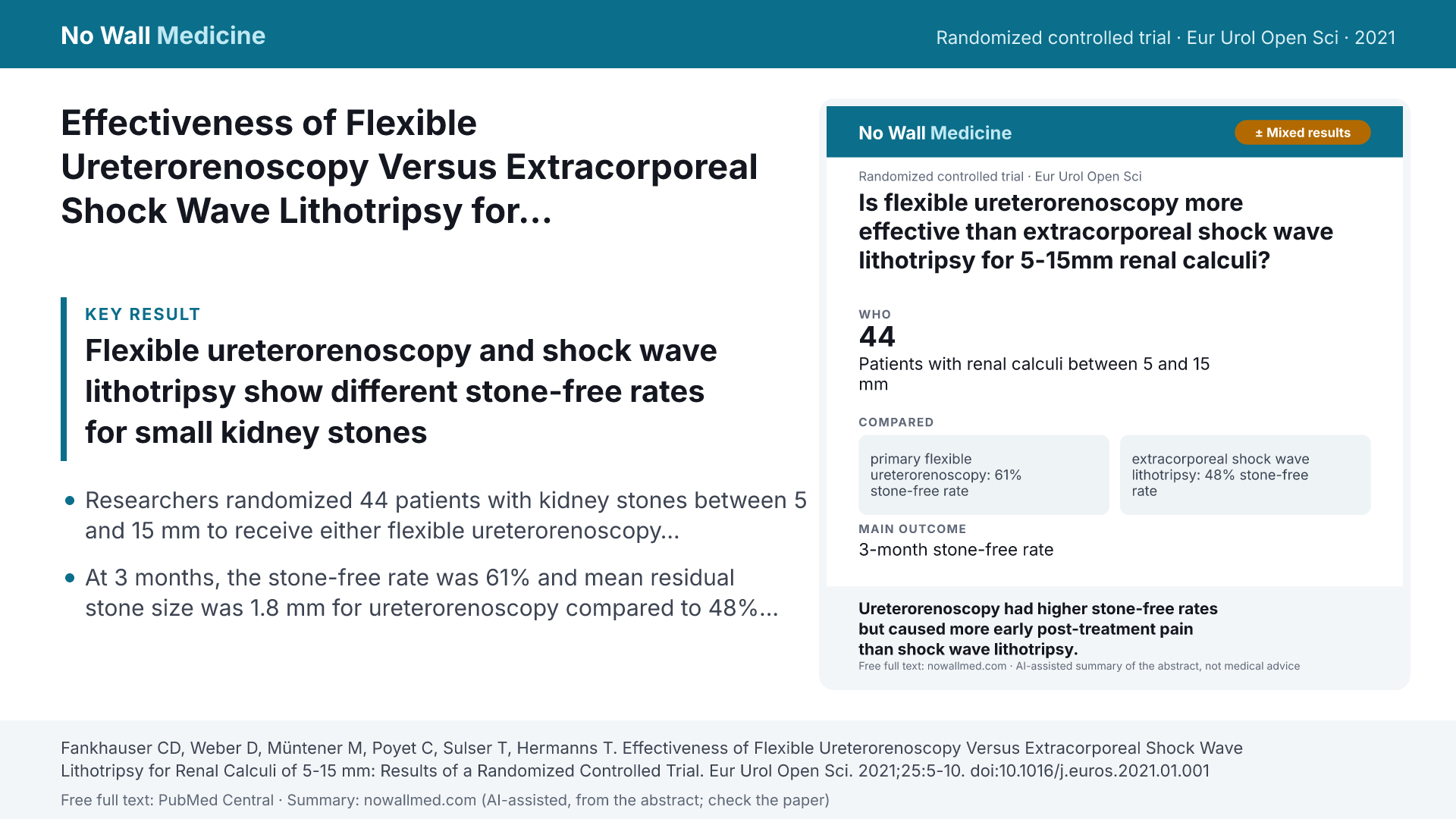
Key result: Flexible ureterorenoscopy and shock wave lithotripsy show different stone-free rates for small kidney stones
Key points
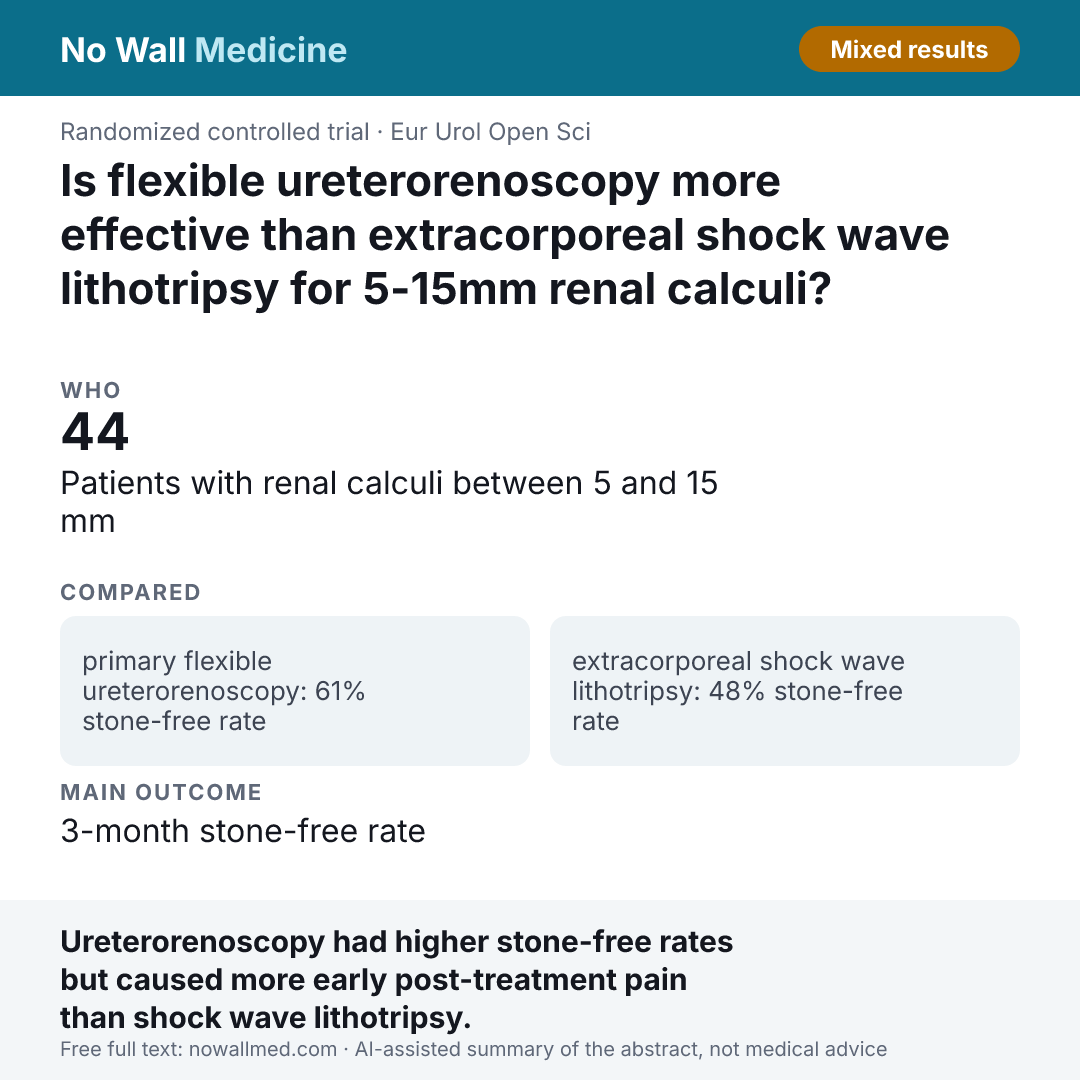
- Researchers randomized 44 patients with kidney stones between 5 and 15 mm to receive either flexible ureterorenoscopy or extracorporeal shock wave lithotripsy.
- At 3 months, the stone-free rate was 61% and mean residual stone size was 1.8 mm for ureterorenoscopy compared to 48% and 2.4 mm for shock wave lithotripsy.
- Early post-treatment pain scores were higher for ureterorenoscopy on day 1 (3.3 vs 1.6) and day 7 (5.2 vs 3.4) than for shock wave lithotripsy.
Limitation the authors note: The study was prematurely closed after randomizing 44 patients due to poor accrual, leaving the trial with insufficient power to formally compare the two treatments.
Discussion prompts
- Would these patients look like yours? Who was left out?
- Is the main outcome one that matters to patients?
- Is the difference large enough to change what you do?
Cite: Fankhauser CD, Weber D, Müntener M, Poyet C, Sulser T, Hermanns T. Effectiveness of Flexible Ureterorenoscopy Versus Extracorporeal Shock Wave Lithotripsy for Renal Calculi of 5-15 mm: Results of a Randomized Controlled Trial. Eur Urol Open Sci. 2021;25:5-10. doi:10.1016/j.euros.2021.01.001
Free full text: PubMed Central · Summary and visual abstract: nowallmed.com/a/effectiveness-of-flexible-ureterorenoscopy-versus-extracorporeal-s86ma6/ (AI-assisted from the abstract; check the paper before relying on it).