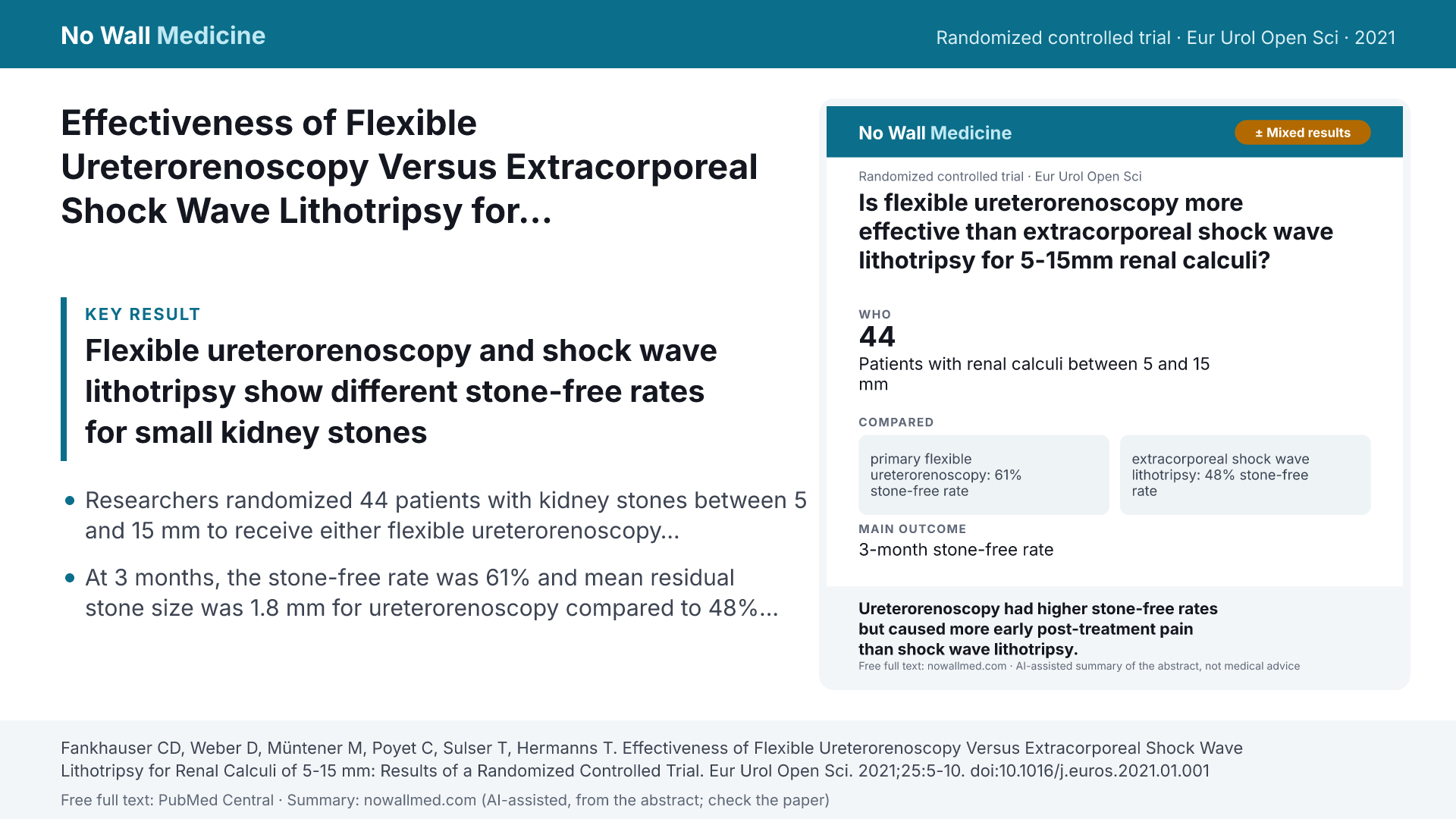
Flexible ureterorenoscopy and shock wave lithotripsy show different stone-free rates for small kidney stones
Effectiveness of Flexible Ureterorenoscopy Versus Extracorporeal Shock Wave Lithotripsy for Renal Calculi of 5-15 mm: Results of a Randomized Controlled Trial
Randomized controlled trialMixed results
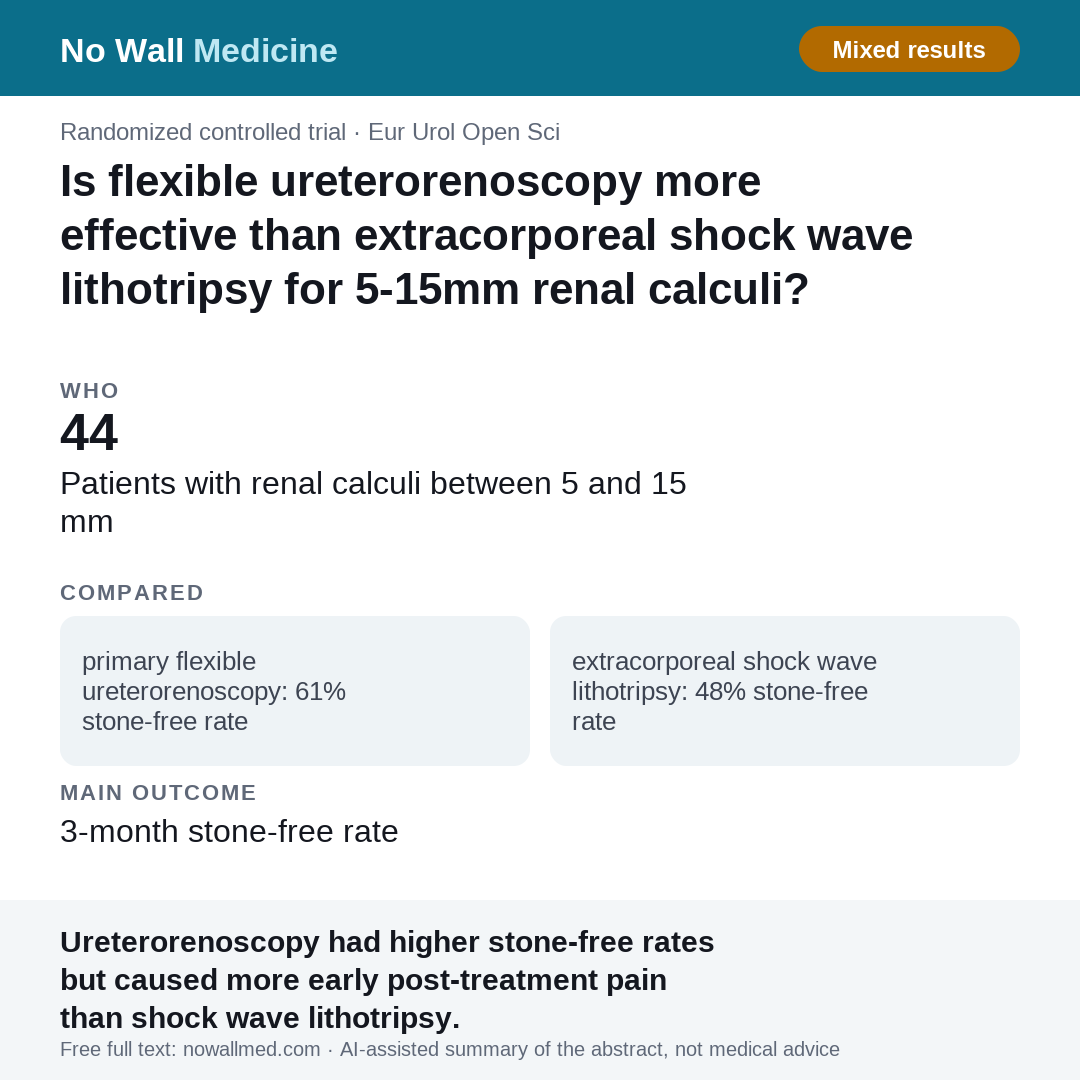
Is flexible ureterorenoscopy more effective than extracorporeal shock wave lithotripsy for 5-15mm renal calculi?
Who
44
Patients with renal calculi between 5 and 15 mm
Compared
primary flexible ureterorenoscopy: 61% stone-free rate
extracorporeal shock wave lithotripsy: 48% stone-free rate
Main outcome
3-month stone-free rate
Bottom line: Ureterorenoscopy had higher stone-free rates but caused more early post-treatment pain than shock wave lithotripsy.
Limitation: The study was prematurely closed due to poor accrual, resulting in insufficient power.
Eur Urol Open Sci · 2021-02-02Download image
Clinical question: Is flexible ureterorenoscopy more effective than extracorporeal shock wave lithotripsy for 5-15mm renal calculi?
Why it matters: It is unclear how flexible ureterorenoscopy compares to extracorporeal shock wave lithotripsy regarding effectiveness, complications, and pain for kidney stones measuring 5 to 15 mm.
Key points
- Researchers randomized 44 patients with kidney stones between 5 and 15 mm to receive either flexible ureterorenoscopy or extracorporeal shock wave lithotripsy.
- At 3 months, the stone-free rate was 61% and mean residual stone size was 1.8 mm for ureterorenoscopy compared to 48% and 2.4 mm for shock wave lithotripsy.
- Early post-treatment pain scores were higher for ureterorenoscopy on day 1 (3.3 vs 1.6) and day 7 (5.2 vs 3.4) than for shock wave lithotripsy.
Limitation the authors note: The study was prematurely closed after randomizing 44 patients due to poor accrual, leaving the trial with insufficient power to formally compare the two treatments.
Headline and key points written with AI from the paper’s abstract, with every number checked against it. Read the paper before relying on them.
Was this summary helpful?
Cite this article
Fankhauser CD, Weber D, Müntener M, Poyet C, Sulser T, Hermanns T. Effectiveness of Flexible Ureterorenoscopy Versus Extracorporeal Shock Wave Lithotripsy for Renal Calculi of 5-15 mm: Results of a Randomized Controlled Trial. Eur Urol Open Sci. 2021. doi:10.1016/j.euros.2021.01.001
Spotted a mistake? Suggest a correction
Top studies every Monday
The week’s key trials and guidelines in your specialties, plus any topics you follow. By email, free.
Get the weekly digest