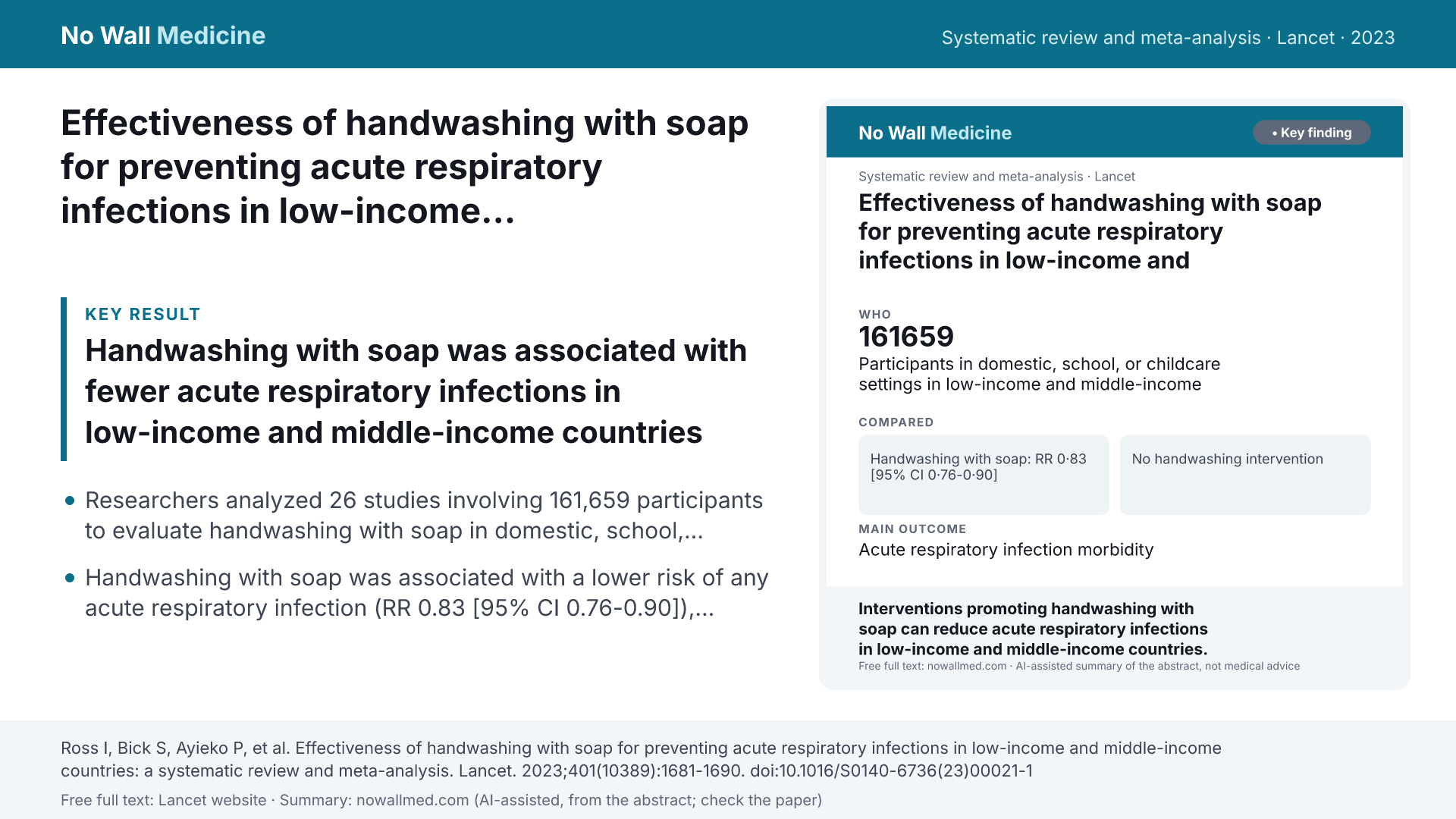
Handwashing with soap was associated with fewer acute respiratory infections in low-income and middle-income countries
Effectiveness of handwashing with soap for preventing acute respiratory infections in low-income and middle-income countries: a systematic review and meta-analysis
Systematic review and meta-analysisBenefit found
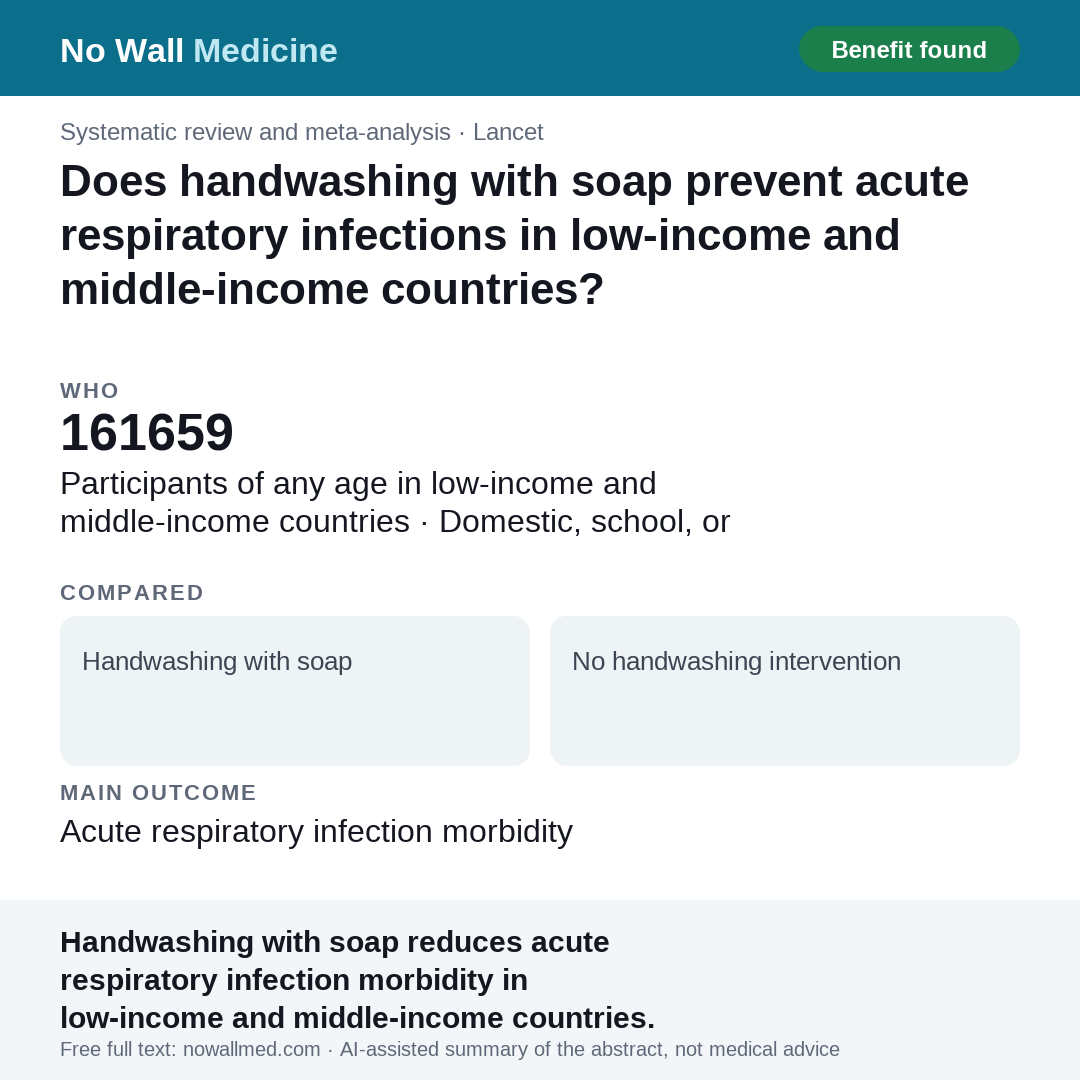
Does handwashing with soap prevent acute respiratory infections in low-income and middle-income countries?
Who
161659
Participants of any age in low-income and middle-income countries · Domestic, school, or childcare settings
Compared
Handwashing with soap
No handwashing intervention
Main outcome
Acute respiratory infection morbidity
Result: relative risk 0·83 (95% CI 0·76-0·90)
Bottom line: Handwashing with soap reduces acute respiratory infection morbidity in low-income and middle-income countries.
Limitation: The GRADE rating for acute respiratory infection was moderate certainty evidence.
Funded by: Bill & Melinda Gates Foundation, Reckitt Global Hygiene Institute, UK FCDO
Lancet · 2023-04-27Download image
Clinical question: Does handwashing with soap prevent acute respiratory infections in low-income and middle-income countries?
Why it matters: Acute respiratory infections cause a large global burden of disease, with 83% of deaths occurring in low-income and middle-income countries.
Key points
- Researchers analyzed 26 studies involving 161,659 participants to evaluate handwashing with soap in domestic, school, or childcare settings.
- Handwashing with soap was associated with a lower risk of any acute respiratory infection (RR 0.83 [95% CI 0.76-0.90]), lower respiratory infections (0.78 [0.64-0.94]), and upper respiratory infections (0.74 [0.59-0.93]).
- The intervention was not associated with changes in test-confirmed influenza (0.94 [0.42-2.11]) or all-cause mortality (prevalence ratio 0.95 [95% CI 0.71-1.27]).
Headline and key points written with AI from the paper’s abstract, with every number checked against it. Read the paper before relying on them.
Was this summary helpful?
Abstract
Background
Acute respiratory infection (ARI) is a leading cause of morbidity and mortality globally, with 83% of ARI mortality occurring in low-income and middle-income countries (LMICs) before the COVID-19 pandemic. We aimed to estimate the effect of interventions promoting handwashing with soap on ARI in LMICs. Methods
In our systematic review and meta-analysis, we searched MEDLINE, Embase, Web of Science, Scopus, Cochrane Library, Global Health, and Global Index Medicus for studies of handwashing with soap interventions in LMICs from inception to May 25, 2021. We included randomised and non-randomised controlled studies of interventions conducted in domestic, school, or childcare settings. Interventions promoting hand hygiene methods other than handwashing with soap were excluded, as were interventions in health-care facilities or the workplace. The primary outcome was ARI morbidity arising from any pathogen for participants of any age. Secondary outcomes were lower respiratory infection, upper respiratory infection, influenza confirmed by diagnostic test, COVID-19 confirmed by diagnostic test, and all-cause mortality. We extracted relative risks (RRs), using random-effects meta-analysis to analyse study results, and metaregression to evaluate heterogeneity. We assessed risk of bias in individual studies using an adapted Newcastle-Ottawa scale, and assessed the overall body of evidence using a Grading of Recommendations, Assessment, Development, and Evaluation (GRADE) approach. The study is registered with PROSPERO, CRD42021231414. Findings
26 studies with 161 659 participants met inclusion criteria, providing 27 comparisons (21 randomised). Interventions promoting handwashing with soap reduced any ARI compared with no handwashing intervention (RR 0·83 [95% CI 0·76-0·90], I2 88%; 27 comparisons). Interventions also reduced lower respiratory infections (0·78 [0·64-0·94], I2 64%; 12 comparisons) and upper respiratory infections (0·74 [0·59-0·93], I2 91%; seven comparisons), but not test-confirmed influenza (0·94 [0·42-2·11], I2 90%; three comparisons), test-confirmed COVID-19 (no comparisons), or all-cause mortality (prevalence ratio 0·95 [95% CI 0·71-1·27]; one comparison). For ARI, no heterogeneity covariates were significant at p<0·1 and the GRADE rating was moderate certainty evidence. Interpretation
Interventions promoting handwashing with soap can reduce ARI in LMICs, and could help to prevent the large burden of respiratory disease. Funding
Bill & Melinda Gates Foundation, Reckitt Global Hygiene Institute, and UK FCDO.
Abstract reproduced under the article’s CC BY licence.
Subject terms
Cite this article
Ross I, Bick S, Ayieko P, Dreibelbis R, Wolf J, Freeman MC. Effectiveness of handwashing with soap for preventing acute respiratory infections in low-income and middle-income countries: a systematic review and meta-analysis. Lancet. 2023. doi:10.1016/S0140-6736(23)00021-1
Spotted a mistake? Suggest a correction