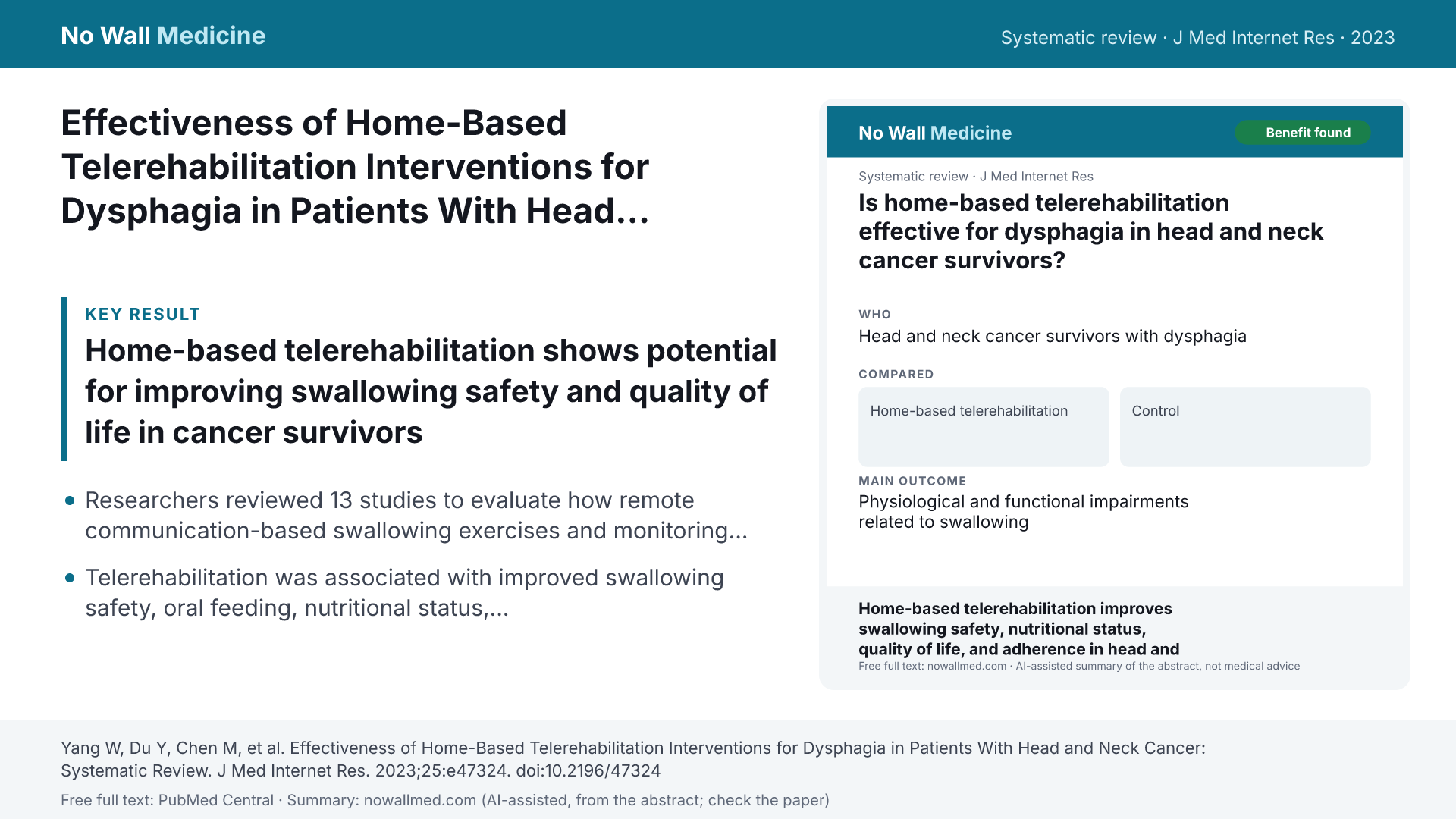
Home-based telerehabilitation shows potential for improving swallowing safety and quality of life in cancer survivors
Effectiveness of Home-Based Telerehabilitation Interventions for Dysphagia in Patients With Head and Neck Cancer: Systematic Review
Systematic reviewBenefit found
Is home-based telerehabilitation effective for dysphagia in head and neck cancer survivors?
Who
Head and neck cancer survivors with dysphagia
Compared
Home-based telerehabilitation
Control
Main outcome
Physiological and functional impairments related to swallowing
Bottom line: Home-based telerehabilitation improves swallowing safety, nutritional status, quality of life, and adherence in head and neck cancer survivors.
Limitation: Current research is in its infancy and patient factors are highly diverse.
J Med Internet Res · 2023-09-08Download image
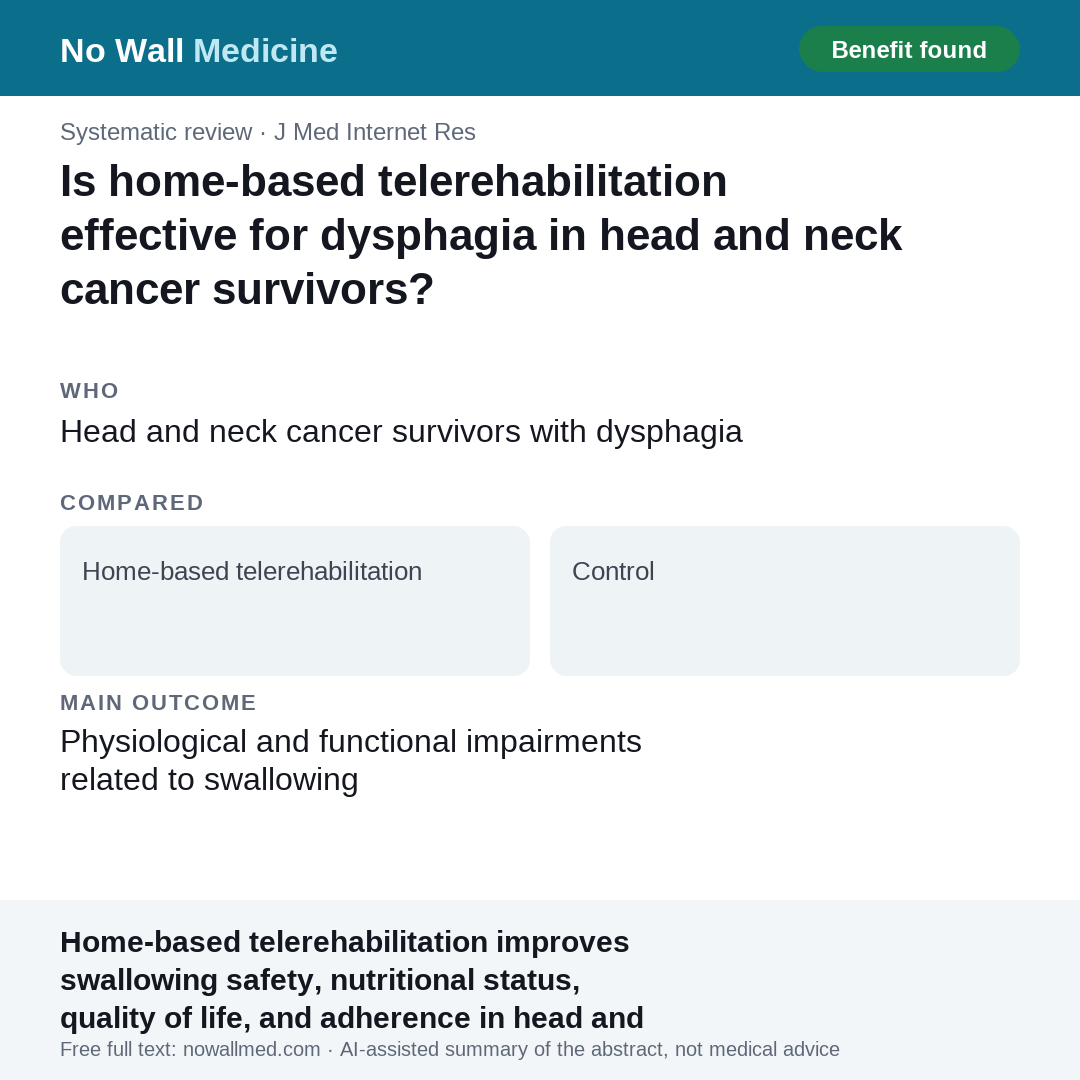
Clinical question: Is home-based telerehabilitation effective for dysphagia in head and neck cancer survivors?
Why it matters: The optimal strategy and effectiveness of remote rehabilitation interventions for swallowing impairments in head and neck cancer survivors are unclear.
Key points
- Researchers reviewed 13 studies to evaluate how remote communication-based swallowing exercises and monitoring affect head and neck cancer survivors.
- Telerehabilitation was associated with improved swallowing safety, oral feeding, nutritional status, swallowing-related quality of life, and adherence to rehabilitation.
- The interventions were associated with reduced negative emotions, high participant satisfaction, and cost-effectiveness.
Headline and key points written with AI from the paper’s abstract, with every number checked against it. Read the paper before relying on them.
Was this summary helpful?
Subject terms
Cite this article
Yang W, Du Y, Chen M, Li S, Zhang F, Yu P. Effectiveness of Home-Based Telerehabilitation Interventions for Dysphagia in Patients With Head and Neck Cancer: Systematic Review. J Med Internet Res. 2023. doi:10.2196/47324
Spotted a mistake? Suggest a correction