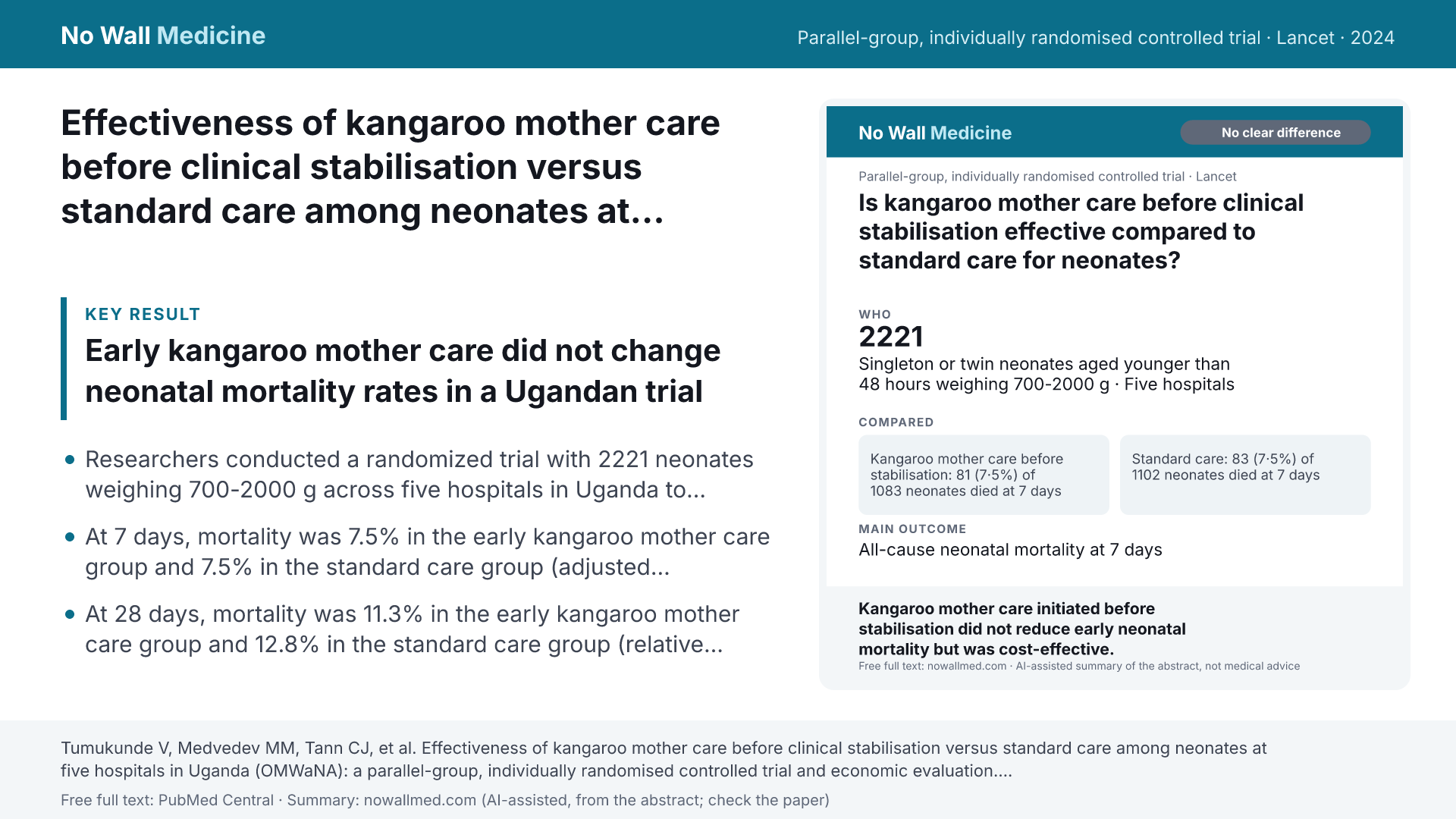
Early kangaroo mother care did not change neonatal mortality rates in a Ugandan trial
Effectiveness of kangaroo mother care before clinical stabilisation versus standard care among neonates at five hospitals in Uganda (OMWaNA): a parallel-group, individually randomised controlled trial and economic evaluation
Parallel-group, individually randomised controlled trialNo clear difference
Is kangaroo mother care before clinical stabilisation effective compared to standard care for neonates?
Who
2221
Singleton or twin neonates aged younger than 48 hours weighing 700-2000 g · Five hospitals in Uganda
Compared
Kangaroo mother care before stabilisation: 81 (7·5%) of 1083 neonates died at 7 days
Standard care: 83 (7·5%) of 1102 neonates died at 7 days
Main outcome
All-cause neonatal mortality at 7 days
Result: relative risk 0·97 (95% CI 0·74-1·28)
Bottom line: Kangaroo mother care initiated before stabilisation did not reduce early neonatal mortality but was cost-effective.
Funded by: Joint Global Health Trials scheme, UKRI Medical Research Council, Wellcome Trust, and NIH
Lancet · 2024-05-13Download image
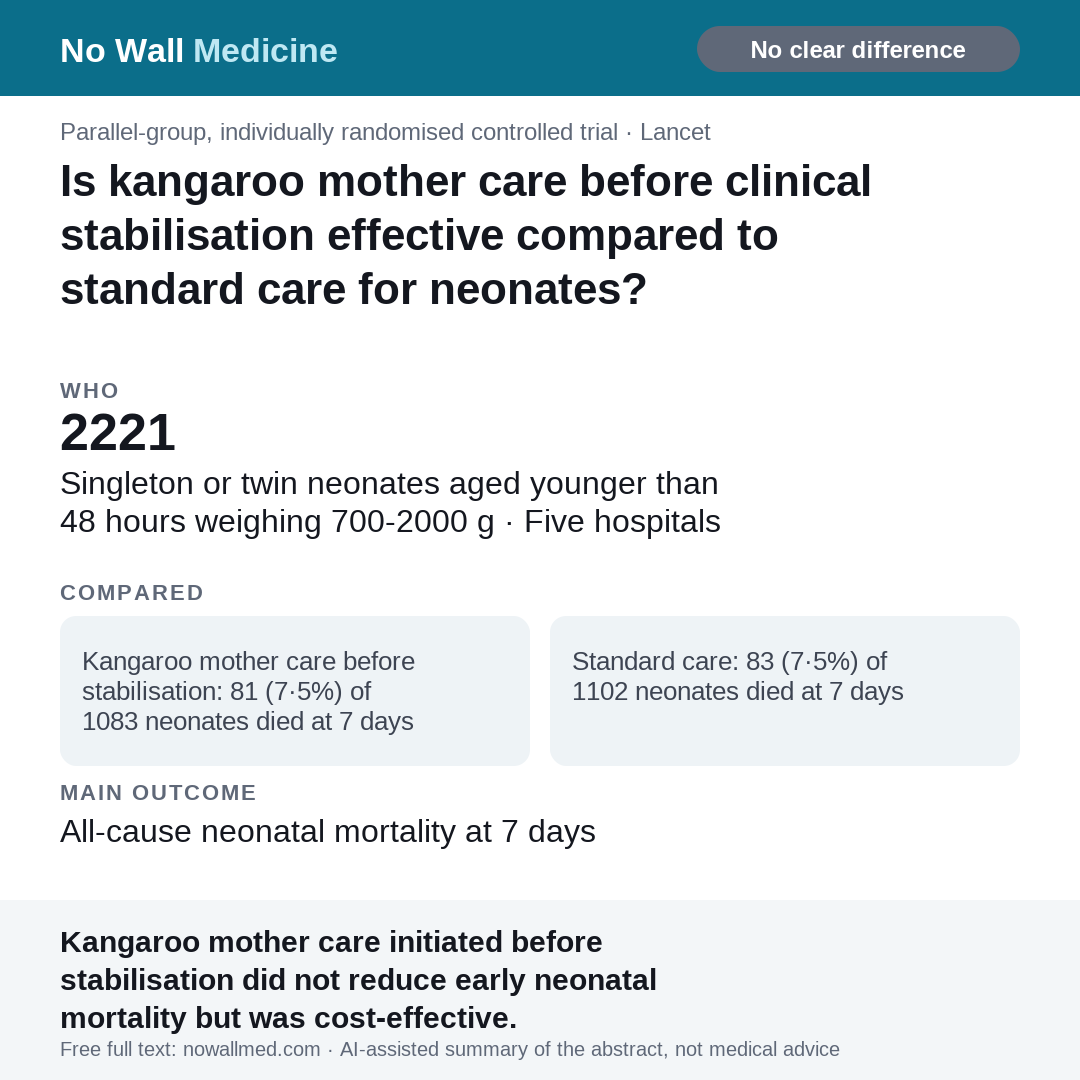
Clinical question: Is kangaroo mother care before clinical stabilisation effective compared to standard care for neonates?
Why it matters: The effects of kangaroo mother care, which involves skin-to-skin contact, on mortality and costs in sub-Saharan Africa remain unclear.
Key points
- Researchers conducted a randomized trial with 2221 neonates weighing 700-2000 g across five hospitals in Uganda to compare early kangaroo mother care with standard care.
- At 7 days, mortality was 7.5% in the early kangaroo mother care group and 7.5% in the standard care group (adjusted relative risk 0.97; p=0.85).
- At 28 days, mortality was 11.3% in the early kangaroo mother care group and 12.8% in the standard care group (relative risk 0.88; p=0.23).
Headline and key points written with AI from the paper’s abstract, with every number checked against it. Read the paper before relying on them.
Was this summary helpful?
Abstract
Background
Preterm birth is the leading cause of death in children younger than 5 years worldwide. WHO recommends kangaroo mother care (KMC); however, its effects on mortality in sub-Saharan Africa and its relative costs remain unclear. We aimed to compare the effectiveness, safety, costs, and cost-effectiveness of KMC initiated before clinical stabilisation versus standard care in neonates weighing up to 2000 g. Methods
We conducted a parallel-group, individually randomised controlled trial in five hospitals across Uganda. Singleton or twin neonates aged younger than 48 h weighing 700-2000 g without life-threatening clinical instability were eligible for inclusion. We randomly assigned (1:1) neonates to either KMC initiated before stabilisation (intervention group) or standard care (control group) via a computer-generated random allocation sequence with permuted blocks of varying sizes, stratified by birthweight and recruitment site. Parents, caregivers, and health-care workers were unmasked to treatment allocation; however, the independent statistician who conducted the analyses was masked. After randomisation, neonates in the intervention group were placed prone and skin-to-skin on the caregiver's chest, secured with a KMC wrap. Neonates in the control group were cared for in an incubator or radiant heater, as per hospital practice; KMC was not initiated until stability criteria were met. The primary outcome was all-cause neonatal mortality at 7 days, analysed by intention to treat. The economic evaluation assessed incremental costs and cost-effectiveness from a disaggregated societal perspective. This trial is registered with ClinicalTrials.gov, NCT02811432. Findings
Between Oct 9, 2019, and July 31, 2022, 2221 neonates were randomly assigned: 1110 (50·0%) neonates to the intervention group and 1111 (50·0%) neonates to the control group. From randomisation to age 7 days, 81 (7·5%) of 1083 neonates in the intervention group and 83 (7·5%) of 1102 neonates in the control group died (adjusted relative risk [RR] 0·97 [95% CI 0·74-1·28]; p=0·85). From randomisation to 28 days, 119 (11·3%) of 1051 neonates in the intervention group and 134 (12·8%) of 1049 neonates in the control group died (RR 0·88 [0·71-1·09]; p=0·23). Even if policy makers place no value on averting neonatal deaths, the intervention would have 97% probability from the provider perspective and 84% probability from the societal perspective of being more cost-effective than standard care. Interpretation
KMC initiated before stabilisation did not reduce early neonatal mortality; however, it was cost-effective from the societal and provider perspectives compared with standard care. Additional investment in neonatal care is needed for increased impact, particularly in sub-Saharan Africa. Funding
Joint Global Health Trials scheme of the Department of Health and Social Care, Foreign, Commonwealth and Development Office, UKRI Medical Research Council, and Wellcome Trust; Eunice Kennedy Shriver National Institute of Child Health and Human Development.
Abstract reproduced under the article’s CC BY licence.
Subject terms
Cite this article
Tumukunde V, Medvedev MM, Tann CJ, et al. Effectiveness of kangaroo mother care before clinical stabilisation versus standard care among neonates at five hospitals in Uganda (OMWaNA): a parallel-group, individually randomised controlled trial and economic evaluation. Lancet. 2024. doi:10.1016/S0140-6736(24)00064-3
Spotted a mistake? Suggest a correction