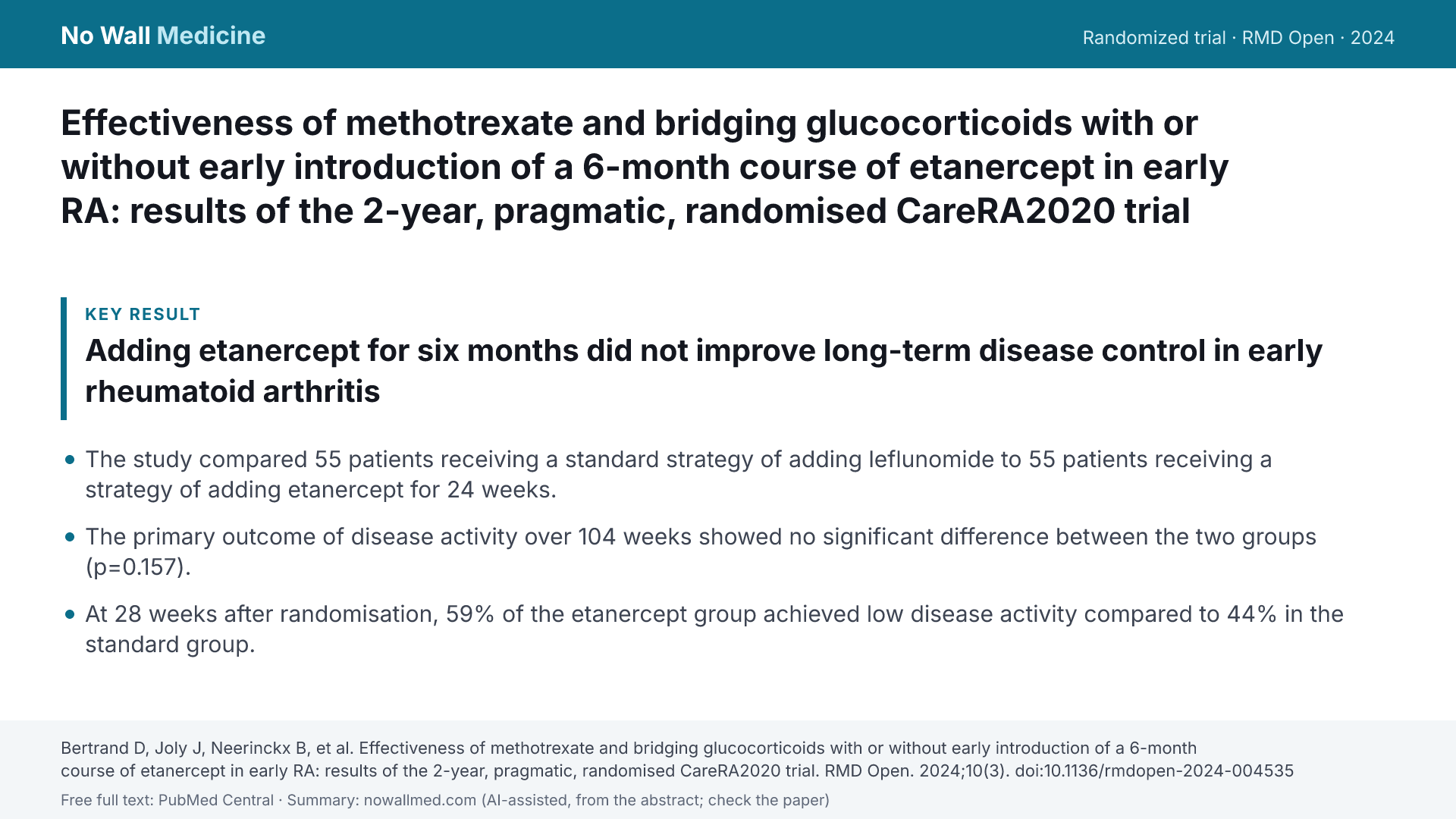
Adding etanercept for six months did not improve long-term disease control in early rheumatoid arthritis
Effectiveness of methotrexate and bridging glucocorticoids with or without early introduction of a 6-month course of etanercept in early RA: results of the 2-year, pragmatic, randomised CareRA2020 trial
Why it matters: It was unknown if a temporary course of etanercept could serve as an effective second attempt to induce remission in patients not responding to methotrexate and glucocorticoids.
Key points
- The study compared 55 patients receiving a standard strategy of adding leflunomide to 55 patients receiving a strategy of adding etanercept for 24 weeks.
- The primary outcome of disease activity over 104 weeks showed no significant difference between the two groups (p=0.157).
- At 28 weeks after randomisation, 59% of the etanercept group achieved low disease activity compared to 44% in the standard group.
Headline and key points written with AI from the paper’s abstract, with every number checked against it. Read the paper before relying on them.
Was this summary helpful?
Abstract
Objectives
To investigate if patients with early rheumatoid arthritis responding insufficiently to initial methotrexate (MTX) and bridging glucocorticoids (GCs) could benefit from early but temporary etanercept introduction as a second remission-induction attempt. Methods
CareRA2020 (NCT03649061) was a 2-year, open-label, multicentre, pragmatic randomised controlled trial. Treatment-naïve patients started MTX and GC bridging (COBRA-Slim: CS). Within a time window from week (W) 8 until W32, early insufficient responders (28-joint Disease Activity Score - C-reactive Protein (DAS28-CRP) >3.2 between W8 and W32 or ≥2.6 at W32) were randomised to a Standard-CS strategy (adding leflunomide first) or Bio-induction-CS strategy (adding etanercept for 24 weeks). Additional treatment adaptations followed the treat-to-target principle. Longitudinal disease activity (DAS28-CRP) over 104 weeks (primary outcome), achievement of DAS28-CRP <2.6 28 weeks after randomisation, and biologic or targeted synthetic disease-modifying antirheumatic drug (b/tsDMARD) use at W104 were compared between randomisation groups. Results
Following CS treatment, 142 patients were early responders; 55 early insufficient responders received Standard-CS and 55 Bio-induction-CS. Superiority of Bio-induction-CS over Standard-CS could not be demonstrated (ß=-0.204, (95% CI -0.486 to 0.078), p=0.157) for the primary outcome. More patients on Bio-induction-CS achieved DAS28-CRP <2.6 at 28 weeks after randomisation (59% (95% CI 44% to 72%) vs 44% (95% CI 31% to 59%) in Standard-CS) and they were treated less frequently with b/tsDMARDs at W104 (19/55, 35%) compared with Standard-CS (29/55, 53%). Conclusion
Half of the patients responded well to initial COBRA-Slim induction therapy. In early insufficient responders, adding etanercept for 6 months did not improve disease control over 104 weeks versus adding leflunomide first. However, temporary introduction of etanercept resulted in improved disease control early after randomisation and less patients on b/tsDMARDs at W104. Trial registration number
NCT03649061. Ctr pilot approval belgium
S59474, EudraCT number: 2017-004054-41.
Abstract reproduced under the article’s CC BY NC licence.
Subject terms
Cite this article
Bertrand D, Joly J, Neerinckx B, Durez P, Lenaerts J, Joos R. Effectiveness of methotrexate and bridging glucocorticoids with or without early introduction of a 6-month course of etanercept in early RA: results of the 2-year, pragmatic, randomised CareRA2020 trial. RMD Open. 2024. doi:10.1136/rmdopen-2024-004535
Spotted a mistake? Suggest a correction
Top studies every Monday
The week’s key trials and guidelines in your specialties, plus any topics you follow. By email, free.
Get the weekly digest