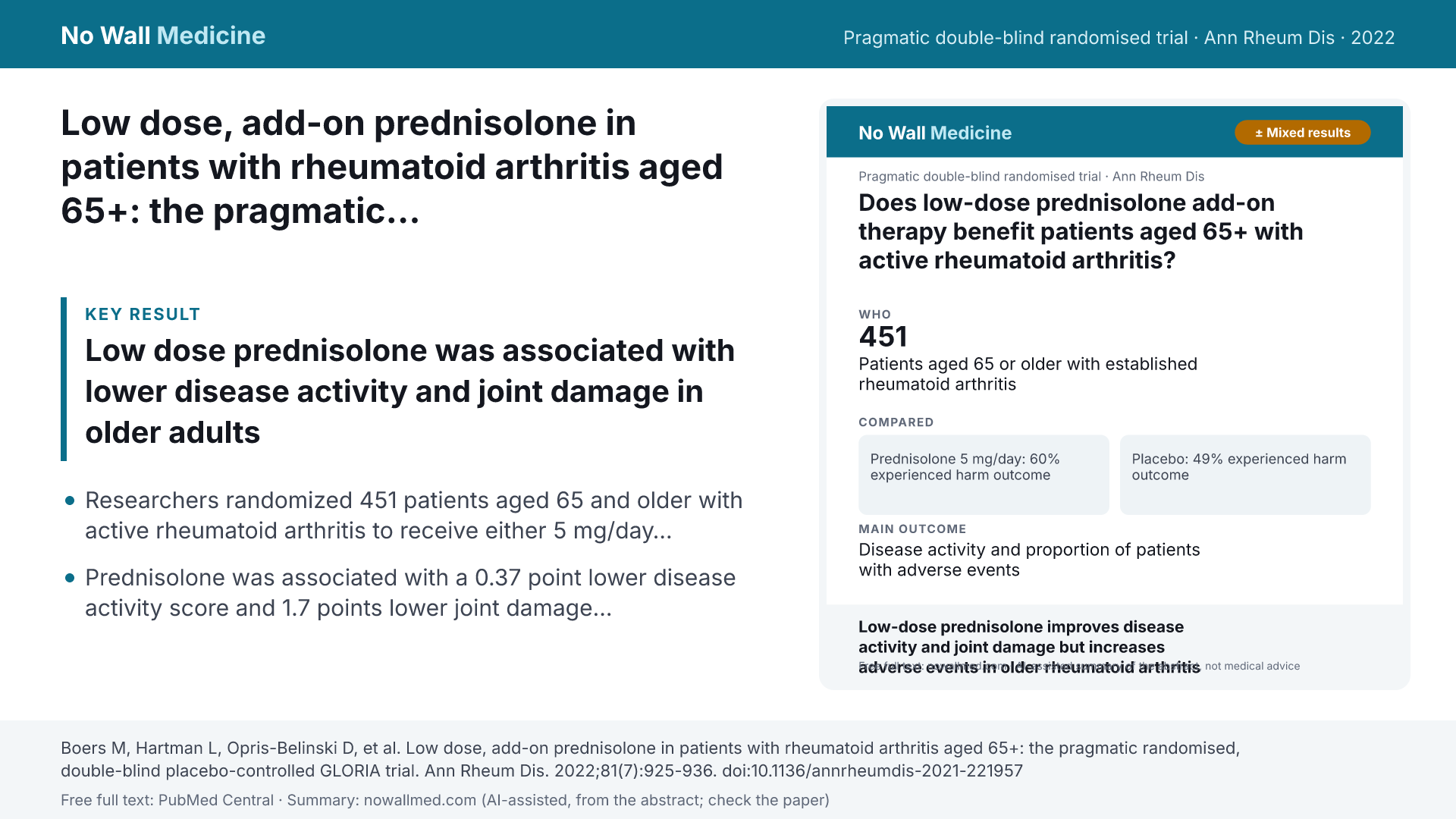
Low dose prednisolone was associated with lower disease activity and joint damage in older adults
Low dose, add-on prednisolone in patients with rheumatoid arthritis aged 65+: the pragmatic randomised, double-blind placebo-controlled GLORIA trial
Pragmatic double-blind randomised trialMixed results
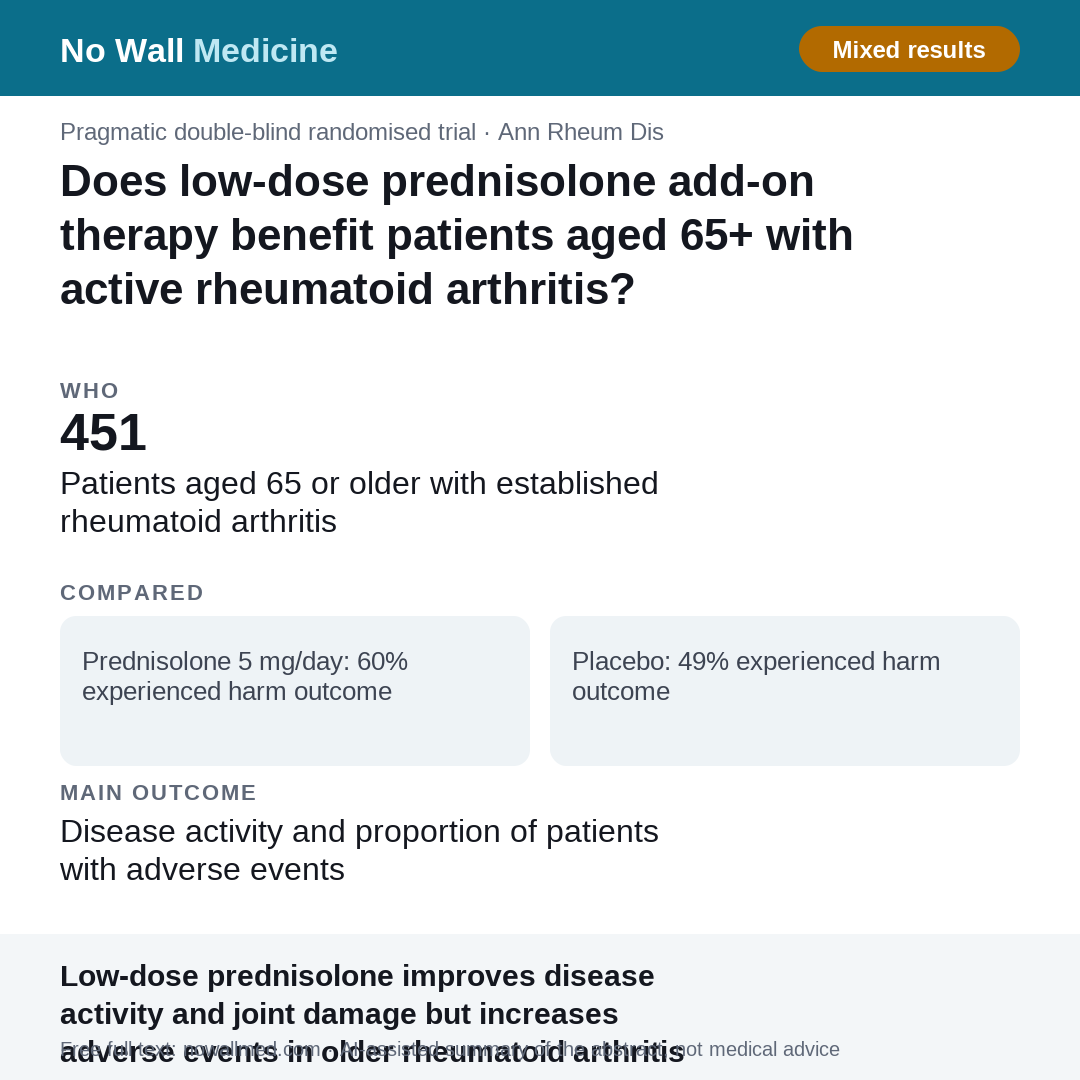
Does low-dose prednisolone add-on therapy benefit patients aged 65+ with active rheumatoid arthritis?
Who
451
Patients aged 65 or older with established rheumatoid arthritis
Compared
Prednisolone 5 mg/day: 60% experienced harm outcome
Placebo: 49% experienced harm outcome
Main outcome
Disease activity and proportion of patients with adverse events
Result: adjusted relative risk 1.24 (95% CL 1.04, p=0.02)
Bottom line: Low-dose prednisolone improves disease activity and joint damage but increases adverse events in older rheumatoid arthritis patients.
Ann Rheum Dis · 2022-05-31Download image
Clinical question: Does low-dose prednisolone add-on therapy benefit patients aged 65+ with active rheumatoid arthritis?
Why it matters: The balance of benefits and harms for using low-dose glucocorticoid therapy in older patients with rheumatoid arthritis remains unclear.
Key points
- Researchers randomized 451 patients aged 65 and older with active rheumatoid arthritis to receive either 5 mg/day of prednisolone or a placebo for 2 years.
- Prednisolone was associated with a 0.37 point lower disease activity score and 1.7 points lower joint damage progression compared to placebo.
- The harm outcome, including serious and glucocorticoid-specific events, occurred in 60% of prednisolone patients versus 49% of placebo patients.
Headline and key points written with AI from the paper’s abstract, with every number checked against it. Read the paper before relying on them.
Was this summary helpful?
Abstract
Background
Low-dose glucocorticoid (GC) therapy is widely used in rheumatoid arthritis (RA) but the balance of benefit and harm is still unclear. Methods
The GLORIA (Glucocorticoid LOw-dose in RheumatoId Arthritis) pragmatic double-blind randomised trial compared 2 years of prednisolone, 5 mg/day, to placebo in patients aged 65+ with active RA. We allowed all cotreatments except long-term open label GC and minimised exclusion criteria, tailored to seniors. Benefit outcomes included disease activity (disease activity score; DAS28, coprimary) and joint damage (Sharp/van der Heijde, secondary). The other coprimary outcome was harm, expressed as the proportion of patients with ≥1 adverse event (AE) of special interest. Such events comprised serious events, GC-specific events and those causing study discontinuation. Longitudinal models analysed the data, with one-sided testing and 95% confidence limits (95% CL). Results
We randomised 451 patients with established RA and mean 2.1 comorbidities, age 72, disease duration 11 years and DAS28 4.5. 79% were on disease-modifying treatment, including 14% on biologics. 63% prednisolone versus 61% placebo patients completed the trial. Discontinuations were for AE (both, 14%), active disease (3 vs 4%) and for other (including covid pandemic-related disease) reasons (19 vs 21%); mean time in study was 19 months. Disease activity was 0.37 points lower on prednisolone (95% CL 0.23, p<0.0001); joint damage progression was 1.7 points lower (95% CL 0.7, p=0.003). 60% versus 49% of patients experienced the harm outcome, adjusted relative risk 1.24 (95% CL 1.04, p=0.02), with the largest contrast in (mostly non-severe) infections. Other GC-specific events were rare. Conclusion
Add-on low-dose prednisolone has beneficial long-term effects in senior patients with established RA, with a trade-off of 24% increase in patients with mostly non-severe AE; this suggests a favourable balance of benefit and harm. Trial registration number
NCT02585258.
Abstract reproduced under the article’s CC BY NC licence.
Subject terms
Cite this article
Boers M, Hartman L, Opris-Belinski D, et al. Low dose, add-on prednisolone in patients with rheumatoid arthritis aged 65+: the pragmatic randomised, double-blind placebo-controlled GLORIA trial. Ann Rheum Dis. 2022. doi:10.1136/annrheumdis-2021-221957
Spotted a mistake? Suggest a correction