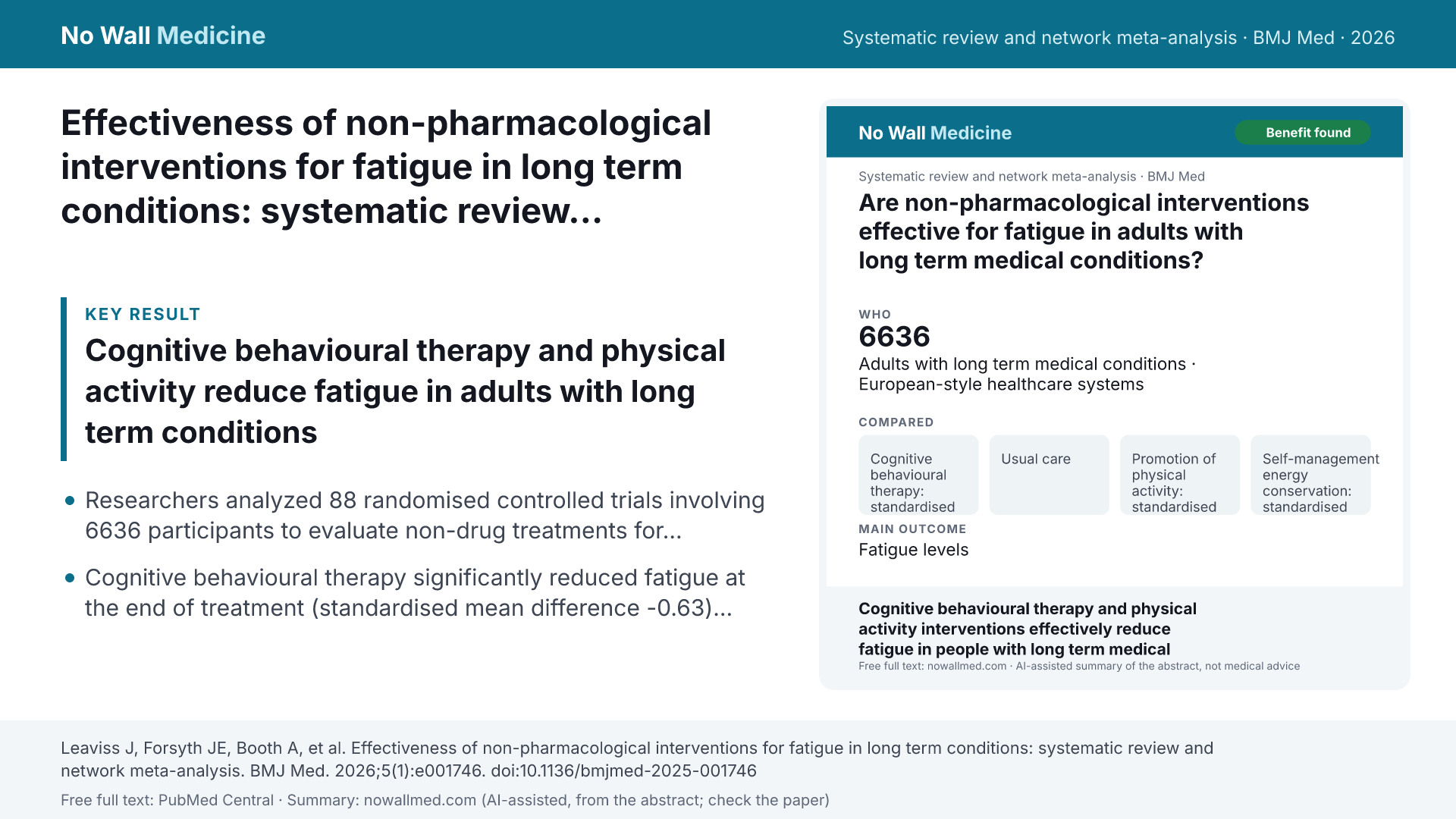
Effectiveness of non-pharmacological interventions for fatigue in long term conditions: systematic review and network meta-analysis
Key result: Cognitive behavioural therapy and physical activity reduce fatigue in adults with long term conditions
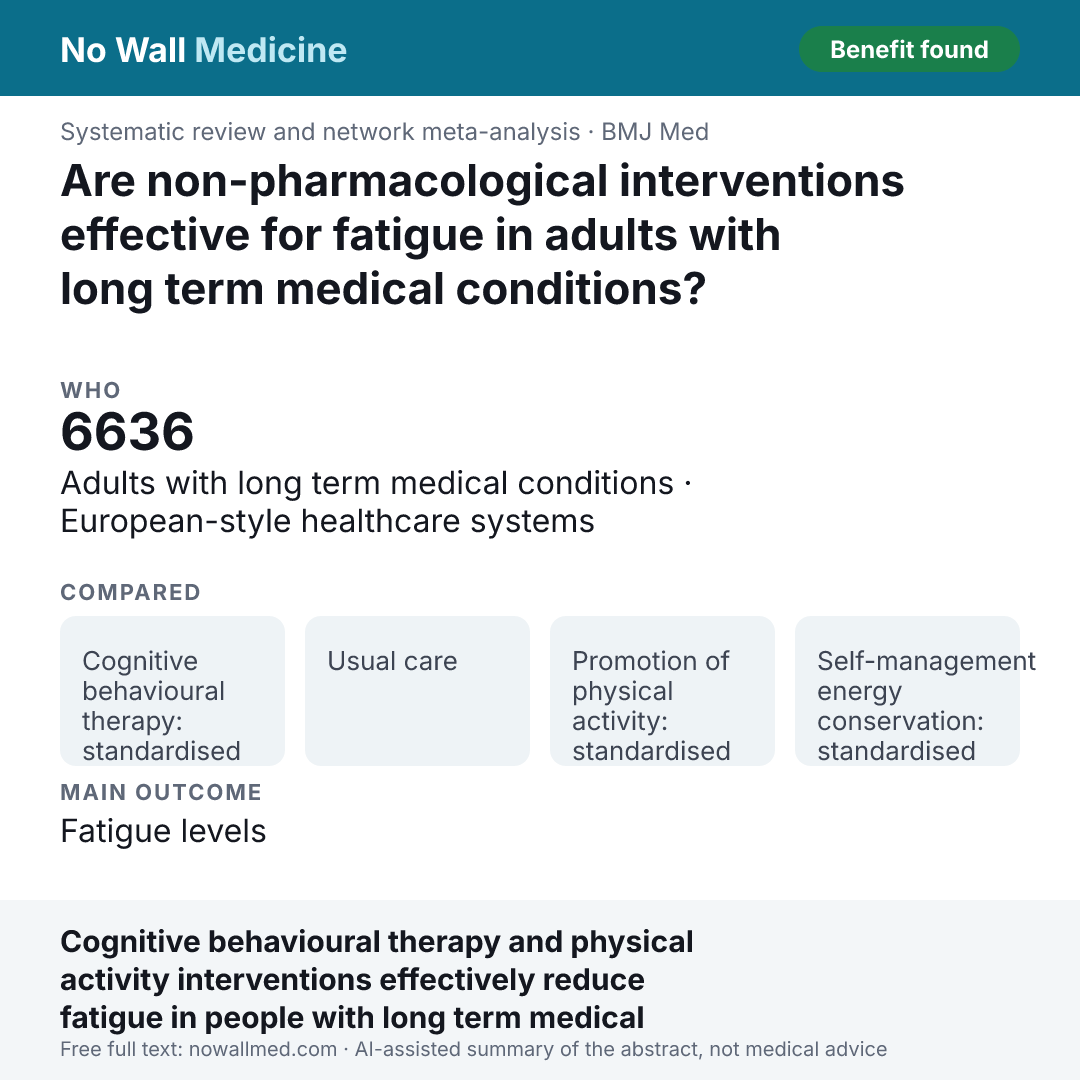
Systematic review and network meta-analysisBenefit found
Are non-pharmacological interventions effective for fatigue in adults with long term medical conditions?
Who
6636
Adults with long term medical conditions · European-style healthcare systems
Compared
Cognitive behavioural therapy: standardised mean difference -0.63 (95% credible interval -0.87 to -0.40)
Usual care
Promotion of physical activity: standardised mean difference -0.32 (95% credible interval -0.62 to -0.01)
Self-management energy conservation: standardised mean difference -0.20 (95% credible interval -0.52 to 0.12)
Main outcome
Fatigue levels
Bottom line: Cognitive behavioural therapy and physical activity interventions effectively reduce fatigue in people with long term medical conditions.
Limitation: The strength of the evidence was moderate to low.
BMJ Med · 2026-03-13 · Save PNG
Key points
- Researchers analyzed 88 randomised controlled trials involving 6636 participants to evaluate non-drug treatments for fatigue in adults with long term medical conditions.
- Cognitive behavioural therapy significantly reduced fatigue at the end of treatment (standardised mean difference -0.63) and at long term follow-up (-0.40).
- Promoting physical activity significantly reduced fatigue at the end of treatment (-0.32), short term (-0.51), and long term (-0.52).
Limitation the authors note: The strength of the evidence was moderate to low and relatively few studies existed for conditions other than multiple sclerosis.
Discussion prompts
- Would these patients look like yours? Who was left out?
- Is the main outcome one that matters to patients?
- Is the difference large enough to change what you do?
Cite: Leaviss J, Forsyth JE, Booth A, et al. Effectiveness of non-pharmacological interventions for fatigue in long term conditions: systematic review and network meta-analysis. BMJ Med. 2026;5(1):e001746. doi:10.1136/bmjmed-2025-001746
Free full text: PubMed Central · Summary and visual abstract: nowallmed.com/a/effectiveness-of-non-pharmacological-interventions-for-fatigue-in-10htlia/ (AI-assisted from the abstract; check the paper before relying on it).