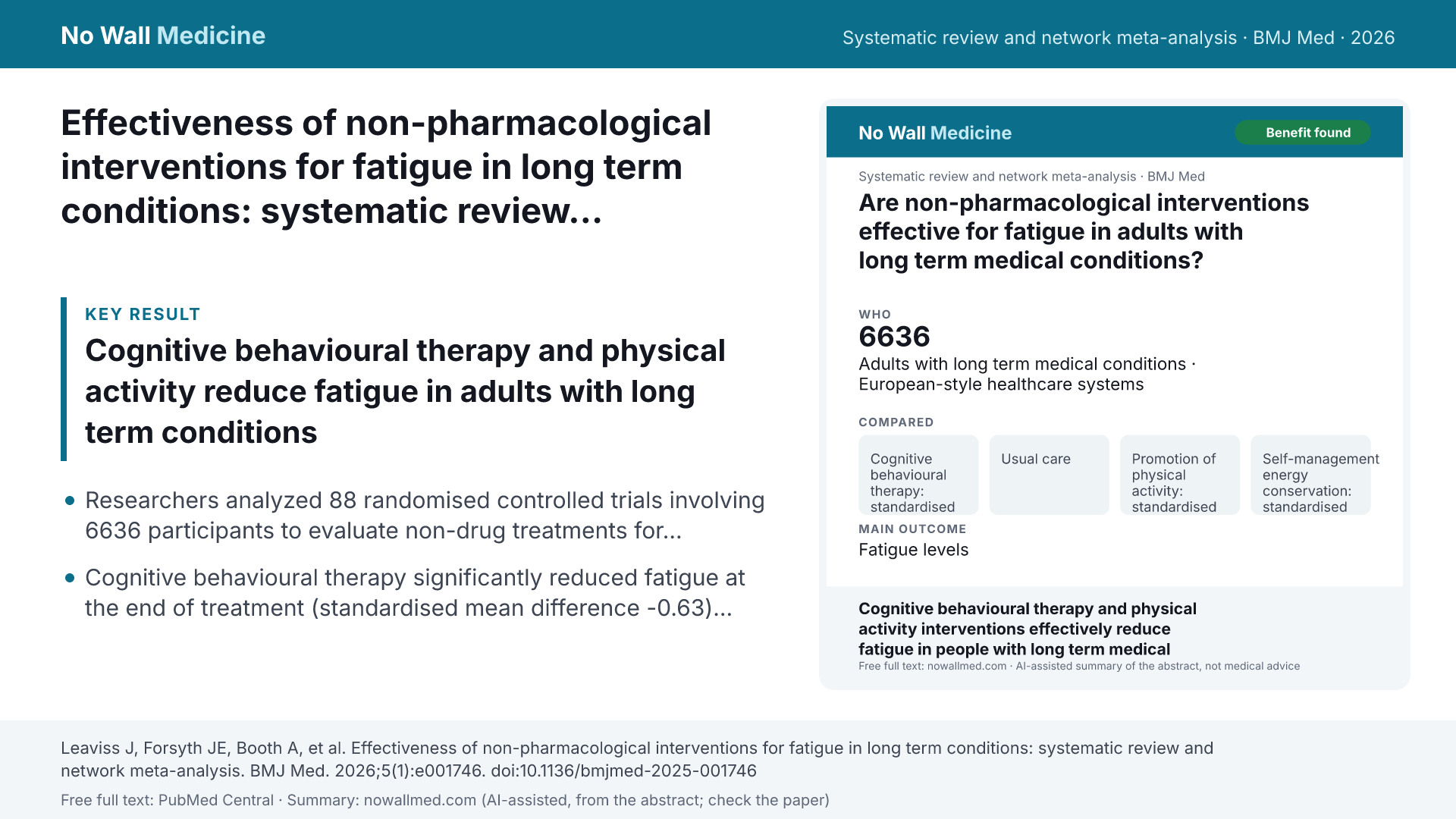
Cognitive behavioural therapy and physical activity reduce fatigue in adults with long term conditions
Effectiveness of non-pharmacological interventions for fatigue in long term conditions: systematic review and network meta-analysis
Systematic review and network meta-analysisBenefit found
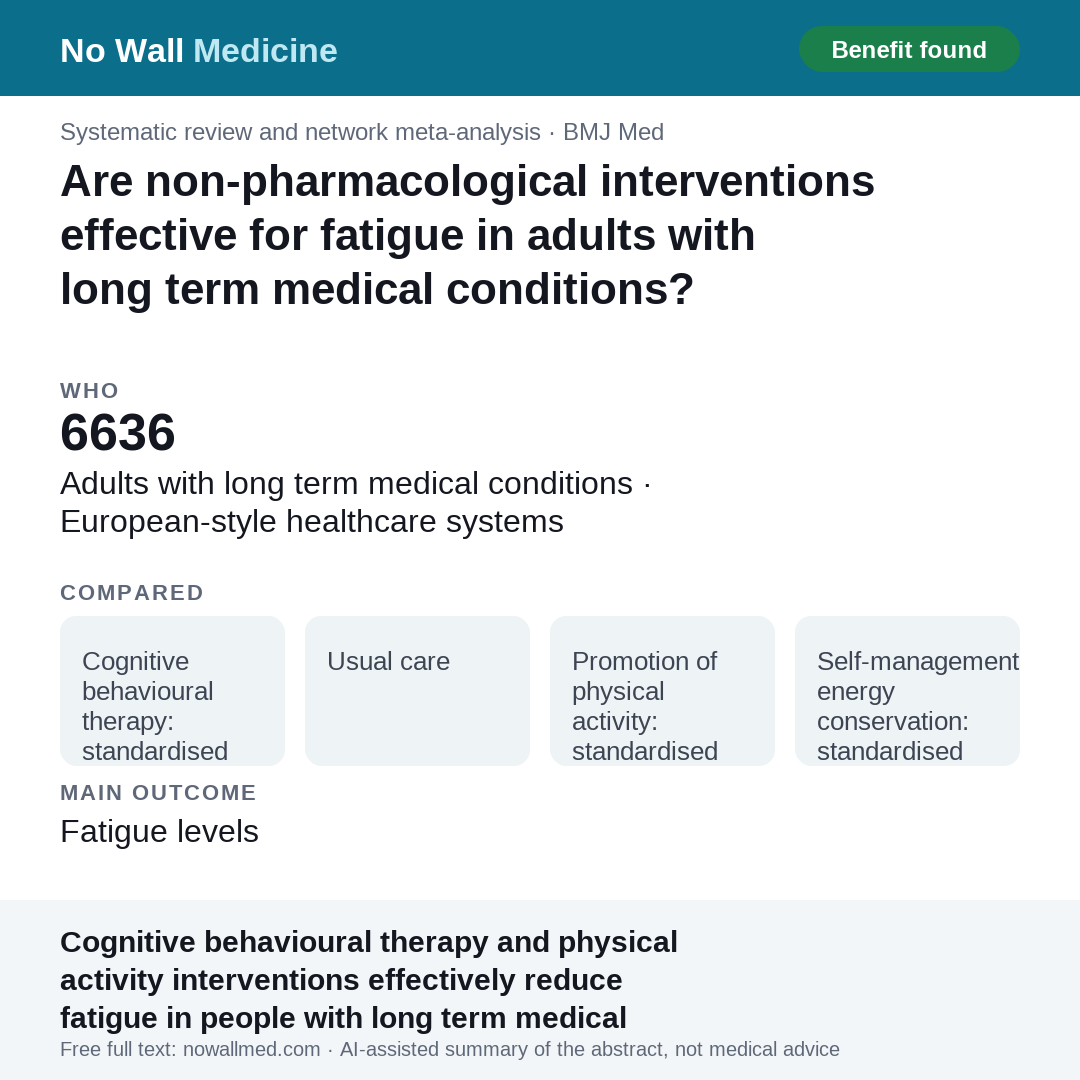
Are non-pharmacological interventions effective for fatigue in adults with long term medical conditions?
Who
6636
Adults with long term medical conditions · European-style healthcare systems
Compared
Cognitive behavioural therapy: standardised mean difference -0.63 (95% credible interval -0.87 to -0.40)
Usual care
Promotion of physical activity: standardised mean difference -0.32 (95% credible interval -0.62 to -0.01)
Self-management energy conservation: standardised mean difference -0.20 (95% credible interval -0.52 to 0.12)
Main outcome
Fatigue levels
Bottom line: Cognitive behavioural therapy and physical activity interventions effectively reduce fatigue in people with long term medical conditions.
Limitation: The strength of the evidence was moderate to low.
BMJ Med · 2026-03-13Download image
Clinical question: Are non-pharmacological interventions effective for fatigue in adults with long term medical conditions?
Why it matters: There is a need to assess how effective non-drug interventions are for managing fatigue in adults living with long term medical conditions.
Key points
- Researchers analyzed 88 randomised controlled trials involving 6636 participants to evaluate non-drug treatments for fatigue in adults with long term medical conditions.
- Cognitive behavioural therapy significantly reduced fatigue at the end of treatment (standardised mean difference -0.63) and at long term follow-up (-0.40).
- Promoting physical activity significantly reduced fatigue at the end of treatment (-0.32), short term (-0.51), and long term (-0.52).
Limitation the authors note: The strength of the evidence was moderate to low and relatively few studies existed for conditions other than multiple sclerosis.
Headline and key points written with AI from the paper’s abstract, with every number checked against it. Read the paper before relying on them.
Was this summary helpful?
Abstract
Objective
To assess the clinical effectiveness of non-pharmacological interventions for fatigue in adults with long term medical conditions. Design
Systematic review and network meta-analysis. Data sources
Medline, Embase, CINAHL, APA PsycInfo, Web of Science Core Collection, and the Cochrane Central Register of Controlled Trials, from database inception to 28 September-3 October 2023, and updated 23-24 September 2024. Eligibility criteria for selecting studies
Randomised controlled trials of non-pharmacological interventions for fatigue in long term medical conditions where fatigue was a criterion for inclusion, the primary target of the intervention, or the primary or co-primary outcome. Excluded were studies of fatigue in people with cancer, in relation to or after infection, or resulting from injuries or developmental disorders. Studies were limited to European-style healthcare systems. Results
88 randomised controlled trials were included, comprising 6636 participants for the end of treatment analyses, 1849 participants for the short term (≤3 months after the end of treatment) analyses, and 2322 participants for the long term (>3 months) analyses, allocated to one of 27 interventions. The most common condition studied was multiple sclerosis (51 studies). A range of interventions were identified, and heterogeneity was found within intervention groups and between individual interventions. Interventions varied by duration, delivery methods, and intensity. Compared with usual care, interventions based on cognitive behavioural therapy (CBT) significantly reduced fatigue at the end of treatment (standardised mean difference -0.63, 95% credible interval (CrI) -0.87 to -0.40, 17 studies) and at the long term follow-up (-0.40, -0.63 to -0.21, nine studies). Promotion of physical activity significantly reduced fatigue at all three time points: end of treatment (standardised mean difference -0.32, 95% CrI -0.62 to -0.01, seven studies), short term (-0.51, -0.84 to -0.17, one study), and long term (-0.52, -0.86 to -0.18, two studies). Self-management focusing on energy conservation was not significantly beneficial at the end of treatment (standardised mean difference -0.20, 95% CrI -0.52 to 0.12, 10 studies) or at the short term follow-up (-0.13, -0.51 to 0.25, seven studies) but at longer term follow-up, comparable benefit with other interventions was suggested (-0.42, -0.90 to 0.09, three studies). The standard deviation of the variation between studies in the end of treatment, short term, and long term network meta-analyses indicated moderate heterogeneity of studies in each of the analyses. No significant inconsistency was detected within the networks. Conclusions
Interventions that support individuals to increase physical activity or that are based on CBT were effective in reducing fatigue in people with long term medical conditions. The strength of the evidence was moderate to low. Although relatively few studies in any condition other than multiple sclerosis exist, the magnitude of effect seemed to be similar across different conditions. Systematic review registration
PROSPERO CRD42023440141.
Abstract reproduced under the article’s CC BY licence.
Cite this article
Leaviss J, Forsyth JE, Booth A, et al. Effectiveness of non-pharmacological interventions for fatigue in long term conditions: systematic review and network meta-analysis. BMJ Med. 2026. doi:10.1136/bmjmed-2025-001746
Spotted a mistake? Suggest a correction