Non-pharmacological interventions show different benefits for lower limb recovery after a stroke
Effectiveness of non-pharmacological interventions for lower limb motor impairment in post-stroke hemiplegia: a systematic review and Bayesian network meta-analysis
Systematic review and Bayesian network meta-analysisMixed results
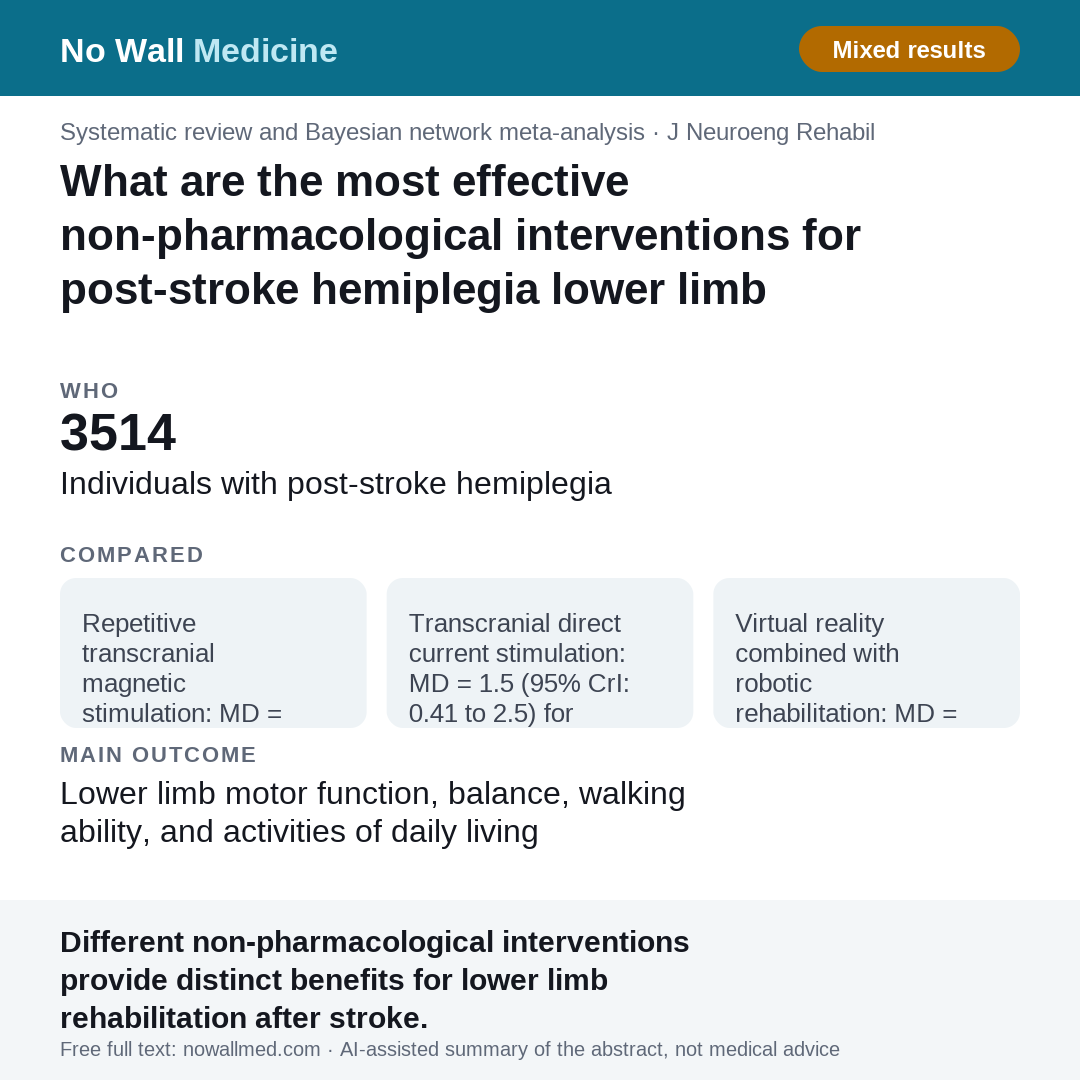
What are the most effective non-pharmacological interventions for post-stroke hemiplegia lower limb impairment?
Who
3514
Individuals with post-stroke hemiplegia
Compared
Repetitive transcranial magnetic stimulation: MD = 3.7 (95% CI 2.5 to 4.9) for motor function
Transcranial direct current stimulation: MD = 1.5 (95% CrI: 0.41 to 2.5) for walking independence
Virtual reality combined with robotic rehabilitation: MD = -6.6 (95% CrI: -8.9 to -4.3) for TUG time
Main outcome
Lower limb motor function, balance, walking ability, and activities of daily living
Bottom line: Different non-pharmacological interventions provide distinct benefits for lower limb rehabilitation after stroke.
Limitation: Further large-scale, multicenter, standardized randomized controlled trials with longer follow-up are needed.
J Neuroeng Rehabil · 2026-07-09Download image
Clinical question: What are the most effective non-pharmacological interventions for post-stroke hemiplegia lower limb impairment?
Why it matters: The optimal rehabilitation strategy for improving walking, balance, and daily activities in people with post-stroke hemiplegia remains unclear.
Key points
- Researchers analyzed 82 randomized controlled trials involving 3514 participants to compare 16 different non-drug treatments for post-stroke hemiplegia.
- Repetitive transcranial magnetic stimulation improved motor function, balance, and daily living activities, while transcranial direct current stimulation helped walking independence.
- Combining virtual reality with robotic rehabilitation reduced the time taken to complete the Timed Up and Go test.
Limitation the authors note: The authors state that further large-scale, multicenter, standardized randomized controlled trials with longer follow-up are needed to confirm these findings.
Headline and key points written with AI from the paper’s abstract, with every number checked against it. Read the paper before relying on them.
Topics
Cite this article
Zhang D, Yang Y, Xu G, Wang L, Zhang G, Song W. Effectiveness of non-pharmacological interventions for lower limb motor impairment in post-stroke hemiplegia: a systematic review and Bayesian network meta-analysis. J Neuroeng Rehabil. 2026. doi:10.1186/s12984-026-02081-9
Spotted a mistake? Suggest a correction