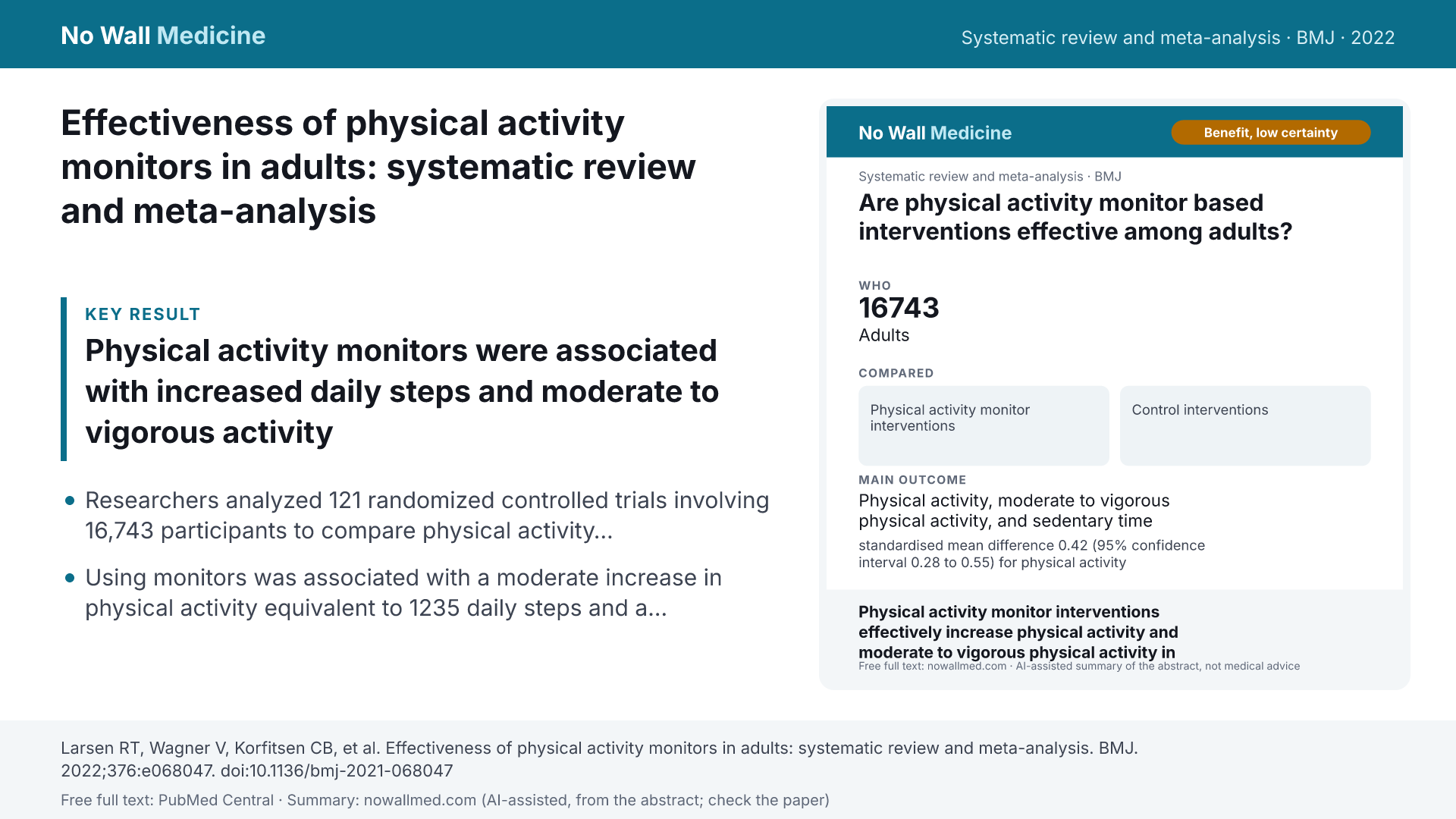
Physical activity monitors were associated with increased daily steps and moderate to vigorous activity
Effectiveness of physical activity monitors in adults: systematic review and meta-analysis
Systematic review and meta-analysisBenefit, low certainty
Are physical activity monitor based interventions effective among adults?
Who
16743
Adults
Compared
Physical activity monitor interventions
Control interventions
Main outcome
Physical activity, moderate to vigorous physical activity, and sedentary time
Result: standardised mean difference 0.42 (95% confidence interval 0.28 to 0.55) for physical activity
Bottom line: Physical activity monitor interventions effectively increase physical activity and moderate to vigorous physical activity in adults.
Limitation: The effect might be overestimated owing to publication bias.
BMJ · 2022-01-26Download image
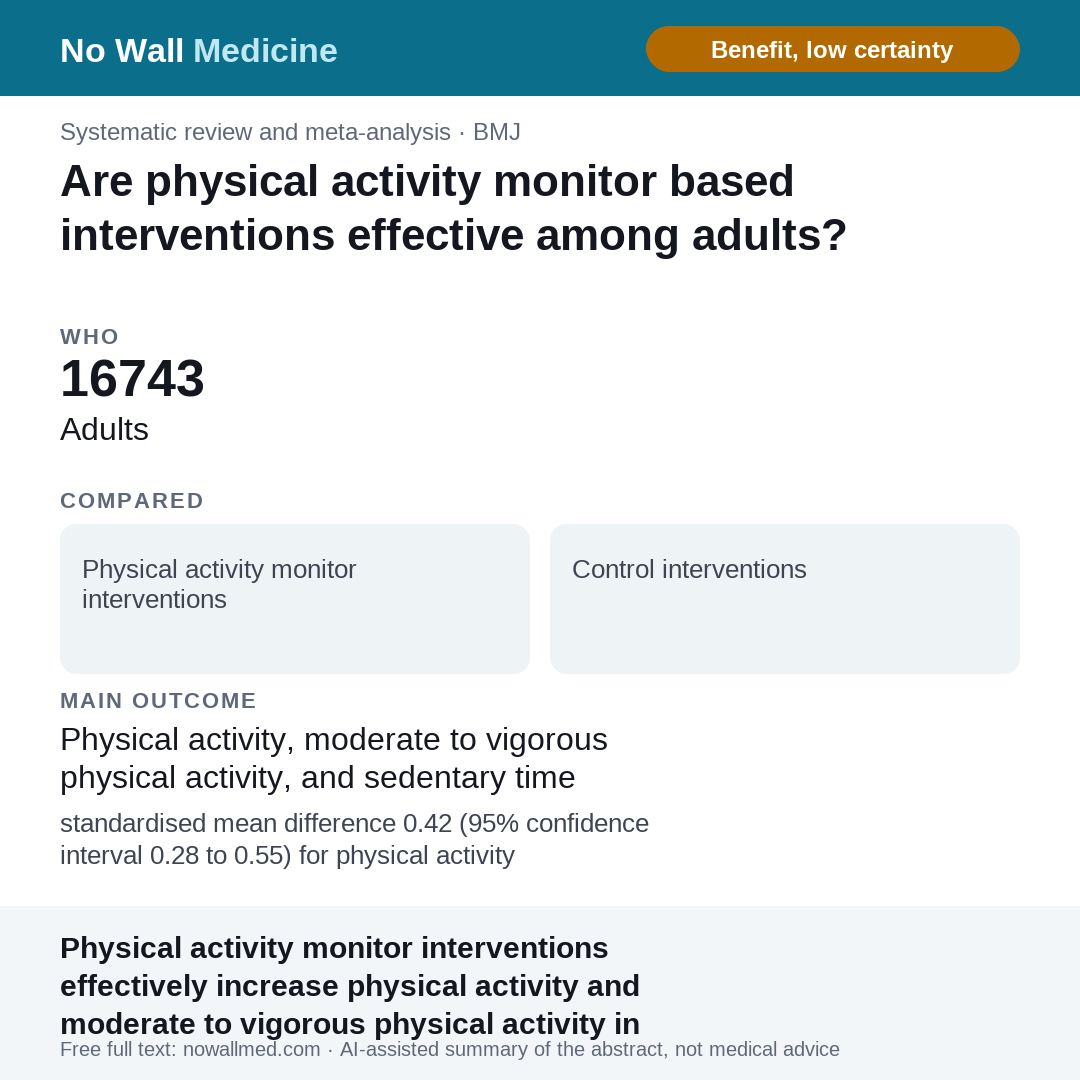
Clinical question: Are physical activity monitor based interventions effective among adults?
Why it matters: The effectiveness of using physical activity monitors to change movement patterns in adults needed to be estimated and the reasons for varying results explored.
Key points
- Researchers analyzed 121 randomized controlled trials involving 16,743 participants to compare physical activity monitor feedback against no feedback.
- Using monitors was associated with a moderate increase in physical activity equivalent to 1235 daily steps and a small increase in moderate to vigorous physical activity of 48.5 weekly minutes.
- The effect on sedentary time was small and not statistically significant, showing a change of -0.12 equivalent to 9.9 daily minutes.
Limitation the authors note: The effect on physical activity and moderate to vigorous physical activity might be overestimated owing to publication bias.
Headline and key points written with AI from the paper’s abstract, with every number checked against it. Read the paper before relying on them.
Was this summary helpful?
Abstract
Objective
To estimate the effectiveness of physical activity monitor (PAM) based interventions among adults and explore reasons for the heterogeneity. Design
Systematic review and meta-analysis. Study selection
The electronic databases MEDLINE, Embase, SPORTDiscus, CINAHL, and the Cochrane Central Register of Controlled Trials (CENTRAL) were searched on 4 June 2021. Eligible randomised controlled trials compared interventions in which adults received feedback from PAMs with control interventions in which no feedback was provided. No restrictions on type of outcome measurement, publication date, or language were applied. Data extraction and synthesis
Two reviewers independently extracted data and assessed risk of bias. Random effects meta-analyses were used to synthesise the results. The certainty of evidence was rated by the Grading of Recommendations Assessment and Evaluation (GRADE) approach. Main outcome measures
The three primary outcomes of interest were physical activity, moderate to vigorous physical activity, and sedentary time. Results
121 randomised controlled trials with 141 study comparisons, including 16 743 participants, were included. The PAM based interventions showed a moderate effect (standardised mean difference 0.42, 95% confidence interval 0.28 to 0.55) on physical activity, equivalent to 1235 daily steps; a small effect (0.23, 0.16 to 0.30) on moderate to vigorous physical activity, equivalent to 48.5 weekly minutes; and a small insignificant effect (-0.12, -0.25 to 0.01) on sedentary time, equal to 9.9 daily minutes. All outcomes favoured the PAM interventions. Conclusions
The certainty of evidence was low for the effect of PAM based interventions on physical activity and moderate for moderate to vigorous physical activity and sedentary time. PAM based interventions are safe and effectively increase physical activity and moderate to vigorous physical activity. The effect on physical activity and moderate to vigorous physical activity is well established but might be overestimated owing to publication bias. Study registration
PROSPERO CRD42018102719.
Abstract reproduced under the article’s CC BY NC licence.
Subject terms
Cite this article
Larsen RT, Wagner V, Korfitsen CB, et al. Effectiveness of physical activity monitors in adults: systematic review and meta-analysis. BMJ. 2022. doi:10.1136/bmj-2021-068047
Spotted a mistake? Suggest a correction