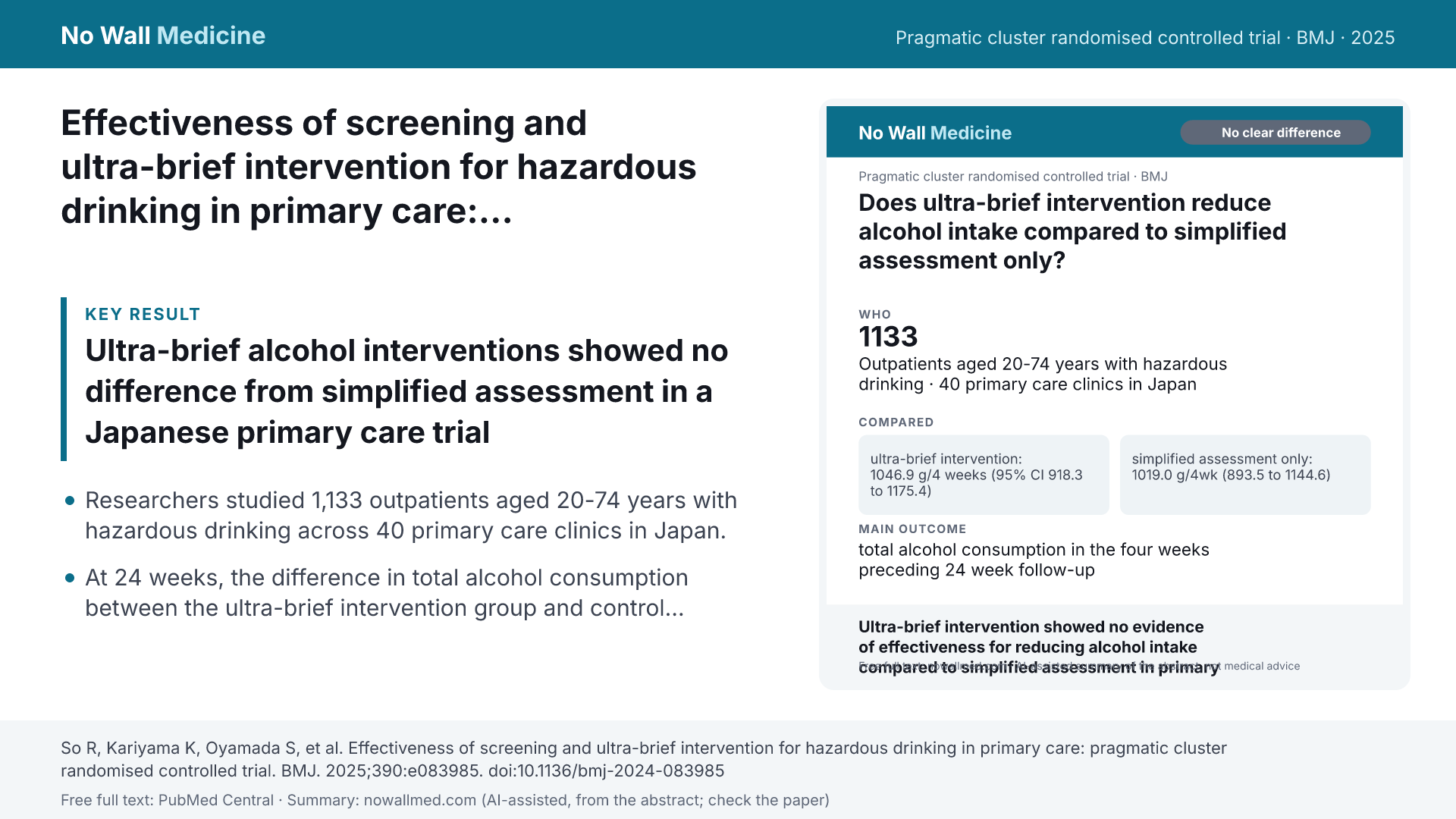
Ultra-brief alcohol interventions showed no difference from simplified assessment in a Japanese primary care trial
Effectiveness of screening and ultra-brief intervention for hazardous drinking in primary care: pragmatic cluster randomised controlled trial
Pragmatic cluster randomised controlled trialNo clear difference
Does ultra-brief intervention reduce alcohol intake compared to simplified assessment only?
Who
1133
Outpatients aged 20-74 years with hazardous drinking · 40 primary care clinics in Japan
Compared
ultra-brief intervention: 1046.9 g/4 weeks (95% CI 918.3 to 1175.4)
simplified assessment only: 1019.0 g/4wk (893.5 to 1144.6)
Main outcome
total alcohol consumption in the four weeks preceding 24 week follow-up
Result: difference 27.8 g/4wk (-149.7 to 205.4, P=0.75)
Bottom line: Ultra-brief intervention showed no evidence of effectiveness for reducing alcohol intake compared to simplified assessment in primary care.
BMJ · 2025-08-12Download image
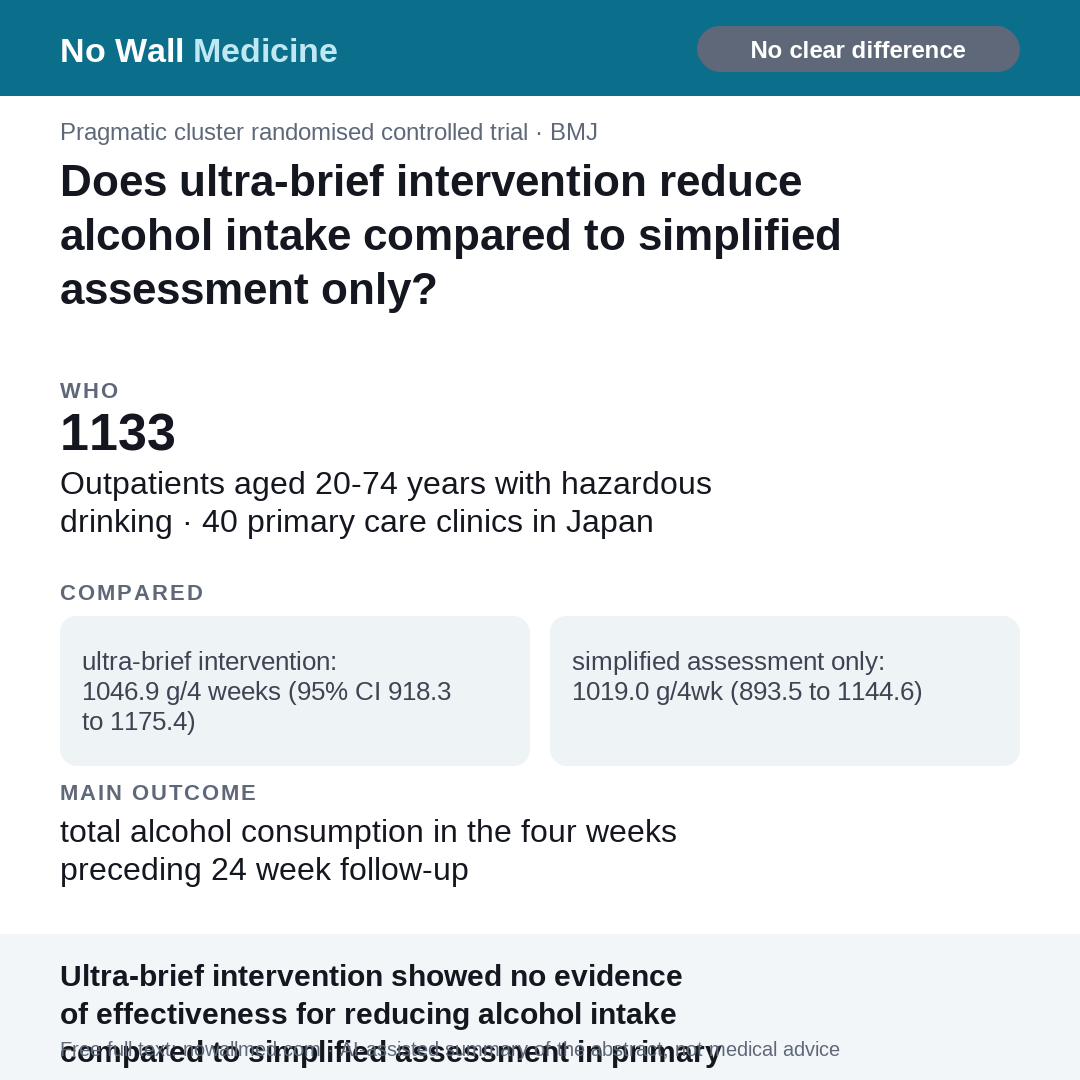
Clinical question: Does ultra-brief intervention reduce alcohol intake compared to simplified assessment only?
Key points
- Researchers studied 1,133 outpatients aged 20-74 years with hazardous drinking across 40 primary care clinics in Japan.
- At 24 weeks, the difference in total alcohol consumption between the ultra-brief intervention group and control group was 27.8 g/4wk (95% CI -149.7 to 205.4, P=0.75).
- At 12 weeks, the difference in total alcohol consumption between the intervention group and control group was 54.9 g/4wk (-104.1 to 213.9, P=0.49).
Headline and key points written with AI from the paper’s abstract, with every number checked against it. Read the paper before relying on them.
Was this summary helpful?
Abstract
Objective
To evaluate the effectiveness of a doctor delivered screening and ultra-brief intervention (<1 minute) compared with simplified assessment only for reducing alcohol intake among patients with hazardous drinking in primary care. Design
Pragmatic cluster randomised controlled trial. Setting
40 primary care clinics in Japan that did not provide routine screening and brief intervention for hazardous drinking or treatment or self-help groups for alcohol dependency. Participants
1133 outpatients aged 20-74 years with hazardous drinking (AUDIT-C (alcohol use disorders identification test-consumption) scores ≥5 for men and ≥4 for women). Clinic clusters were allocated to a study arm using a computer generated random sequence. Participants and staff who collected participant reported outcomes remained blinded to assignment. Interventions
Primary care clinics were randomised to ultra-brief intervention (21 clinics, 531 patients) or simplified assessment only (19 clinics, 602 patients) groups. The intervention group comprised screening with AUDIT-C followed by brief oral advice and an alcohol information leaflet delivered in <1 minute. The control group comprised simplified assessment with AUDIT-C only. Main outcome measures
The primary outcome was total alcohol consumption in the four weeks preceding the 24 week follow-up. Secondary outcomes included total alcohol consumption in the four weeks preceding the 12 week follow-up, and readiness to change drinking behaviour, measured at 12 and 24 weeks. Results
At 24 weeks, the difference in total alcohol consumption between the ultra-brief intervention group (1046.9 g/4 weeks (g/4wk), 95% confidence interval (CI) 918.3 to 1175.4) and control group (1019.0 g/4wk, 893.5 to 1144.6) was 27.8 g/4wk (-149.7 to 205.4, P=0.75), with a Hedges' g of 0.02 (95% CI -0.10 to 0.14). At 12 weeks, the difference in total alcohol consumption between the intervention group (1034.1 g/4wk, 919.6 to 1148.7) and control group (979.3 g/4wk, 866.1 to 1092.4) was 54.9 g/4wk (-104.1 to 213.9, P=0.49), with a Hedges' g of 0.04 (-0.08 to 0.16). Conclusion
This trial found no evidence to support the effectiveness of a doctor delivered ultra-brief intervention for hazardous drinking compared with simplified assessment only in primary care in Japan. Trial registration
UMIN Clinical Trials Registry UMIN000051388.
Abstract reproduced under the article’s CC BY licence.
Subject terms
Cite this article
So R, Kariyama K, Oyamada S, et al. Effectiveness of screening and ultra-brief intervention for hazardous drinking in primary care: pragmatic cluster randomised controlled trial. BMJ. 2025. doi:10.1136/bmj-2024-083985
Spotted a mistake? Suggest a correction