Primary care preconception interventions improved health knowledge and reduced risk factors in females
Effectiveness of preconception interventions in primary care: a systematic review
Systematic review of randomized controlled trialsMixed results
Are primary care-based preconception interventions effective for improving health and pregnancy outcomes?
Who
22
Reproductive-aged females and/or males
Compared
Brief education
Intensive education
Supplementary medication
Dietary modification
Main outcome
Health knowledge, preconception risk factors, and pregnancy outcomes
Bottom line: Preconception interventions improve health knowledge and reduce risk factors, but evidence for pregnancy outcomes remains limited.
Limitation: Most randomized controlled trials were of low quality.
Br J Gen Pract · 2022-11-24Download image
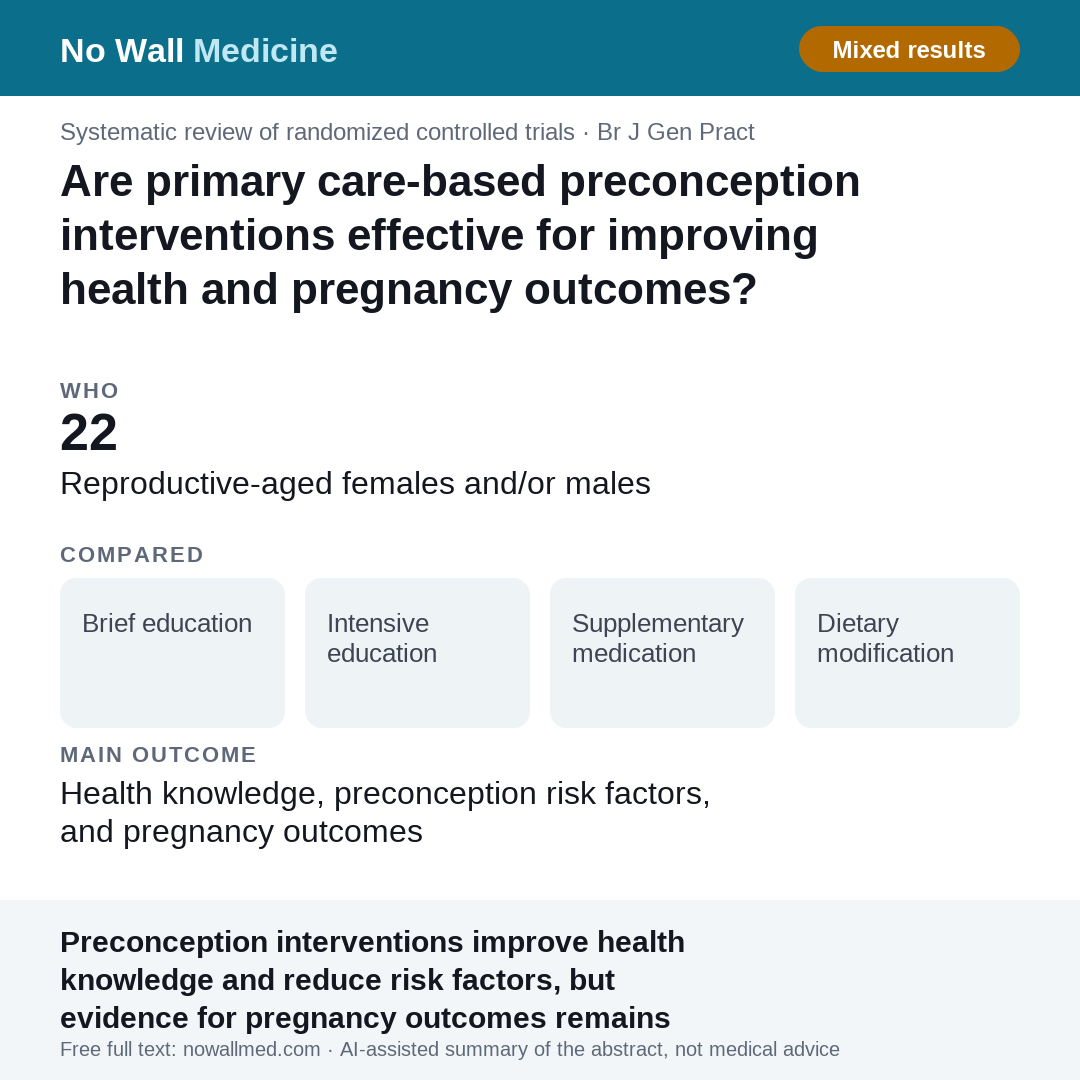
Clinical question: Are primary care-based preconception interventions effective for improving health and pregnancy outcomes?
Why it matters: The effectiveness of primary care-based preconception care for improving health knowledge, risk factors, and pregnancy outcomes remains unclear.
Key points
- Researchers reviewed 22 randomized controlled trials involving brief education, intensive education, medication, and dietary changes for people planning pregnancy.
- Brief education improved health knowledge in females and males, reduced alcohol and tobacco use, and increased folate intake.
- Intensive education was associated with reduced spontaneous pregnancy loss and alcohol-exposed pregnancies, while dietary modification was associated with increased birth weight.
Limitation the authors note: Most randomized controlled trials included in the review were of low quality.
Headline and key points written with AI from the paper’s abstract, with every number checked against it. Read the paper before relying on them.
Was this summary helpful?
Subject terms
Cite this article
Withanage NN, Botfield JR, Srinivasan S, Black KI, Mazza D. Effectiveness of preconception interventions in primary care: a systematic review. Br J Gen Pract. 2022. doi:10.3399/BJGP.2022.0040
Spotted a mistake? Suggest a correction
Top studies every Monday
The week’s key trials and guidelines in your specialties, plus any topics you follow. By email, free.
Get the weekly digest