Effectiveness of Standard Sequential Bilateral Repetitive Transcranial Magnetic Stimulation vs Bilateral Theta Burst Stimulation in Older Adults With Depression: The FOUR-D Randomized Noninferiority Clinical Trial
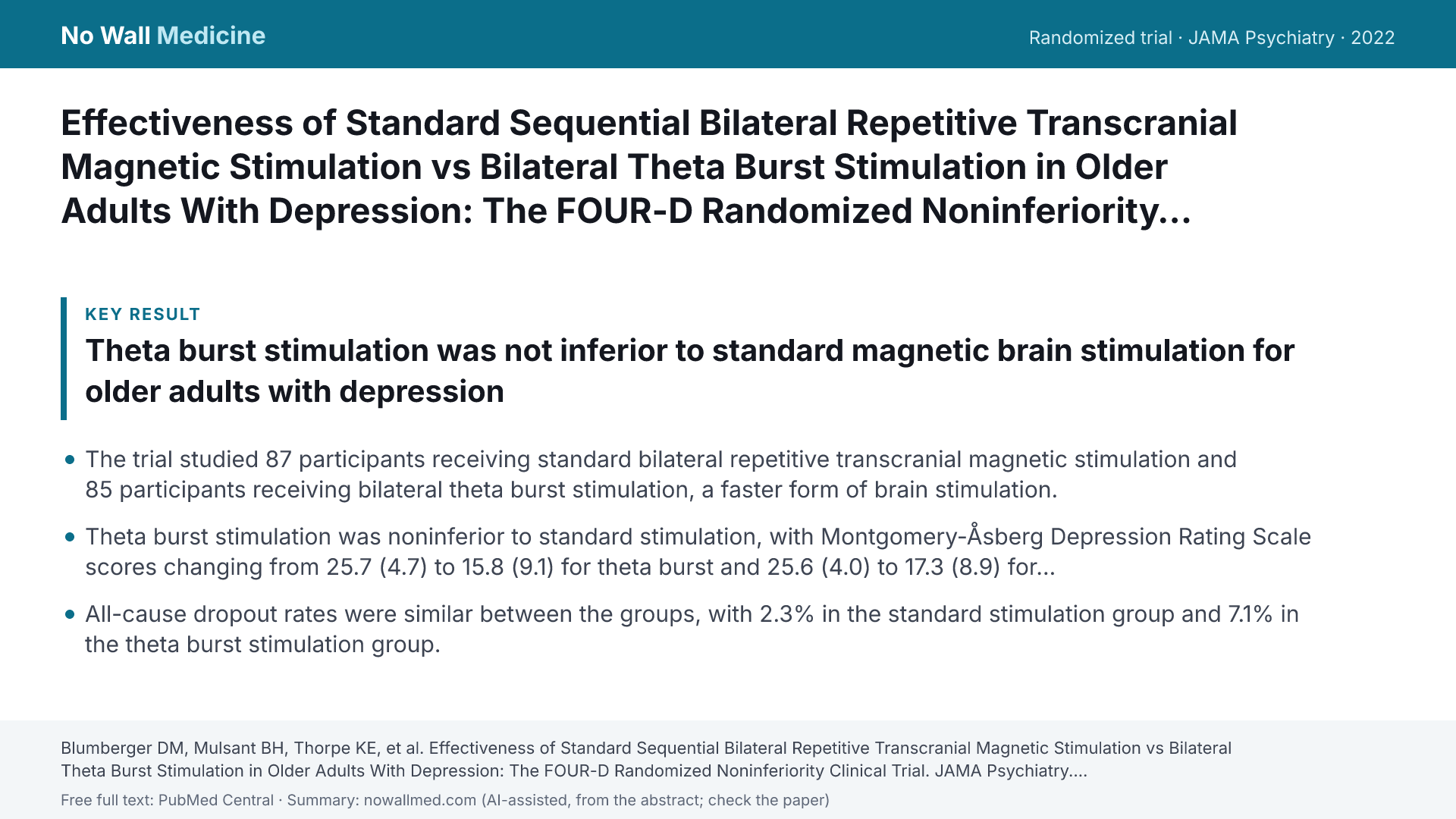
Key result: Theta burst stimulation was not inferior to standard magnetic brain stimulation for older adults with depression
Key points
- The trial studied 87 participants receiving standard bilateral repetitive transcranial magnetic stimulation and 85 participants receiving bilateral theta burst stimulation, a faster form of brain stimulation.
- Theta burst stimulation was noninferior to standard stimulation, with Montgomery-Åsberg Depression Rating Scale scores changing from 25.7 (4.7) to 15.8 (9.1) for theta burst and 25.6 (4.0) to 17.3 (8.9) for standard stimulation.
- All-cause dropout rates were similar between the groups, with 2.3% in the standard stimulation group and 7.1% in the theta burst stimulation group.
Why it matters: It was unknown whether the faster theta burst stimulation is as effective as the standard 48-minute repetitive transcranial magnetic stimulation for older adults with treatment-resistant depression.
Discussion prompts
- Would these patients look like yours? Who was left out?
- Is the main outcome one that matters to patients?
- Is the difference large enough to change what you do?
Cite: Blumberger DM, Mulsant BH, Thorpe KE, et al. Effectiveness of Standard Sequential Bilateral Repetitive Transcranial Magnetic Stimulation vs Bilateral Theta Burst Stimulation in Older Adults With Depression: The FOUR-D Randomized Noninferiority Clinical Trial. JAMA Psychiatry. 2022. doi:10.1001/jamapsychiatry.2022.2862
Free full text: PubMed Central · Summary and visual abstract: nowallmed.com/a/effectiveness-of-standard-sequential-bilateral-repetitive-xbtclk/ (AI-assisted from the abstract; check the paper before relying on it).