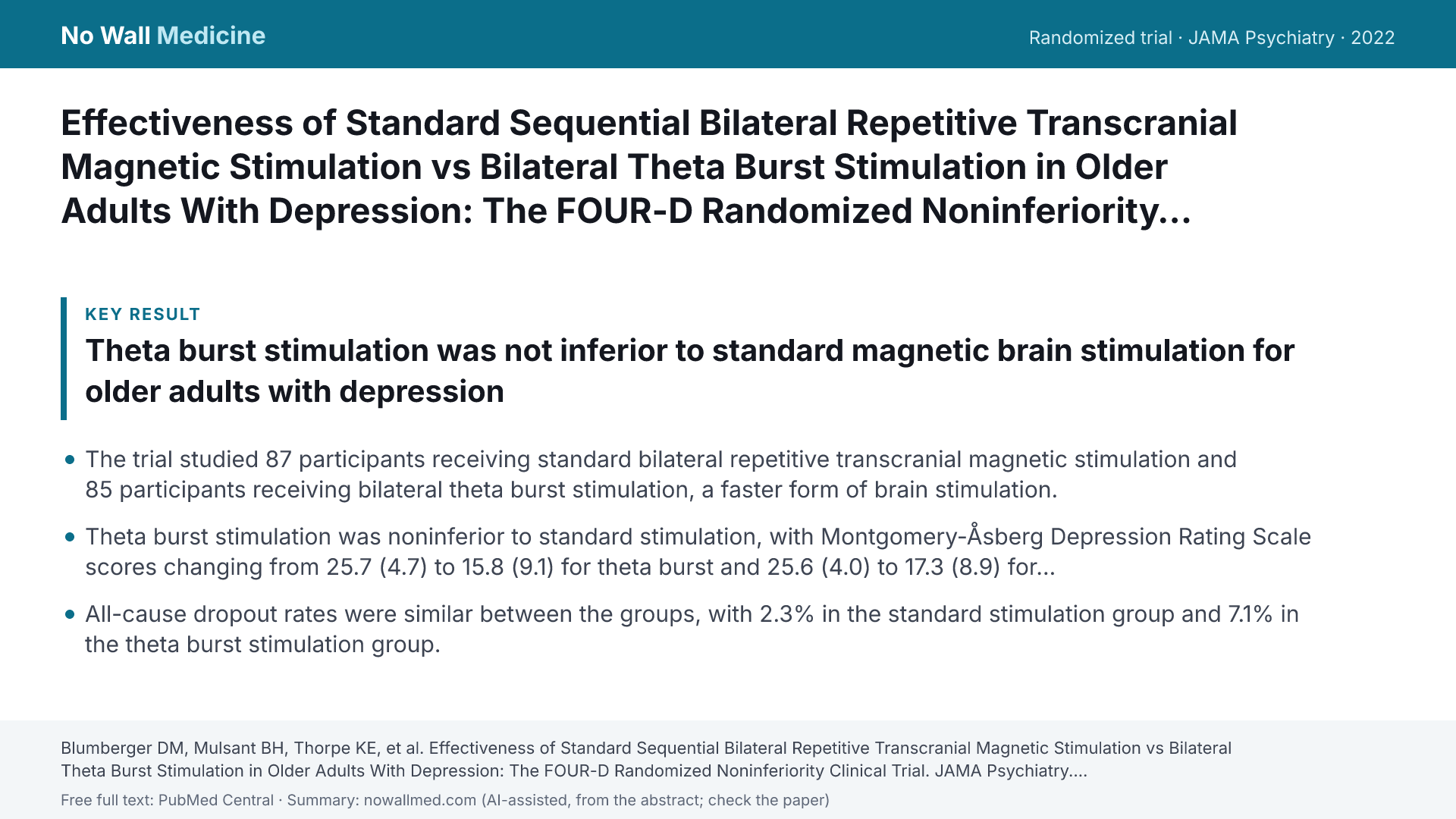
Theta burst stimulation was not inferior to standard magnetic brain stimulation for older adults with depression
Effectiveness of Standard Sequential Bilateral Repetitive Transcranial Magnetic Stimulation vs Bilateral Theta Burst Stimulation in Older Adults With Depression: The FOUR-D Randomized Noninferiority Clinical Trial
Why it matters: It was unknown whether the faster theta burst stimulation is as effective as the standard 48-minute repetitive transcranial magnetic stimulation for older adults with treatment-resistant depression.
Key points
- The trial studied 87 participants receiving standard bilateral repetitive transcranial magnetic stimulation and 85 participants receiving bilateral theta burst stimulation, a faster form of brain stimulation.
- Theta burst stimulation was noninferior to standard stimulation, with Montgomery-Åsberg Depression Rating Scale scores changing from 25.7 (4.7) to 15.8 (9.1) for theta burst and 25.6 (4.0) to 17.3 (8.9) for standard stimulation.
- All-cause dropout rates were similar between the groups, with 2.3% in the standard stimulation group and 7.1% in the theta burst stimulation group.
Headline and key points written with AI from the paper’s abstract, with every number checked against it. Read the paper before relying on them.
Was this summary helpful?
Subject terms
Cite this article
Blumberger DM, Mulsant BH, Thorpe KE, et al. Effectiveness of Standard Sequential Bilateral Repetitive Transcranial Magnetic Stimulation vs Bilateral Theta Burst Stimulation in Older Adults With Depression: The FOUR-D Randomized Noninferiority Clinical Trial. JAMA Psychiatry. 2022. doi:10.1001/jamapsychiatry.2022.2862
Spotted a mistake? Suggest a correction