Accelerated Intermittent Theta-Burst Stimulation and Treatment-Refractory Bipolar Depression: A Randomized Clinical Trial
Randomized clinical trialBenefit found
Is accelerated intermittent theta-burst stimulation effective for treatment-refractory bipolar depression?
Who
24
Individuals with treatment-resistant bipolar disorder and moderate to severe depressive episodes · Penn Bipolar outpatient clinic
Compared
active aiTBS: mean (SD), 10.5 (6.7) after treatment
sham aiTBS: mean (SD), 25.3 (6.7) after treatment
Main outcome
Montgomery-Åsberg Depression Rating Scale scores
Result: estimated difference, -14.75 (95% CI, -19.73 to -9.77)
Bottom line: Accelerated intermittent theta-burst stimulation was more effective than sham stimulation for reducing depressive symptoms in treatment-resistant bipolar depression.
JAMA Psychiatry · 2024-07-10Download image
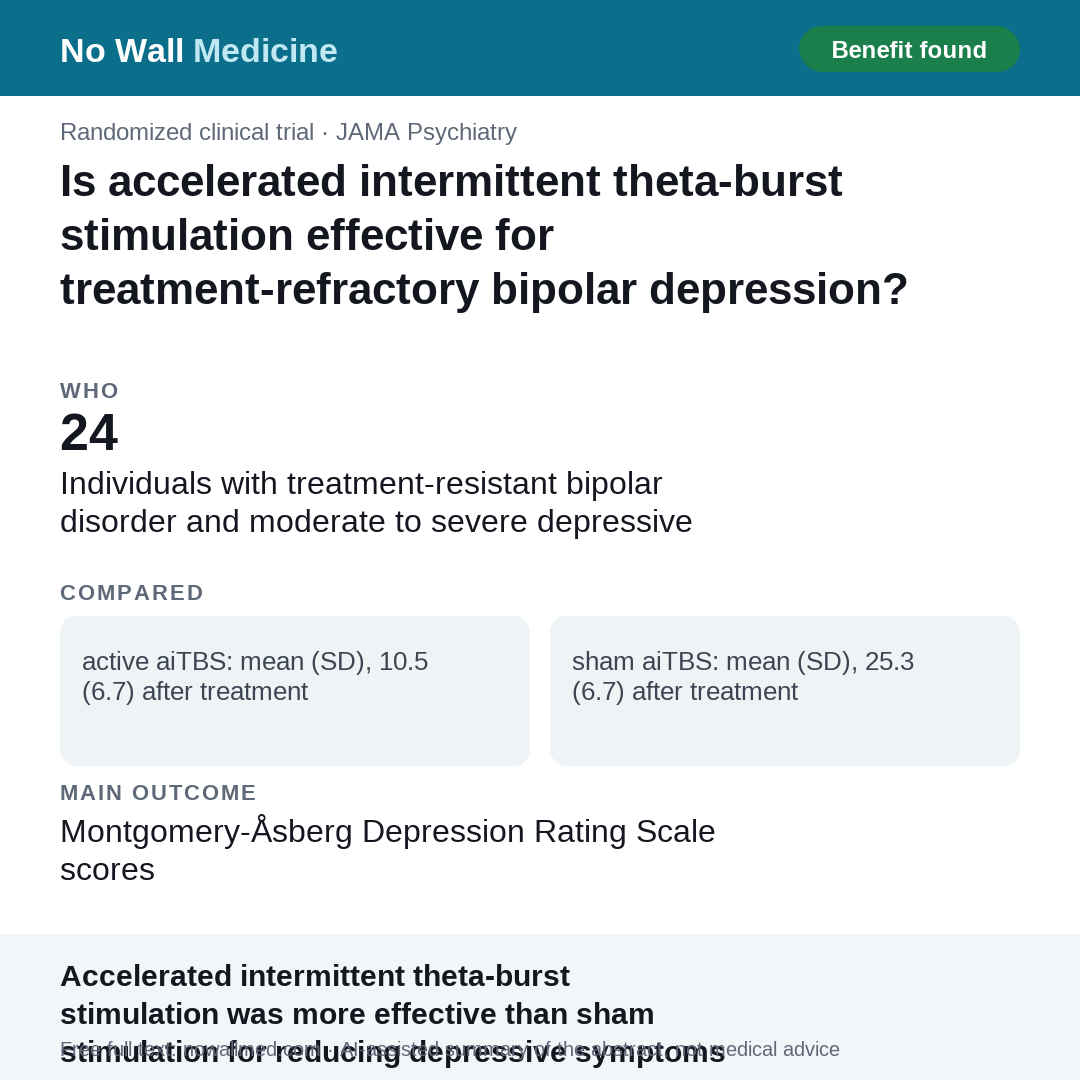
Clinical question: Is accelerated intermittent theta-burst stimulation effective for treatment-refractory bipolar depression?
Abstract
Importance
Bipolar disorder (BD) is chronic and disabling, with depression accounting for the majority of time with illness. Recent research demonstrated a transformative advance in the clinical efficacy of transcranial magnetic stimulation for treatment-resistant major depressive disorder (MDD) using an accelerated schedule of intermittent theta-burst stimulation (aiTBS), but the effectiveness of this treatment for treatment-refractory BD is unknown. Objective
To evaluate the effectiveness of aiTBS for treatment-refractory BD. Design, setting, and participants
This randomized clinical trial, conducted from March 2022 to February 2024, included individuals with treatment-resistant BD with moderate to severe depressive episodes referred from the Penn Bipolar outpatient clinic. Included patients had 2 or more prior failed antidepressant trials by Antidepressant Treatment History Form criteria and no other primary psychiatric diagnosis, were receiving a mood stabilizer for 4 or more weeks, and had a Montgomery-Åsberg Depression Rating Scale (MADRS) score of 20 or higher. Intervention
Prior to treatment, resting-state functional magnetic resonance imaging was used to compute personalized left dorsolateral prefrontal cortex target by connectivity to subgenual anterior cingulate cortex. Patients were randomized 1:1 to 10 sessions per day of imaging-guided active or sham aiTBS for 5 days with 1 session per hour at 90% resting motor threshold for 90 000 pulses total. Main outcome and measures
The main outcome was repeated MADRS scores before and after treatment. Results
A total of 24 participants (12 [50%] female; 12 [50%] male; mean [SD] age, 43.3 [16.9] years) were randomized to active (n = 12) or sham (n = 12) aiTBS. All participants completed treatment and 1-month follow-up. MADRS scores were significantly lower in the active group (mean [SD], 30.4 [4.8] at baseline; 10.5 [6.7] after treatment) than in the sham group (28.0 [5.4] at baseline; 25.3 [6.7] after treatment) at treatment end (estimated difference, -14.75; 95% CI, -19.73 to -9.77; P < .001; Cohen d, -2.19). Conclusion and relevance
In this randomized clinical trial, aiTBS was more effective than sham stimulation for depressive symptom reduction in patients with treatment-resistant BD. Further trials are needed to determine aiTBS durability and to compare with other treatments. Trial registration
ClinicalTrials.gov Identifier: NCT05228457.
Topics
Cite this article
Sheline YI, Makhoul W, Batzdorf AS, Nitchie FJ, Lynch KG, Cash R. Accelerated Intermittent Theta-Burst Stimulation and Treatment-Refractory Bipolar Depression: A Randomized Clinical Trial. JAMA Psychiatry. 2024. doi:10.1001/jamapsychiatry.2024.1787
Spotted a mistake? Suggest a correction
Top studies every Monday
The week’s key trials and guidelines in your specialties, plus any topics you follow. By email, free.
Get the weekly digest