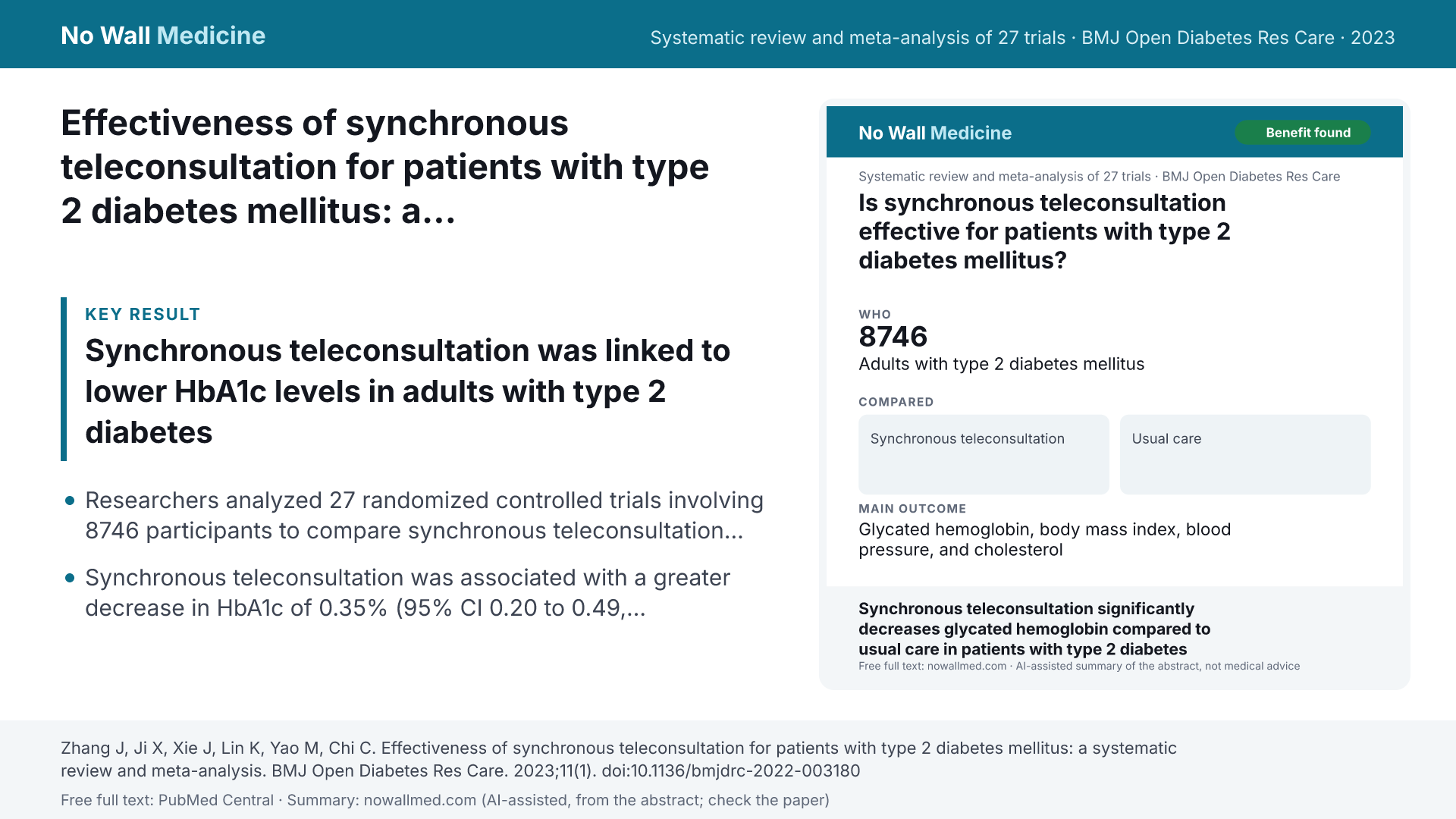
Synchronous teleconsultation was linked to lower HbA1c levels in adults with type 2 diabetes
Effectiveness of synchronous teleconsultation for patients with type 2 diabetes mellitus: a systematic review and meta-analysis
Systematic review and meta-analysis of 27 trialsBenefit found
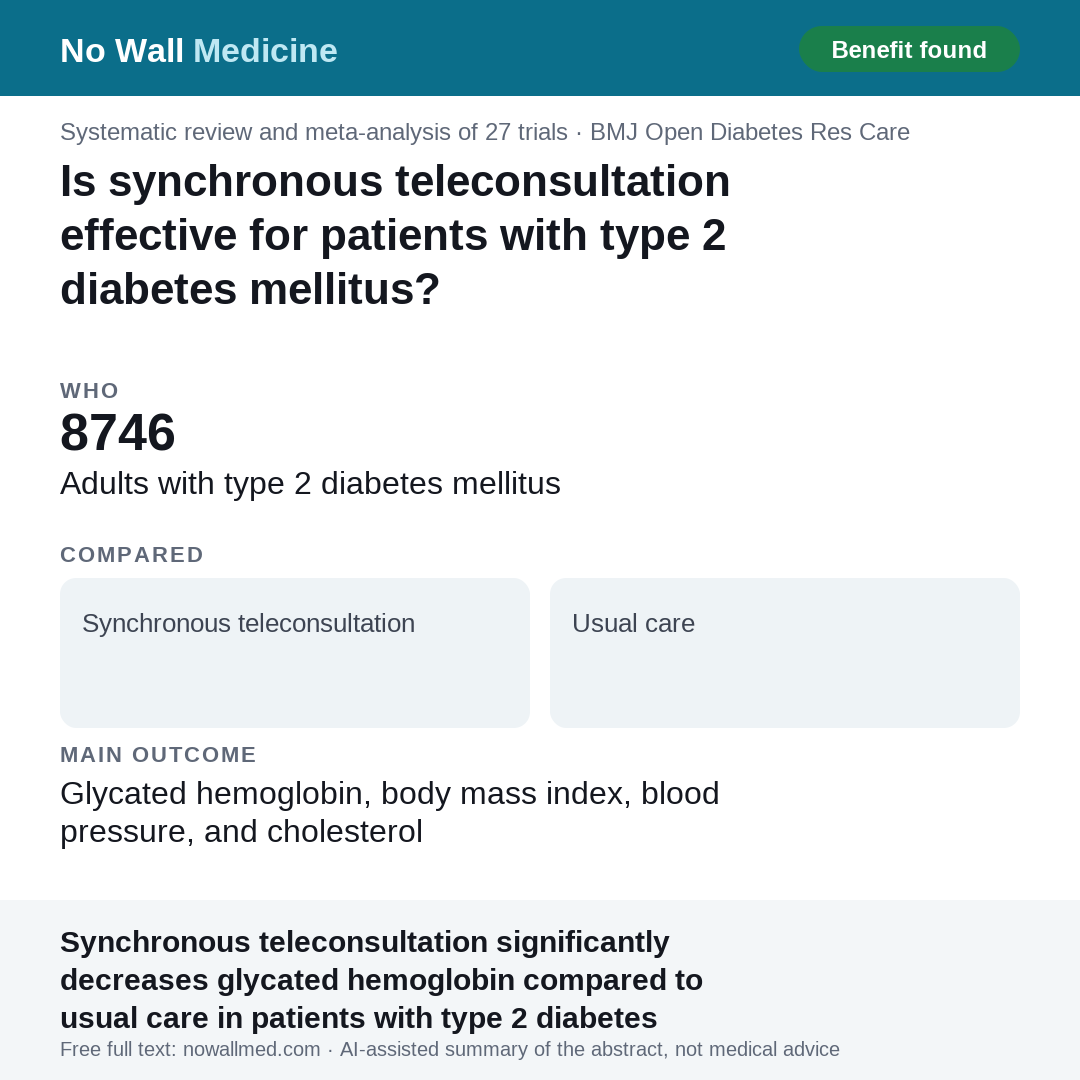
Is synchronous teleconsultation effective for patients with type 2 diabetes mellitus?
Who
8746
Adults with type 2 diabetes mellitus
Compared
Synchronous teleconsultation
Usual care
Main outcome
Glycated hemoglobin, body mass index, blood pressure, and cholesterol
Result: mean difference 0.35 (95% CI 0.20 to 0.49) for HbA1c
Bottom line: Synchronous teleconsultation significantly decreases glycated hemoglobin compared to usual care in patients with type 2 diabetes mellitus.
Limitation: The effect of teleconsultation in improving patient-reported outcomes was uncertain.
BMJ Open Diabetes Res Care · 2023-02-23Download image
Clinical question: Is synchronous teleconsultation effective for patients with type 2 diabetes mellitus?
Why it matters: Previous research did not distinguish between synchronous and asynchronous teleconsultation for managing type 2 diabetes mellitus.
Key points
- Researchers analyzed 27 randomized controlled trials involving 8746 participants to compare synchronous teleconsultation with usual care for type 2 diabetes.
- Synchronous teleconsultation was associated with a greater decrease in HbA1c of 0.35% (95% CI 0.20 to 0.49, p<0.001) compared to usual care.
- No significant effects were found for body mass index, systolic blood pressure, diastolic blood pressure, or LDL-cholesterol, and patient-reported outcomes remained uncertain.
Headline and key points written with AI from the paper’s abstract, with every number checked against it. Read the paper before relying on them.
Was this summary helpful?
Abstract
The popularity of teleconsultation during the COVID-19 pandemic enabled increased accessibility for individuals with type 2 diabetes mellitus (T2DM). However, previous studies did not distinguish between synchronous and asynchronous teleconsultation. We evaluated the effectiveness of synchronous teleconsultation for patients with T2DM. We searched Medline, Embase, Cochrane Central Register of Controlled Trials, Cochrane Library and Cochrane Database of Systematic Reviews, ClinicalTrials.gov, and the WHO International Clinical Trials Registry Platform databases from inception to July 2021. All included studies were randomized controlled trials of synchronous teleconsultation for adults with T2DM compared with usual care. Reviewers independently extracted data and used the Cochrane tool to evaluate risk of bias. Meta-analyses were conducted using random-effects models. A pooled mean difference for both HbA1c (%) and body mass index (BMI) (kg/m2), systolic blood pressure (SBP) (mm Hg), diastolic blood pressure (DBP) (mm Hg), and low density lipoprotein cholesterol (LDL-cholesterol) (mg/dL) were calculated. Patient-reported outcomes, such as depression, medication adherence, and quality of life, were also assessed. A total of 9807 abstracts were identified and 27 trials were included. Synchronous teleconsultation significantly resulted in greater decrease in HbA1c compared with usual care group (n=8746, 0.35, 95% CI 0.20 to 0.49, I2=73%, p<0.001). No significant effects on BMI (n=699, 0.08 kg/m2, 95% CI -0.54 to 0.69), SBP (n=5512, 1.32 mm Hg, 95% CI -0.09 to 2.73), DBP (n=2898, 0.17 mm Hg, 95% CI -1.18 to 1.52), or LDL-cholesterol (n=5276, 3.21 mg/dL, 95% CI -1.75 to 8.17) were found. The effect of teleconsultation in improving patient-reported outcomes was uncertain. Thus, synchronous teleconsultation could be an alternative to usual care. Systematic review registration is PROSPERO CRD42021267019.
Abstract reproduced under the article’s CC BY NC licence.
Subject terms
Cite this article
Zhang J, Ji X, Xie J, Lin K, Yao M, Chi C. Effectiveness of synchronous teleconsultation for patients with type 2 diabetes mellitus: a systematic review and meta-analysis. BMJ Open Diabetes Res Care. 2023. doi:10.1136/bmjdrc-2022-003180
Spotted a mistake? Suggest a correction