Effectiveness of targeted post-acute interventions and follow-up services for sepsis survivors: a systematic review
Systematic reviewBenefit found
Are post-acute interventions and follow-up services effective for sepsis survivors?
Who
383,680
Sepsis survivors · High-income countries
Compared
Post-acute interventions
Usual care
Main outcome
Patient-relevant long-term outcomes
Bottom line: Post-acute interventions like care coordination and rehabilitation can improve outcomes for sepsis survivors.
Limitation: Small number of studies and potential bias from confounding, suboptimal blinding, and outcome assessment.
Crit Care · 2025-08-08Download image
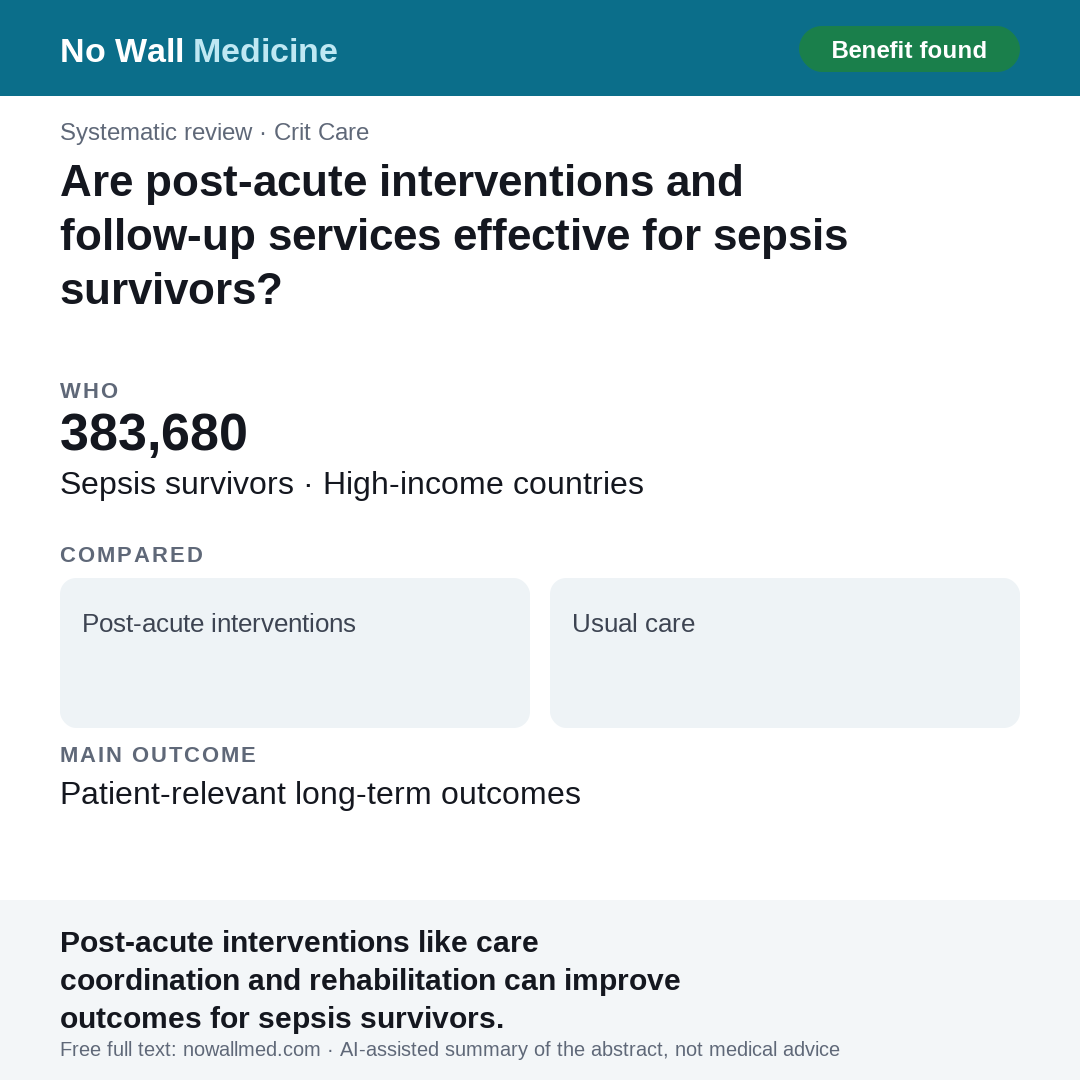
Clinical question: Are post-acute interventions and follow-up services effective for sepsis survivors?
Abstract
Background
The majority of sepsis survivors suffer from significant long-term consequences, including cognitive, psychological, and physical impairments. Despite growing recognition of these challenges, there is a lack of robust evidence regarding effective post-acute interventions to improve long-term outcomes. This systematic review aims to compile the present evidence on the effectiveness of post-acute interventions and follow-up services on patient-relevant long-term outcomes of sepsis survivors. Methods
PubMed, Web of Science and ClinicalTrials.gov were searched for relevant publications from 01/2013 until 08/2024. Studies evaluating the effect of targeted post-acute interventions and follow-up services compared to usual care were included. Risk of bias was assessed using the RoB2- and ROBINS-I tool. Results
Fourteen studies including 383,680 patients from high-income-countries were identified. All included studies showed either a moderate risk of bias (non-randomized studies) or some concerns (randomized trials), primarily due to residual confounding, suboptimal blinding and outcome assessment. Interventions varied substantially in terms of measures, implementation time and outcomes addressed. Rehabilitation interventions were associated with long-term survival benefits until 10 years after sepsis according to three observational studies. Additionally, one randomized controlled trial with minimization found that an 8-week exercise-based intervention improved the anaerobic threshold in sepsis survivors. Interventions (n = 7) targeting care coordination and follow-up bundles led to reductions in rehospitalization rates and mortality until 12 months post-discharge and were associated with improvements in long-term physical function and PTSD symptoms. An ICU-specific virtual reality-based intervention may reduce symptoms of PTSD and depression up to six months after exposure. Conclusion
Post-acute interventions, such as care coordination, bundle approaches, and rehabilitation can improve patient-relevant outcomes in sepsis survivors. However, the overall number of existing studies is small, all studies may be affected by certain forms of bias and for some domains of post-sepsis impairment no specific interventions have yet been identified. Therefore, further high-quality prospective follow-up studies are needed to strengthen the evidence regarding the effectiveness and acceptability of interventions across all domains of post-sepsis impairments, particularly cognitive impairments.
Subject terms
Cite this article
Bircak-Kuchtova B, Rose N, Geis C, Finke K, Pletz MW, Chung HY. Effectiveness of targeted post-acute interventions and follow-up services for sepsis survivors: a systematic review. Crit Care. 2025. doi:10.1186/s13054-025-05585-3
Spotted a mistake? Suggest a correction
Top studies every Monday
The week’s key trials and guidelines in your specialties, plus any topics you follow. By email, free.
Get the weekly digest