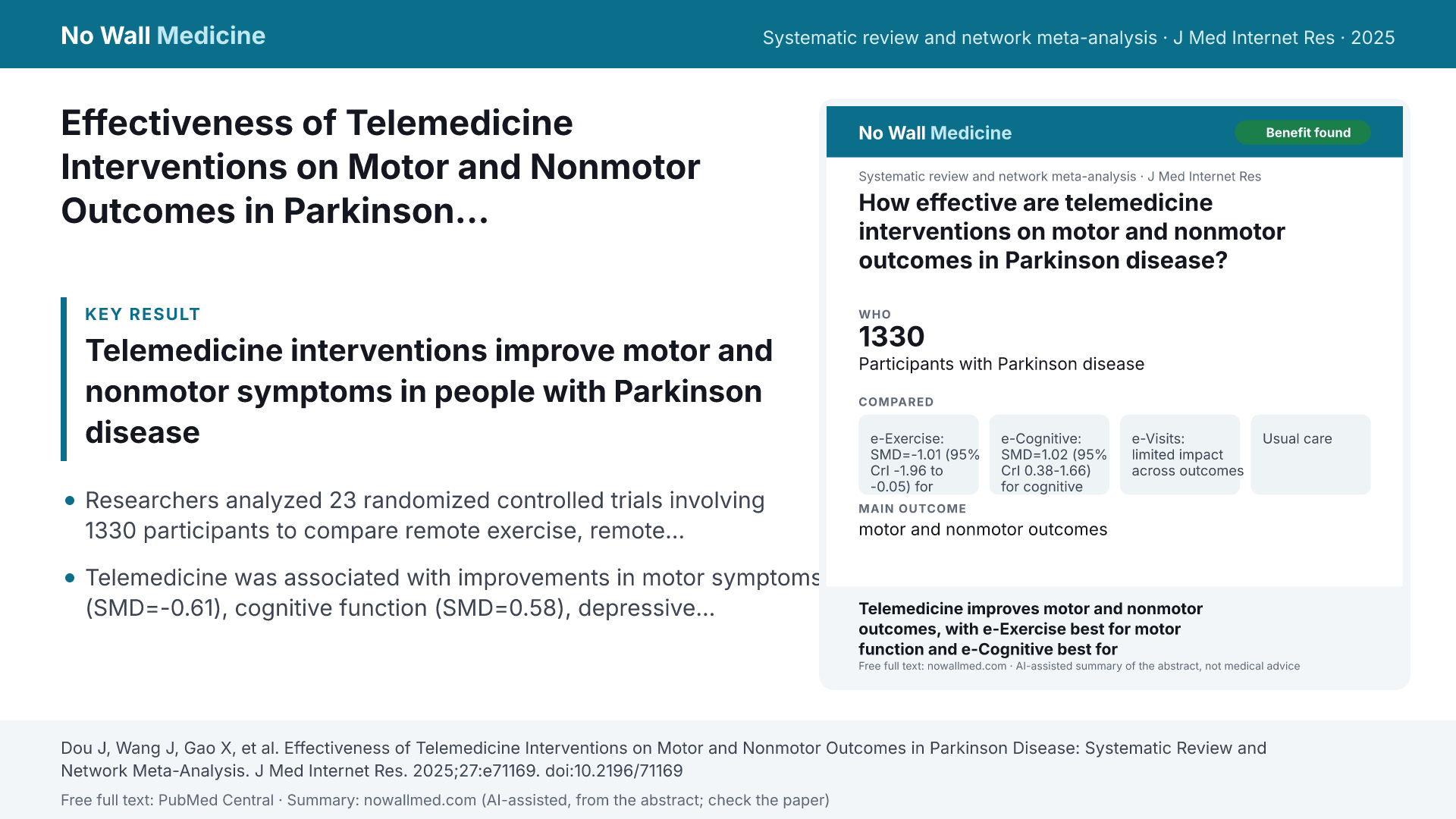
Telemedicine interventions improve motor and nonmotor symptoms in people with Parkinson disease
Effectiveness of Telemedicine Interventions on Motor and Nonmotor Outcomes in Parkinson Disease: Systematic Review and Network Meta-Analysis
Systematic review and network meta-analysisBenefit found
How effective are telemedicine interventions on motor and nonmotor outcomes in Parkinson disease?
Who
1330
Participants with Parkinson disease
Compared
e-Exercise: SMD=-1.01 (95% CrI -1.96 to -0.05) for motor symptoms
e-Cognitive: SMD=1.02 (95% CrI 0.38-1.66) for cognitive function
e-Visits: limited impact across outcomes
Usual care
Main outcome
motor and nonmotor outcomes
Bottom line: Telemedicine improves motor and nonmotor outcomes, with e-Exercise best for motor function and e-Cognitive best for psychological challenges.
Limitation: Evidence quality was low or very low for several outcomes.
J Med Internet Res · 2025-06-03 · Save PNG
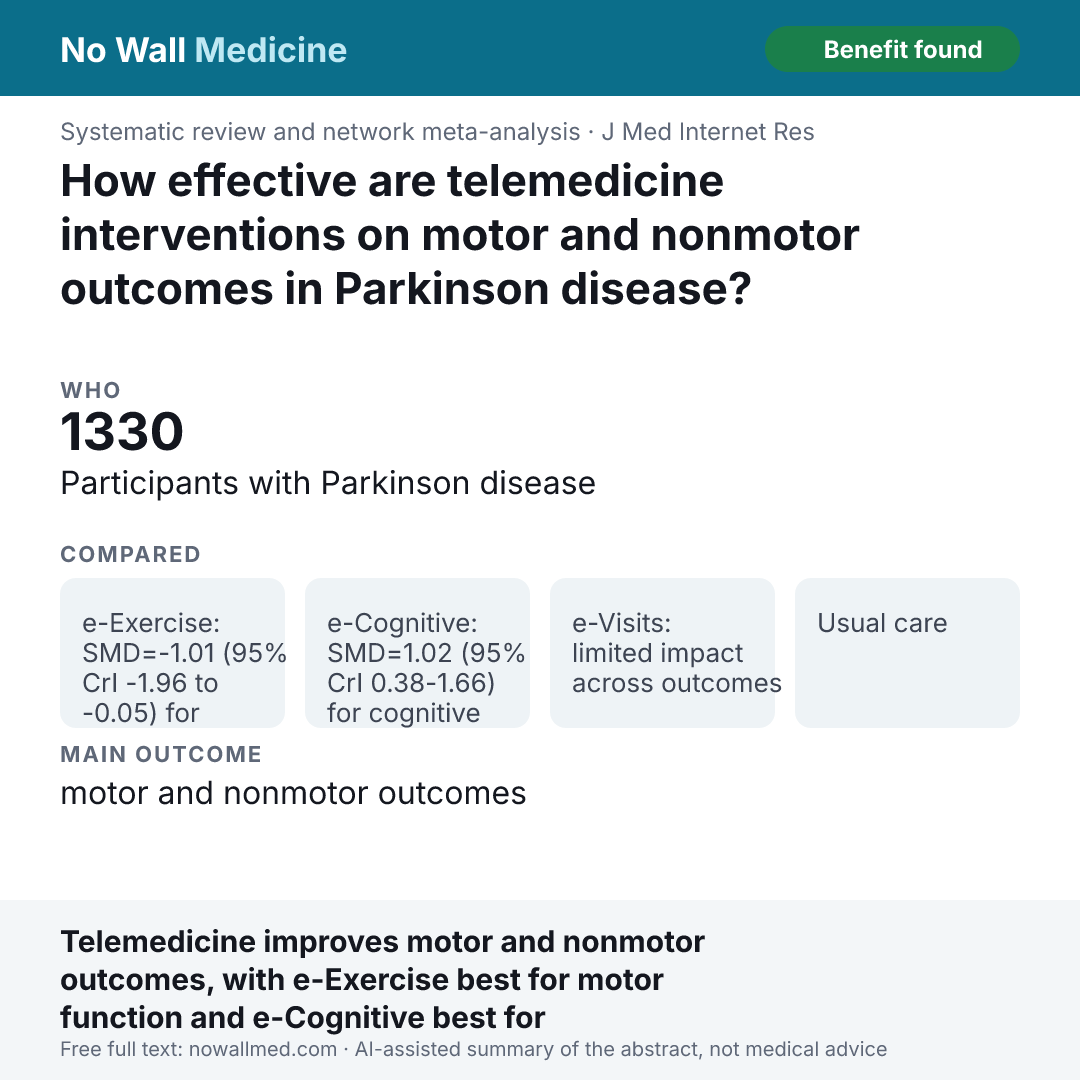
Clinical question: How effective are telemedicine interventions on motor and nonmotor outcomes in Parkinson disease?
Key points
- Researchers analyzed 23 randomized controlled trials involving 1330 participants to compare remote exercise, remote cognitive training, and remote consultations against usual care.
- Telemedicine was associated with improvements in motor symptoms (SMD=-0.61), cognitive function (SMD=0.58), depressive symptoms (SMD=-0.46), and 6-minute walk test performance (mean difference=18.98 meters).
- Remote exercise was most effective for motor symptoms and walking distance, while remote cognitive training was most effective for quality of life and psychological symptoms.
Limitation the authors note: The quality of evidence was low or very low for several outcomes including anxiety, fear of falling, walking velocity, balance, and timed up and go tests.
Headline and key points written with AI from the paper’s abstract, with every number checked against it. Read the paper before relying on them.
Was this summary helpful?
Subject terms
Headline, design, result, key points, caveat and citation as plain text.
Cite this article
Dou J, Wang J, Gao X, et al. Effectiveness of Telemedicine Interventions on Motor and Nonmotor Outcomes in Parkinson Disease: Systematic Review and Network Meta-Analysis. J Med Internet Res. 2025;27:e71169. doi:10.2196/71169
Spotted a mistake? Suggest a correction