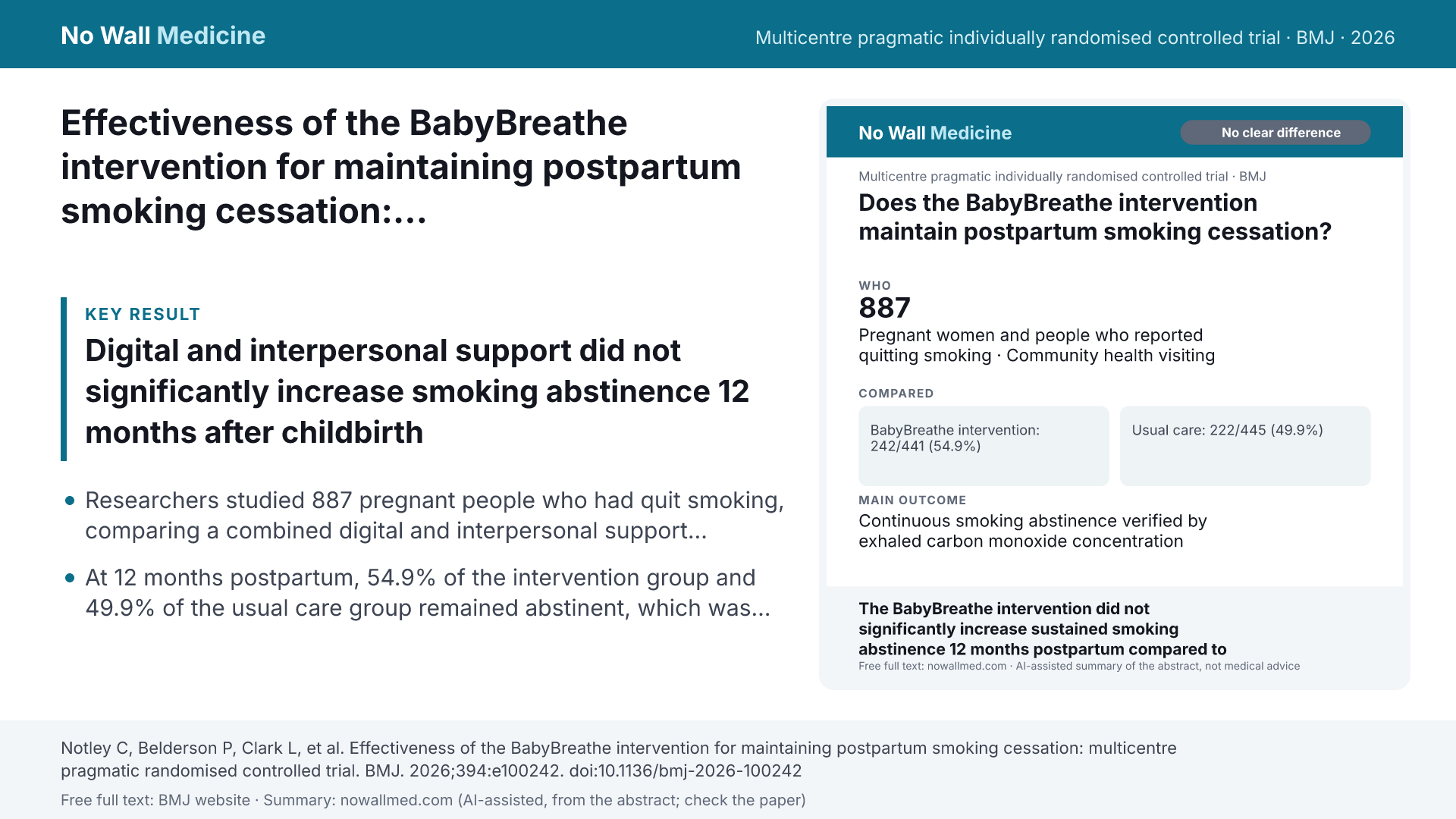
Digital and interpersonal support did not significantly increase smoking abstinence 12 months after childbirth
Effectiveness of the BabyBreathe intervention for maintaining postpartum smoking cessation: multicentre pragmatic randomised controlled trial
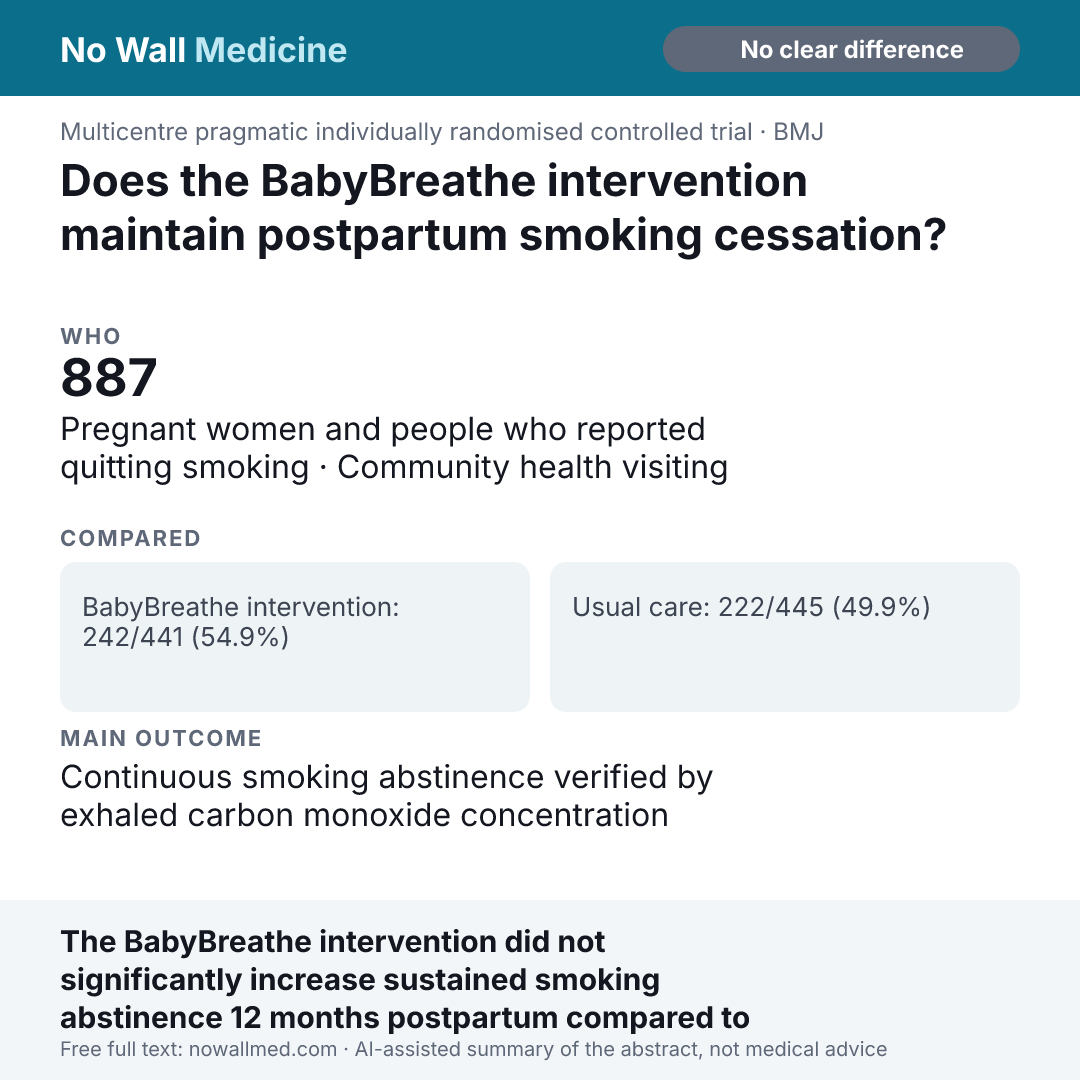
Multicentre pragmatic individually randomised controlled trialNo clear difference
Does the BabyBreathe intervention maintain postpartum smoking cessation?
Who
887
Pregnant women and people who reported quitting smoking · Community health visiting services in the UK
Compared
BabyBreathe intervention: 242/441 (54.9%)
Usual care: 222/445 (49.9%)
Main outcome
Continuous smoking abstinence verified by exhaled carbon monoxide concentration
Result: odds ratio 1.23, 95% confidence interval (CI) 0.94 to 1.60
Bottom line: The BabyBreathe intervention did not significantly increase sustained smoking abstinence 12 months postpartum compared to usual care.
BMJ · 2026-08-18 · ISRCTN70307341
Headline and visual abstract written with AI from the paper’s abstract, with every number checked against it. Read the paper before relying on them.
Was this summary helpful?
Abstract
Objective
To assess the effectiveness of an interpersonal and digital intervention, BabyBreathe, for maintaining postpartum smoking cessation. Design
Multicentre pragmatic individually randomised controlled trial. Setting
Community health visiting services in the UK. Participants
887 pregnant women and people who reported quitting smoking in the 12 months before, or during, pregnancy, with abstinence verified by exhaled carbon monoxide readings. A secure web based randomisation sequence, stratified by recruitment hub, partner smoking status, and quit timing (before or during pregnancy), was used to randomise participants (1:1) to receive the intervention or usual care. The trial was unblinded. Intervention
BabyBreathe comprised in-person or remote smoking cessation maintenance interpersonal support at 28-32 weeks' gestation and 10-14 days post partum. The BabyBreathe box, posted at the time of birth notification, contained theory driven advice for cessation maintenance, a sample of nicotine replacement gum, and motivational tools. Tailored motivational and educational text messages were provided. A website and app provided tailored cessation maintenance advice, social support, motivational tools, and gamification. Control was usual postpartum care. Main outcome measure
The primary outcome was continuous smoking abstinence, verified by exhaled carbon monoxide concentration (≤7 parts per million (ppm)) 12 months post partum. Results
Between 4 September 2021 and 3 August 2023, 887 participants were randomised: 442 to receive BabyBreathe and 445 to receive usual care. After one post-randomisation exclusion, 886 participants were included in an intention-to-treat analysis. The group difference in smoking abstinence at 12 months post partum was not significant (BabyBreathe 242/441 (54.9%) v usual care 222/445 (49.9%); odds ratio 1.23, 95% confidence interval (CI) 0.94 to 1.60, P=0.13, risk difference 4.8% (-1.7% to 11.2%), and number needed to treat (NNT) 21 (NNT to benefit 8.9 to ∞) and NNT to harm 59). A post hoc per protocol analysis favoured the intervention (BabyBreathe 200/347 (57.6%) v usual care 222/445 (49.9%); adjusted odds ratio 1.36, 95% CI 1.02 to 1.81, P=0.04), risk difference 7.2% (0.3% to 14.1%), and NNT 13.9 (7.1 to 333.3). No trial related adverse incidents occurred. Conclusions
BabyBreathe did not statistically significantly increase sustained smoking abstinence post partum for people who quit smoking in pregnancy. A post hoc per protocol analysis, including only those who received interpersonal support as intended, showed statistically significantly greater benefit from BabyBreathe over usual care. A focus on fidelity and further targeting of BabyBreathe to groups with lower socioeconomic status may be warranted. Trial registration
ISRCTN Registry ISRCTN70307341.
Abstract reproduced under the article’s CC BY licence.
Subject terms
Cite this article
Notley C, Belderson P, Clark L, et al. Effectiveness of the BabyBreathe intervention for maintaining postpartum smoking cessation: multicentre pragmatic randomised controlled trial. BMJ. 2026;394:e100242. doi:10.1136/bmj-2026-100242
Spotted a mistake? Suggest a correction