Parenting programme in Kenya improved family well-being but not overall child development
Effectiveness of the Moments that Matter parenting programme on caregiving practices, family violence, mental health and early child development in Kenya: a cluster-randomised controlled trial
Cluster-randomised controlled trialMixed results
Does the Moments that Matter parenting programme improve child development and caregiving outcomes?
Who
595
Primary caregivers of children aged 0-18 months · Two counties in western Kenya
Compared
Moments that Matter programme
Standard-of-care waitlist control
Main outcome
Child development measured using Caregiver Reported Early Development Instruments
Bottom line: The programme improved multiple caregiving and family well-being outcomes but did not improve overall child development.
Limitation: Treatment heterogeneity by county was observed in exploratory subgroup analyses.
BMJ Glob Health · 2026-08-05Download image
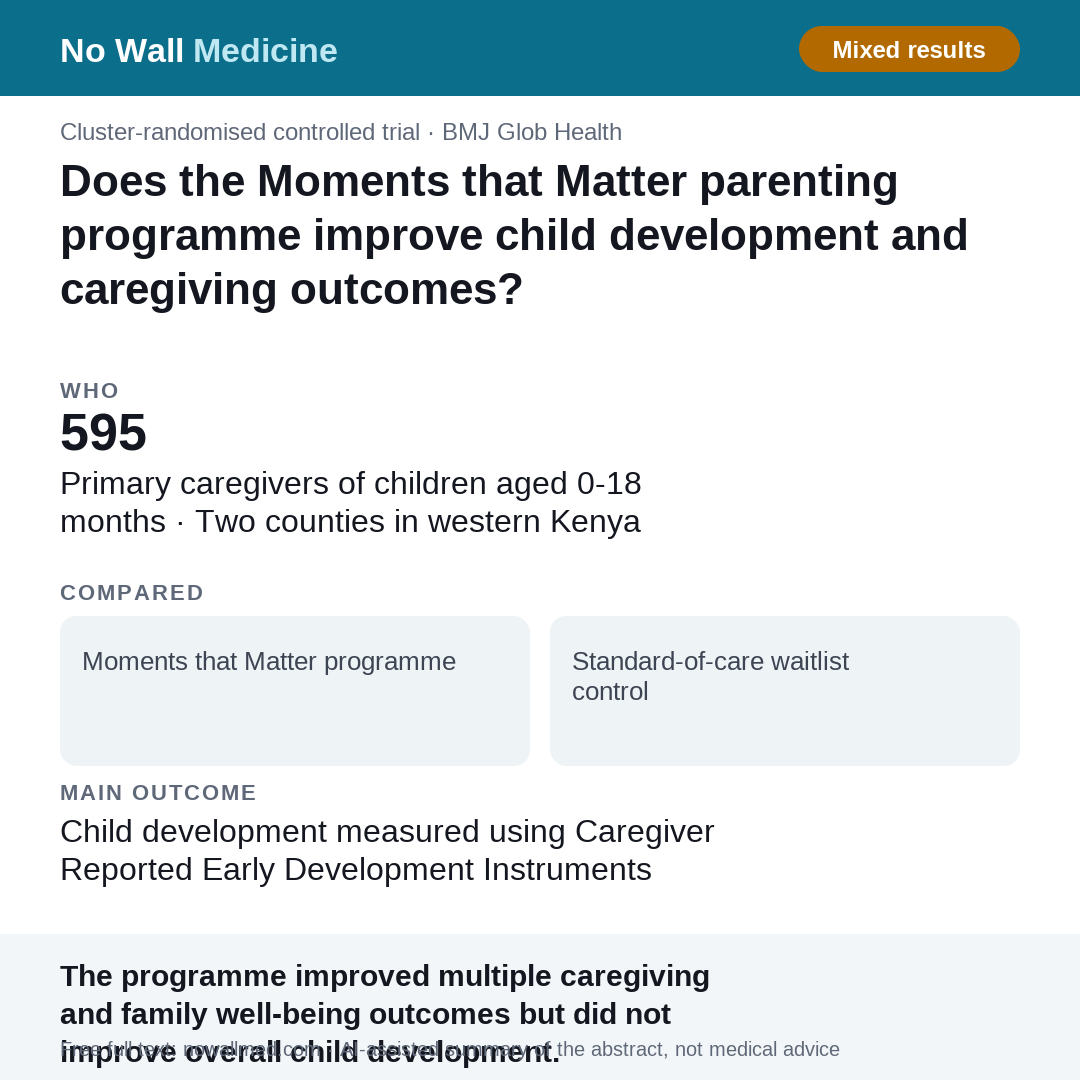
Clinical question: Does the Moments that Matter parenting programme improve child development and caregiving outcomes?
Why it matters: Rigorous evidence remains limited regarding the effectiveness of parenting programmes that use multiple community-based delivery platforms in sub-Saharan Africa.
Key points
- Researchers studied 595 caregiver-child dyads in 46 villages in western Kenya, comparing a community-based parenting programme to a standard-of-care waitlist control.
- The intervention showed no overall effects on child development, though it improved caregiver stimulation, harsh discipline, mental health, and intimate partner violence victimisation.
- Exploratory subgroup analyses showed small significant improvements in child language and socioemotional development in one county, but null effects in the other county.
Headline and key points written with AI from the paper’s abstract, with every number checked against it. Read the paper before relying on them.
Abstract
Introduction
Globally, parenting interventions have been shown to improve caregiving practices and child development. However, rigorous evidence from sub-Saharan Africa remains limited, particularly for programmes that leverage multiple community-based delivery platforms. We evaluated the effectiveness of the Moments that Matter (MTM) parenting programme delivered by community volunteers in partnership with faith leaders on child development and caregiving-related outcomes in Kenya. Methods
We conducted a cluster-randomised controlled trial in two counties in western Kenya. Villages were randomly assigned to the MTM parenting programme or a standard-of-care waitlist control, stratified by county. Eligible participants were primary caregivers of children aged 0-18 months. The intervention consisted of monthly group sessions and home visits delivered over 18 months. Caregivers were surveyed at baseline and endline. The primary outcome was child development measured using the Caregiver Reported Early Development Instruments. Intervention effects were estimated using mixed-effects models with a difference-in-differences, intention-to-treat approach. Results
Between February and March 2023, 595 caregiver-child dyads in 46 villages were enrolled and randomly assigned to the intervention (n=310) or control (n=285). At endline, there were no overall intervention effects on child development outcomes. Moderate-to-large effects were observed across multiple secondary outcomes, including caregiver stimulation, harsh discipline, caregiver mental health, social support, intimate partner violence victimisation, child dietary diversity, and male caregiver engagement, as reported by female primary caregivers. Exploratory subgroup analyses revealed treatment heterogeneity by county, with small significant improvements in child language and socioemotional development in one county but null effects in the other. Conclusions
A multicomponent parenting programme delivered in partnership between community volunteers and faith leaders improved multiple caregiving and family well-being outcomes but did not lead to overall improvements in child development. Findings highlight the potential of integrating multiple community-based platforms for delivering parenting programmes, while underscoring the need for implementation research to enhance impacts on child development at scale. Trial registration number
NCT05796934.
Abstract reproduced under the article’s CC BY NC licence.
Topics
Cite this article
Jeong J, McCann JK, Hadd AR, Ochuka W, Ochieng M. Effectiveness of the Moments that Matter parenting programme on caregiving practices, family violence, mental health and early child development in Kenya: a cluster-randomised controlled trial. BMJ Glob Health. 2026. doi:10.1136/bmjgh-2025-023335
Spotted a mistake? Suggest a correction