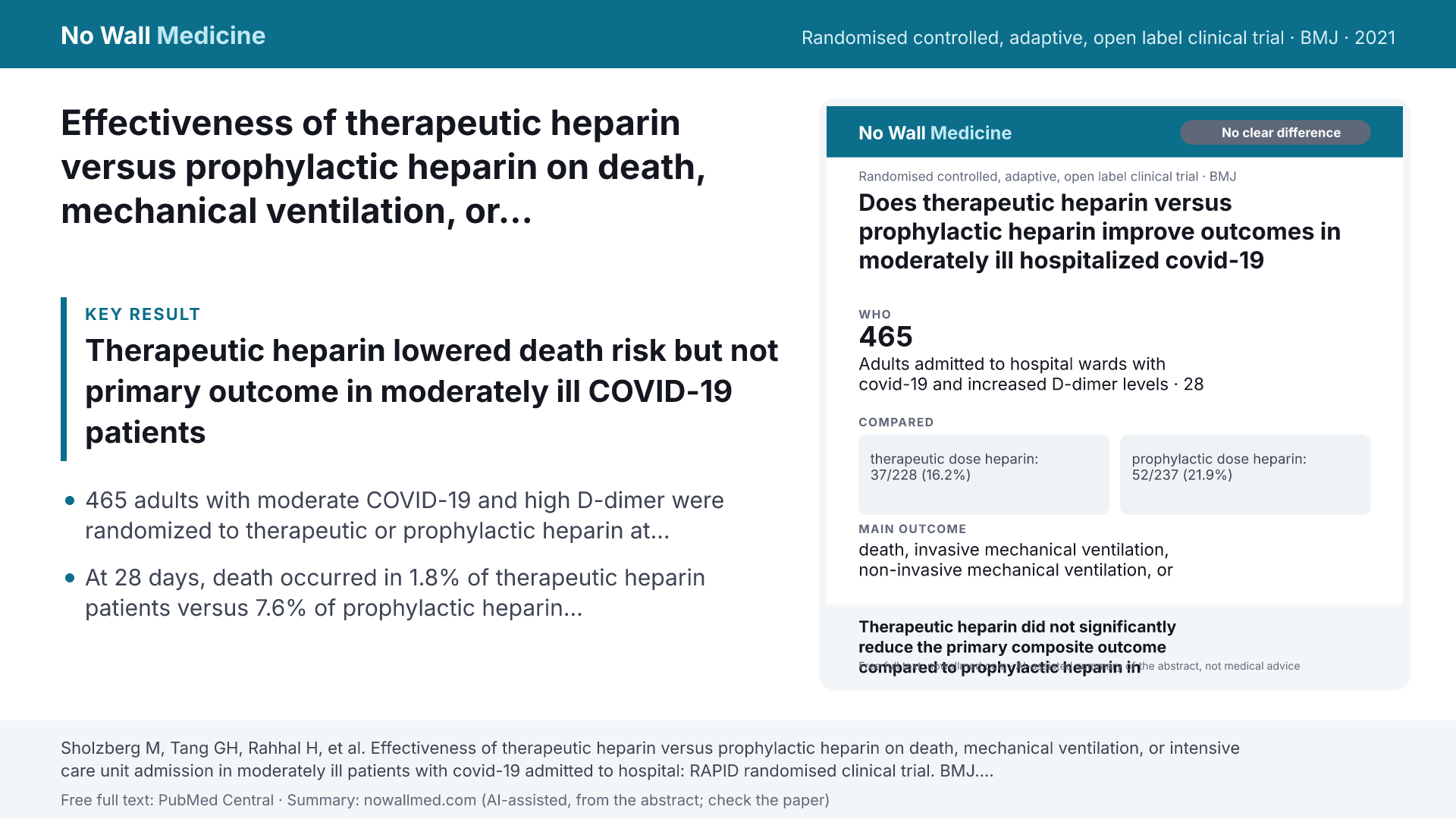
Therapeutic heparin lowered death risk but not primary outcome in moderately ill COVID-19 patients
Effectiveness of therapeutic heparin versus prophylactic heparin on death, mechanical ventilation, or intensive care unit admission in moderately ill patients with covid-19 admitted to hospital: RAPID randomised clinical trial
Randomised controlled, adaptive, open label clinical trialNo clear difference
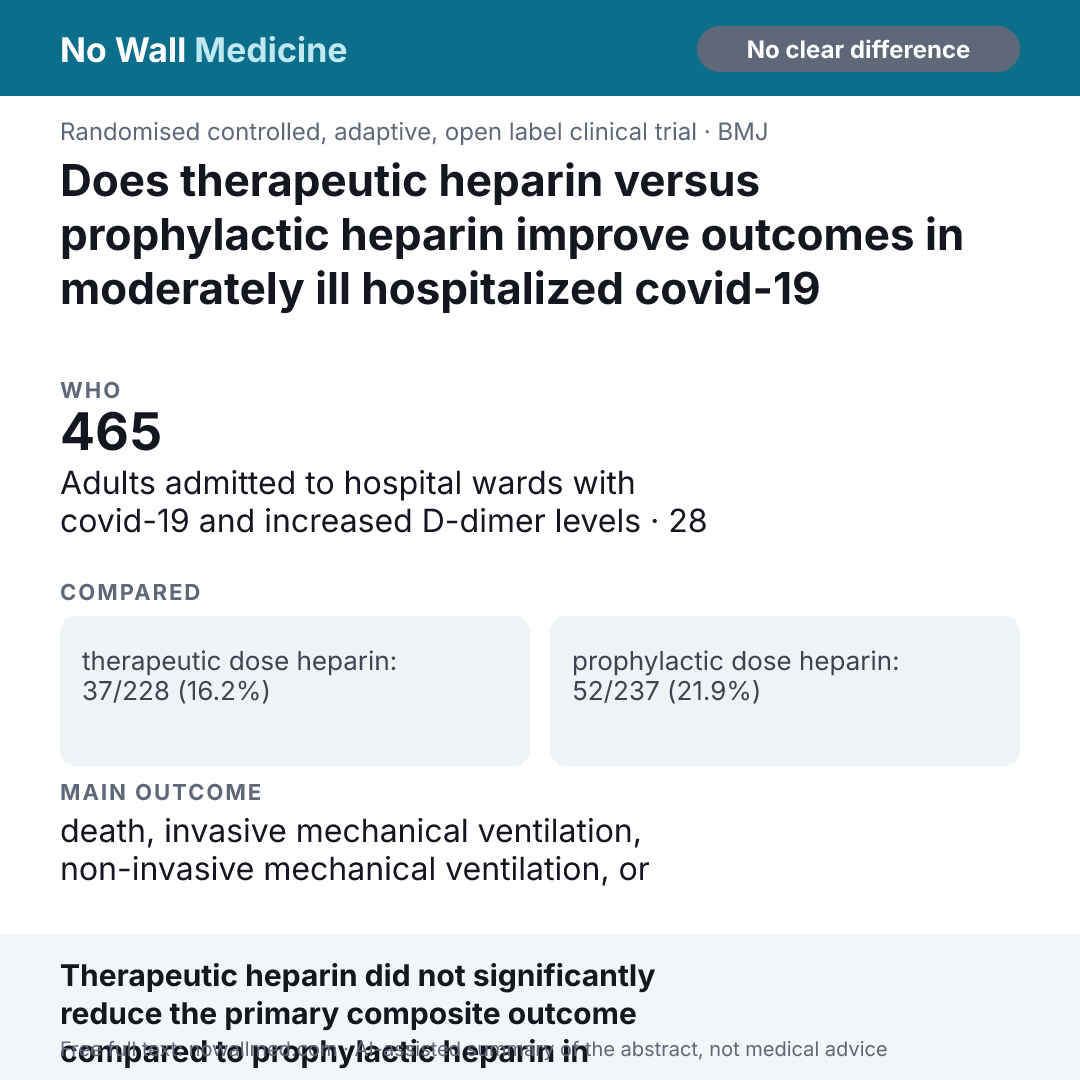
Does therapeutic heparin versus prophylactic heparin improve outcomes in moderately ill hospitalized covid-19 patients?
Who
465
Adults admitted to hospital wards with covid-19 and increased D-dimer levels · 28 hospitals in six countries
Compared
therapeutic dose heparin: 37/228 (16.2%)
prophylactic dose heparin: 52/237 (21.9%)
Main outcome
death, invasive mechanical ventilation, non-invasive mechanical ventilation, or intensive care unit admission
Result: odds ratio 0.69, 95% confidence interval 0.43 to 1.10
Bottom line: Therapeutic heparin did not significantly reduce the primary composite outcome compared to prophylactic heparin in moderately ill covid-19 patients.
BMJ · 2021-10-14 · Save PNG
Clinical question: Does therapeutic heparin versus prophylactic heparin improve outcomes in moderately ill hospitalized covid-19 patients?
Key points
- 465 adults with moderate COVID-19 and high D-dimer were randomized to therapeutic or prophylactic heparin at 28 hospitals.
- At 28 days, death occurred in 1.8% of therapeutic heparin patients versus 7.6% of prophylactic heparin patients (P=0.006).
- The primary composite of death, ventilation, or ICU admission was not significantly different between the two groups (P=0.12).
Headline and key points written with AI from the paper’s abstract, with every number checked against it. Read the paper before relying on them.
Was this summary helpful?
Abstract
Objective
To evaluate the effects of therapeutic heparin compared with prophylactic heparin among moderately ill patients with covid-19 admitted to hospital wards. Design
Randomised controlled, adaptive, open label clinical trial. Setting
28 hospitals in Brazil, Canada, Ireland, Saudi Arabia, United Arab Emirates, and US. Participants
465 adults admitted to hospital wards with covid-19 and increased D-dimer levels were recruited between 29 May 2020 and 12 April 2021 and were randomly assigned to therapeutic dose heparin (n=228) or prophylactic dose heparin (n=237). Interventions
Therapeutic dose or prophylactic dose heparin (low molecular weight or unfractionated heparin), to be continued until hospital discharge, day 28, or death. Main outcome measures
The primary outcome was a composite of death, invasive mechanical ventilation, non-invasive mechanical ventilation, or admission to an intensive care unit, assessed up to 28 days. The secondary outcomes included all cause death, the composite of all cause death or any mechanical ventilation, and venous thromboembolism. Safety outcomes included major bleeding. Outcomes were blindly adjudicated. Results
The mean age of participants was 60 years; 264 (56.8%) were men and the mean body mass index was 30.3 kg/m2. At 28 days, the primary composite outcome had occurred in 37/228 patients (16.2%) assigned to therapeutic heparin and 52/237 (21.9%) assigned to prophylactic heparin (odds ratio 0.69, 95% confidence interval 0.43 to 1.10; P=0.12). Deaths occurred in four patients (1.8%) assigned to therapeutic heparin and 18 patients (7.6%) assigned to prophylactic heparin (0.22, 0.07 to 0.65; P=0.006). The composite of all cause death or any mechanical ventilation occurred in 23 patients (10.1%) assigned to therapeutic heparin and 38 (16.0%) assigned to prophylactic heparin (0.59, 0.34 to 1.02; P=0.06). Venous thromboembolism occurred in two patients (0.9%) assigned to therapeutic heparin and six (2.5%) assigned to prophylactic heparin (0.34, 0.07 to 1.71; P=0.19). Major bleeding occurred in two patients (0.9%) assigned to therapeutic heparin and four (1.7%) assigned to prophylactic heparin (0.52, 0.09 to 2.85; P=0.69). Conclusions
In moderately ill patients with covid-19 and increased D-dimer levels admitted to hospital wards, therapeutic heparin was not significantly associated with a reduction in the primary outcome but the odds of death at 28 days was decreased. The risk of major bleeding appeared low in this trial. Trial registration
ClinicalTrials.gov NCT04362085.
Abstract reproduced under the article’s CC BY NC licence.
Subject terms
Headline, design, result, key points, caveat and citation as plain text.
Cite this article
Sholzberg M, Tang GH, Rahhal H, et al. Effectiveness of therapeutic heparin versus prophylactic heparin on death, mechanical ventilation, or intensive care unit admission in moderately ill patients with covid-19 admitted to hospital: RAPID randomised clinical trial. BMJ. 2021;375:n2400. doi:10.1136/bmj.n2400
Spotted a mistake? Suggest a correction