Two different systems-level interventions were equally effective at reducing perinatal depression symptoms
Effectiveness of two systems-level interventions to address perinatal depression in obstetric settings (PRISM): an active-controlled cluster-randomised trial
Cluster-randomised, active-controlled trialNo clear difference
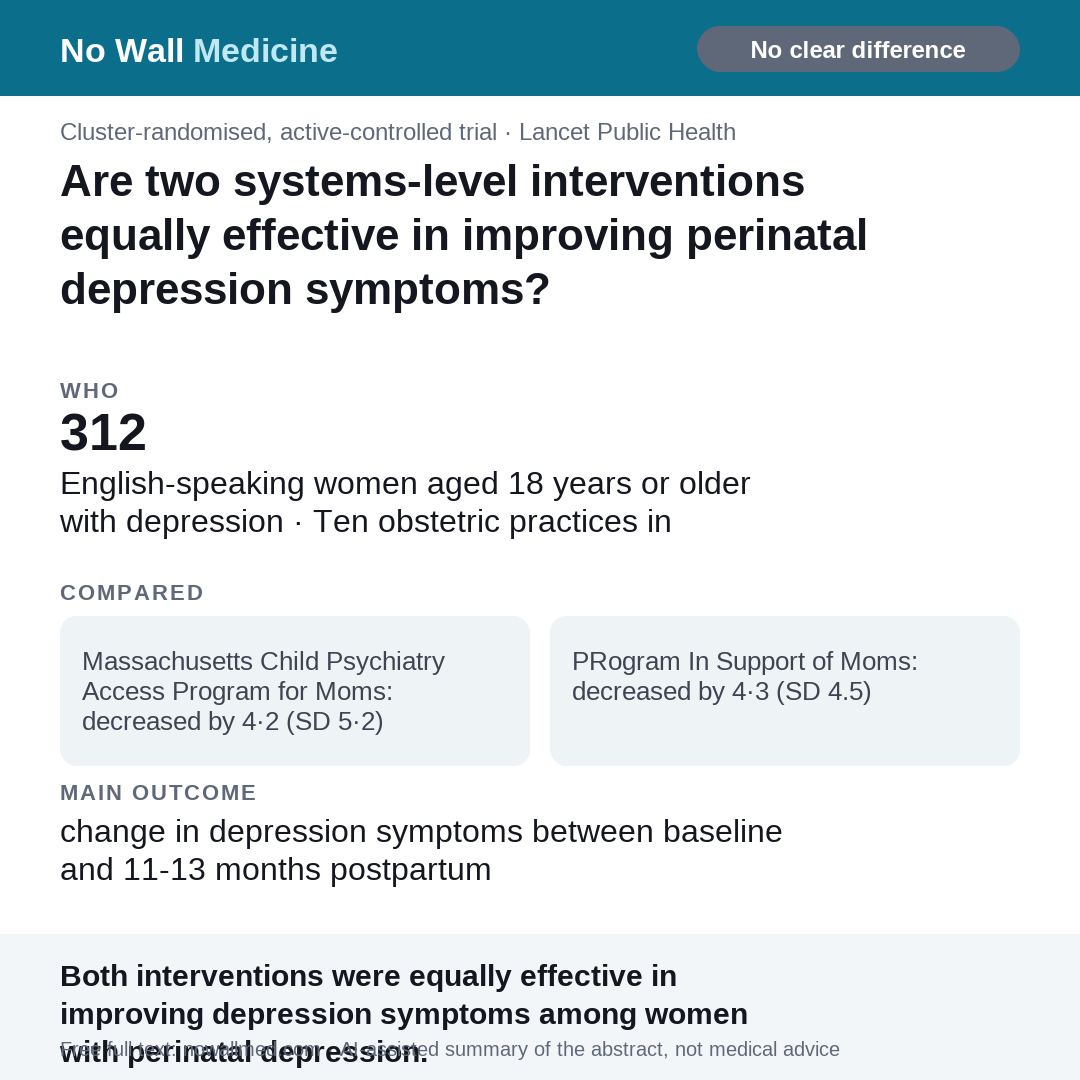
Are two systems-level interventions equally effective in improving perinatal depression symptoms?
Who
312
English-speaking women aged 18 years or older with depression · Ten obstetric practices in Massachusetts, United States
Compared
Massachusetts Child Psychiatry Access Program for Moms: decreased by 4·2 (SD 5·2)
PRogram In Support of Moms: decreased by 4·3 (SD 4.5)
Main outcome
change in depression symptoms between baseline and 11-13 months postpartum
Result: estimated difference 0·1 (95% CI -1·2 to 1·4)
Bottom line: Both interventions were equally effective in improving depression symptoms among women with perinatal depression.
Funded by: US Centers for Disease Control and Prevention
Lancet Public Health · 2024-01-05Download image
Clinical question: Are two systems-level interventions equally effective in improving perinatal depression symptoms?
Why it matters: It was unknown whether adding intensive implementation support to a state-wide program would improve depression symptom reduction compared to the existing population-based program.
Key points
- The study compared 312 women recruited from ten obstetric practices using either the Massachusetts Child Psychiatry Access Program for Moms or the PRogram In Support of Moms.
- Depression scores decreased by 4.2 (SD 5.2) in the Massachusetts Child Psychiatry Access Program for Moms group and by 4.3 (SD 4.5) in the PRogram In Support of Moms group.
- The estimated difference in symptom reduction between the two intervention groups was 0.1 (95% CI -1.2 to 1.4) with a p-value of 0.87.
Headline and key points written with AI from the paper’s abstract, with every number checked against it. Read the paper before relying on them.
Was this summary helpful?
Abstract
Background
Perinatal depression is a common and undertreated condition, with potential deleterious effects on maternal, obstetric, infant, and child outcomes. We aimed to compare the effectiveness of two systems-level interventions in the obstetric setting-the Massachusetts Child Psychiatry Access Program (MCPAP) for Moms and the PRogram In Support of Moms (PRISM)-in improving depression symptoms and participation in mental health treatment among women with perinatal depression. Methods
In this cluster-randomised, active-controlled trial, obstetric practices across Massachusetts (USA) were allocated (1:1) via covariate adaptive randomisation to either continue participating in the MCPAP for Moms intervention, a state-wide, population-based programme, or to participate in the PRISM intervention, which involved MCPAP for Moms plus a proactive, multifaceted, obstetric practice-level intervention with intensive implementation support. English-speaking women (aged ≥18 years) who screened positive for depression (Edinburgh Postnatal Depression Scale [EPDS] score ≥10) were recruited from the practices. Patients were followed up at 4-25 weeks of gestation, 32-40 weeks of gestation, 0-3 months postpartum, 5-7 months postpartum, and 11-13 months postpartum via telephone interview. Participants were masked to the intervention; investigators were not masked. The primary outcome was change in depression symptoms (EPDS score) between baseline assessment and 11-13 months postpartum. Analysis was done by intention to treat, fitting generalised linear mixed models adjusting for age, insurance status, education, and race, and accounting for clustering of patients within practices. This trial is registered with ClinicalTrials.gov, NCT02760004. Findings
Between July 29, 2015, and Sept 20, 2021, ten obstetric practices were recruited and retained; five (50%) practices were randomly allocated to MCPAP for Moms and five (50%) to PRISM. 1265 participants were assessed for eligibility and 312 (24·7%) were recruited, of whom 162 (51·9%) were enrolled in MCPAP for Moms practices and 150 (48·1%) in PRISM practices. Comparing baseline to 11-13 months postpartum, EPDS scores decreased by 4·2 (SD 5·2; p<0·0001) among participants in MCPAP for Moms practices and by 4·3 (SD 4.5; p<0·0001) among those in PRISM practices (estimated difference between groups 0·1 [95% CI -1·2 to 1·4]; p=0·87). Interpretation
Both the MCPAP for Moms and PRISM interventions were equally effective in improving depression symptoms. This finding is important because the 4-point decrease in EPDS score is clinically significant, and MCPAP for Moms has a lower intensity and greater population-based reach than does PRISM. Funding
US Centers for Disease Control and Prevention.
Abstract reproduced under the article’s CC BY NC ND licence.
Subject terms
Cite this article
Byatt N, Brenckle L, Sankaran P, Flahive J, Ko JY, Robbins CL. Effectiveness of two systems-level interventions to address perinatal depression in obstetric settings (PRISM): an active-controlled cluster-randomised trial. Lancet Public Health. 2024. doi:10.1016/S2468-2667(23)00268-2
Spotted a mistake? Suggest a correction
Top studies every Monday
The week’s key trials and guidelines in your specialties, plus any topics you follow. By email, free.
Get the weekly digest