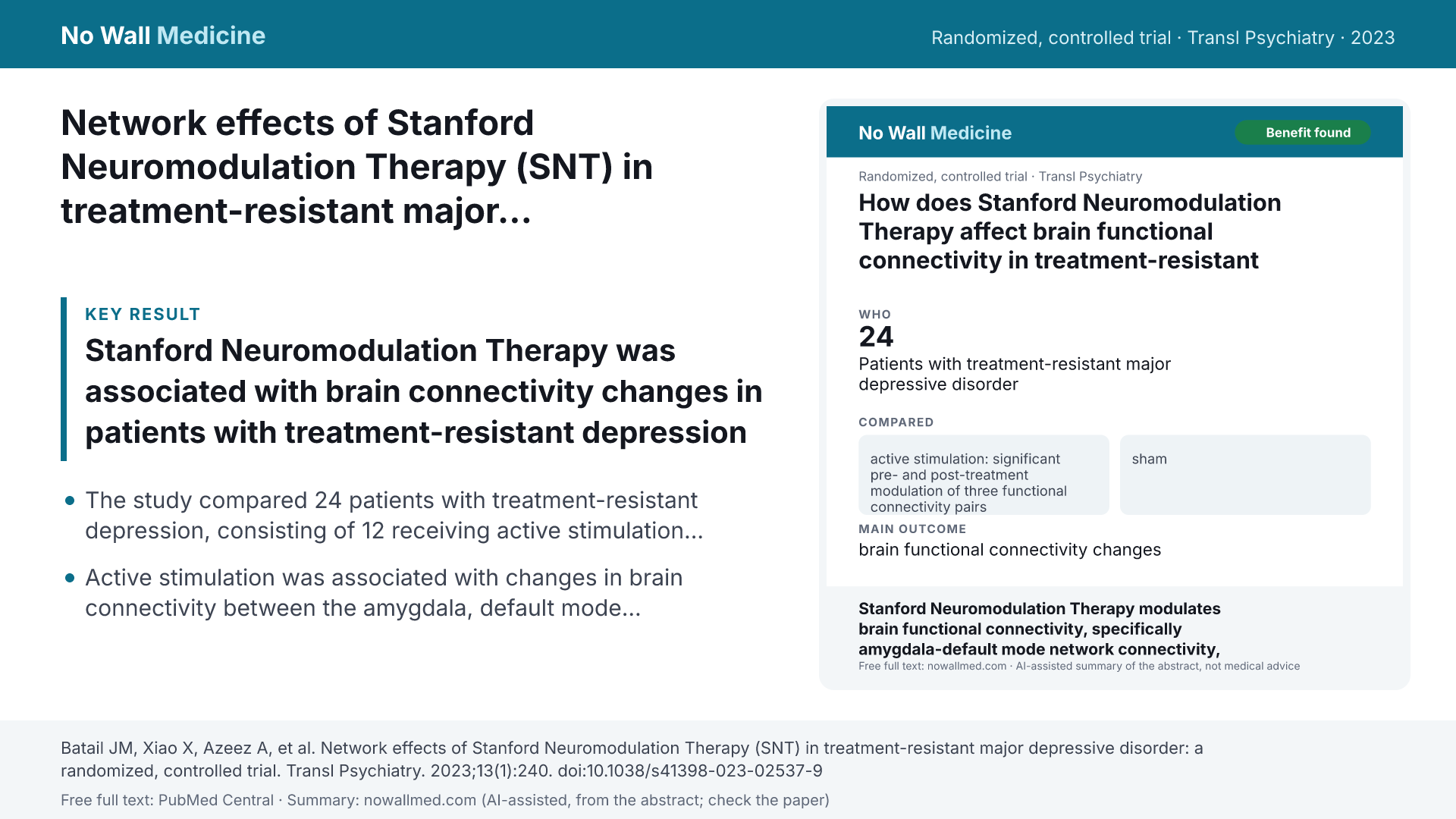
Stanford Neuromodulation Therapy was associated with brain connectivity changes in patients with treatment-resistant depression
Network effects of Stanford Neuromodulation Therapy (SNT) in treatment-resistant major depressive disorder: a randomized, controlled trial
Randomized, controlled trialBenefit found
How does Stanford Neuromodulation Therapy affect brain functional connectivity in treatment-resistant depression?
Who
24
Patients with treatment-resistant major depressive disorder
Compared
active stimulation: significant pre- and post-treatment modulation of three functional connectivity pairs
sham
Main outcome
brain functional connectivity changes
Result: group*time interaction F(1,22) = 14.89, p < 0.001
Bottom line: Stanford Neuromodulation Therapy modulates brain functional connectivity, specifically amygdala-default mode network connectivity, in treatment-resistant depression.
Transl Psychiatry · 2023-07-03 · Save PNG
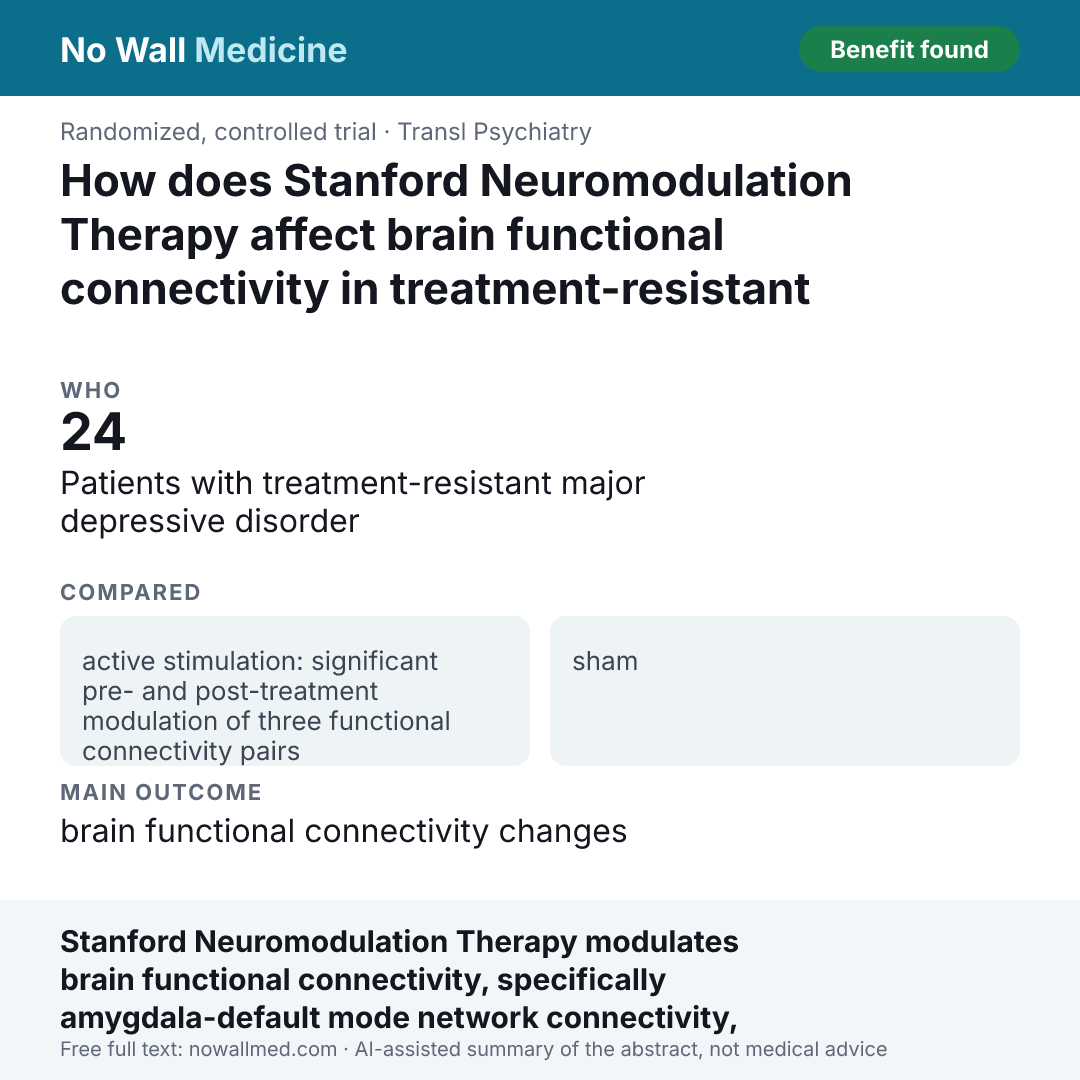
Clinical question: How does Stanford Neuromodulation Therapy affect brain functional connectivity in treatment-resistant depression?
Key points
- The study compared 24 patients with treatment-resistant depression, consisting of 12 receiving active stimulation and 12 receiving a sham or placebo stimulation.
- Active stimulation was associated with changes in brain connectivity between the amygdala, default mode network, salience network, and striatum.
- The change in connectivity between the amygdala and default mode network was associated with an improvement in depressive symptoms (rho = -0.45, p = 0.026).
Headline and key points written with AI from the paper’s abstract, with every number checked against it. Read the paper before relying on them.
Was this summary helpful?
Subject terms
Headline, design, result, key points, caveat and citation as plain text.
Cite this article
Batail JM, Xiao X, Azeez A, et al. Network effects of Stanford Neuromodulation Therapy (SNT) in treatment-resistant major depressive disorder: a randomized, controlled trial. Transl Psychiatry. 2023;13(1):240. doi:10.1038/s41398-023-02537-9
Spotted a mistake? Suggest a correction