Virtual reality supported exercise therapy improves upper extremity motor function and range of motion after stroke
Effectiveness of Using Virtual Reality-Supported Exercise Therapy for Upper Extremity Motor Rehabilitation in Patients With Stroke: Systematic Review and Meta-analysis of Randomized Controlled Trials
Systematic review and meta-analysis of randomized controlled trialsBenefit found
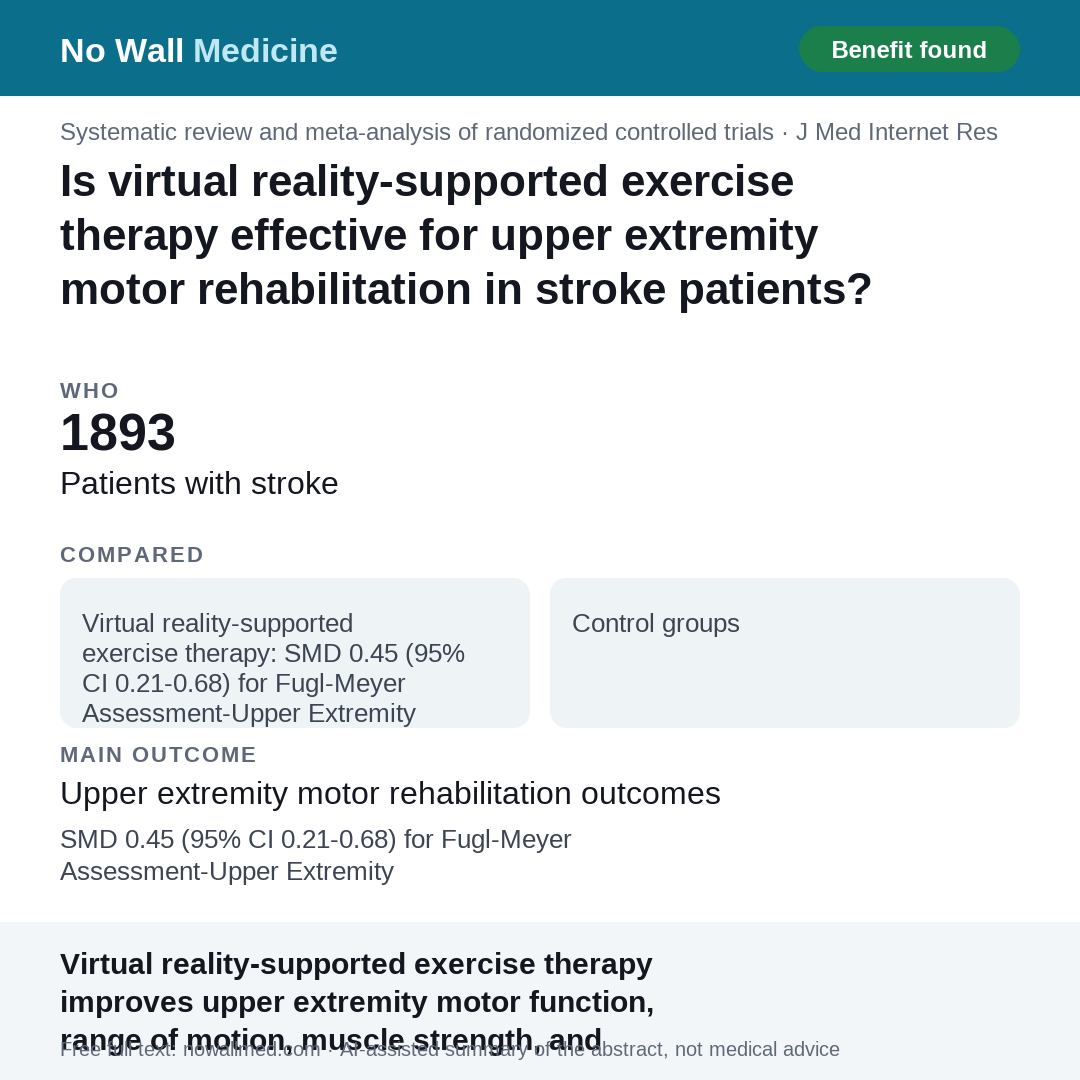
Is virtual reality-supported exercise therapy effective for upper extremity motor rehabilitation in stroke patients?
Who
1893
Patients with stroke
Compared
Virtual reality-supported exercise therapy: SMD 0.45 (95% CI 0.21-0.68) for Fugl-Meyer Assessment-Upper Extremity
Control groups
Main outcome
Upper extremity motor rehabilitation outcomes
Result: SMD 0.45 (95% CI 0.21-0.68) for Fugl-Meyer Assessment-Upper Extremity
Bottom line: Virtual reality-supported exercise therapy improves upper extremity motor function, range of motion, muscle strength, and independence in day-to-day activities.
Limitation: There was no evidence that the benefits were maintained after the intervention ended.
J Med Internet Res · 2022-06-20Download image
Clinical question: Is virtual reality-supported exercise therapy effective for upper extremity motor rehabilitation in stroke patients?
Why it matters: It was unknown how effective virtual reality supported exercise therapy is for upper extremity motor rehabilitation in patients who have had a stroke.
Key points
- Researchers analyzed 43 randomized controlled trials involving 1893 patients to compare virtual reality supported exercise with conventional therapy or no therapy.
- Virtual reality was associated with improvements in upper extremity motor function (SMD 0.45), range of motion (SMD 1.01), muscle strength (SMD 0.79), and independence in daily activities.
- The analysis found no evidence that the benefits of virtual reality supported exercise therapy were maintained after the intervention ended.
Headline and key points written with AI from the paper’s abstract, with every number checked against it. Read the paper before relying on them.
Was this summary helpful?
Subject terms
Cite this article
Chen J, Or CK, Chen T. Effectiveness of Using Virtual Reality-Supported Exercise Therapy for Upper Extremity Motor Rehabilitation in Patients With Stroke: Systematic Review and Meta-analysis of Randomized Controlled Trials. J Med Internet Res. 2022. doi:10.2196/24111
Spotted a mistake? Suggest a correction
Top studies every Monday
The week’s key trials and guidelines in your specialties, plus any topics you follow. By email, free.
Get the weekly digest