Virtual reality technology interventions were associated with improved social skills in children and adolescents with autism
Effectiveness of Virtual Reality Technology Interventions in Improving the Social Skills of Children and Adolescents With Autism: Systematic Review
Systematic reviewBenefit found
Are virtual reality technology interventions effective in improving social skills in autism?
Who
14
Children and adolescents with autism spectrum disorder
Compared
Virtual reality interventions
Control
Main outcome
Social skills improvement
Bottom line: Virtual reality interventions positively impact social skills in children and adolescents with autism spectrum disorder.
Limitation: Potential adverse side effects include dizziness, eye fatigue, and sensory overload.
J Med Internet Res · 2025-02-05Download image
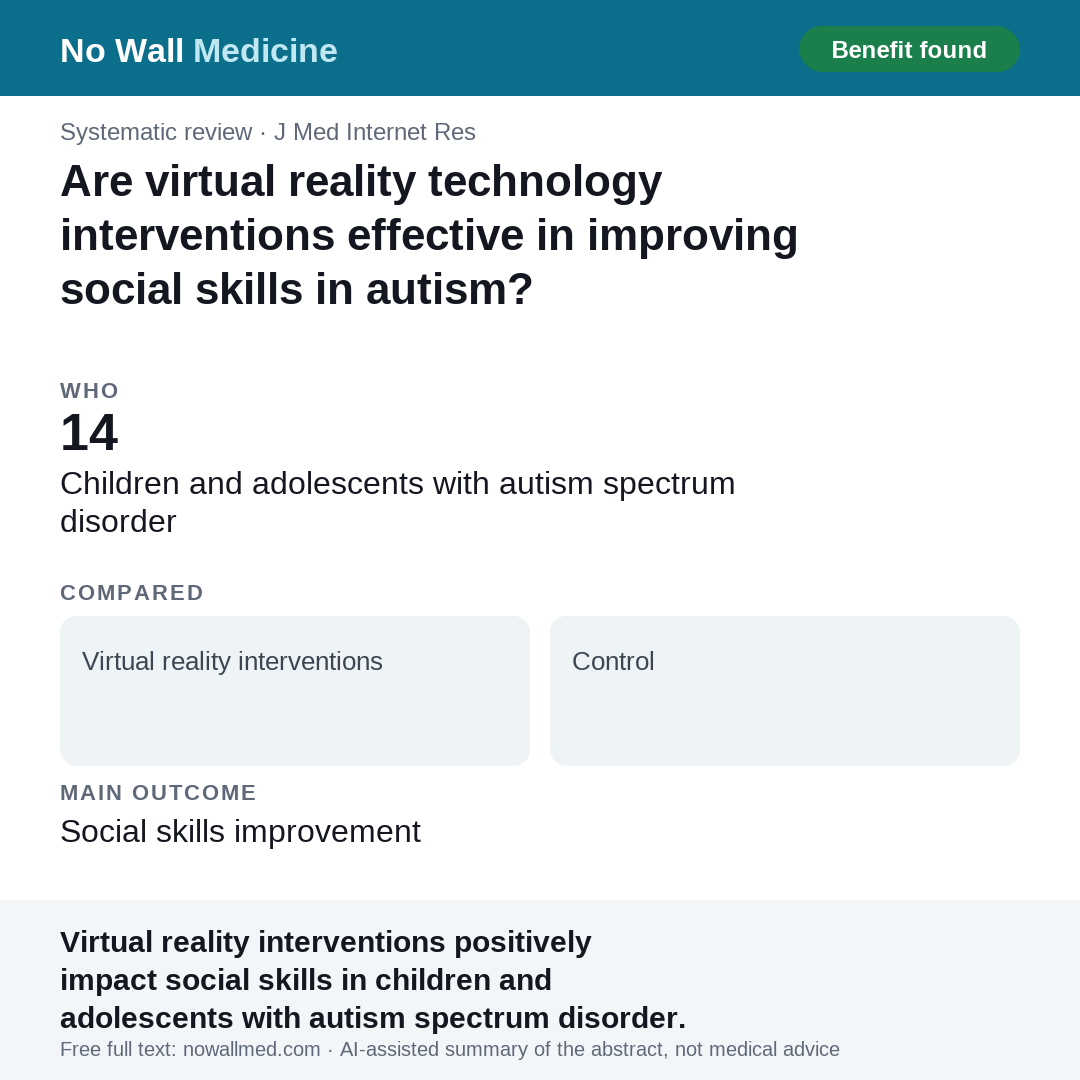
Clinical question: Are virtual reality technology interventions effective in improving social skills in autism?
Why it matters: It was unknown how different types of virtual reality technology, such as immersive or nonimmersive systems, affect social skill development across different levels of autism functioning.
Key points
- Researchers analyzed 14 studies involving children and adolescents with autism spectrum disorder to evaluate the effectiveness of virtual reality technology.
- High-functioning autism individuals benefited more from interventions, while those with low-functioning autism showed progress mainly in basic skills.
- Immersive virtual reality was linked to complex skill training, but some studies reported side effects like dizziness, eye fatigue, and sensory overload.
Headline and key points written with AI from the paper’s abstract, with every number checked against it. Read the paper before relying on them.
Topics
Cite this article
Yang X, Wu J, Ma Y, Yu J, Cao H, Zeng A. Effectiveness of Virtual Reality Technology Interventions in Improving the Social Skills of Children and Adolescents With Autism: Systematic Review. J Med Internet Res. 2025. doi:10.2196/60845
Spotted a mistake? Suggest a correction
Top studies every Monday
The week’s key trials and guidelines in your specialties, by email. Free.
Get the weekly digest