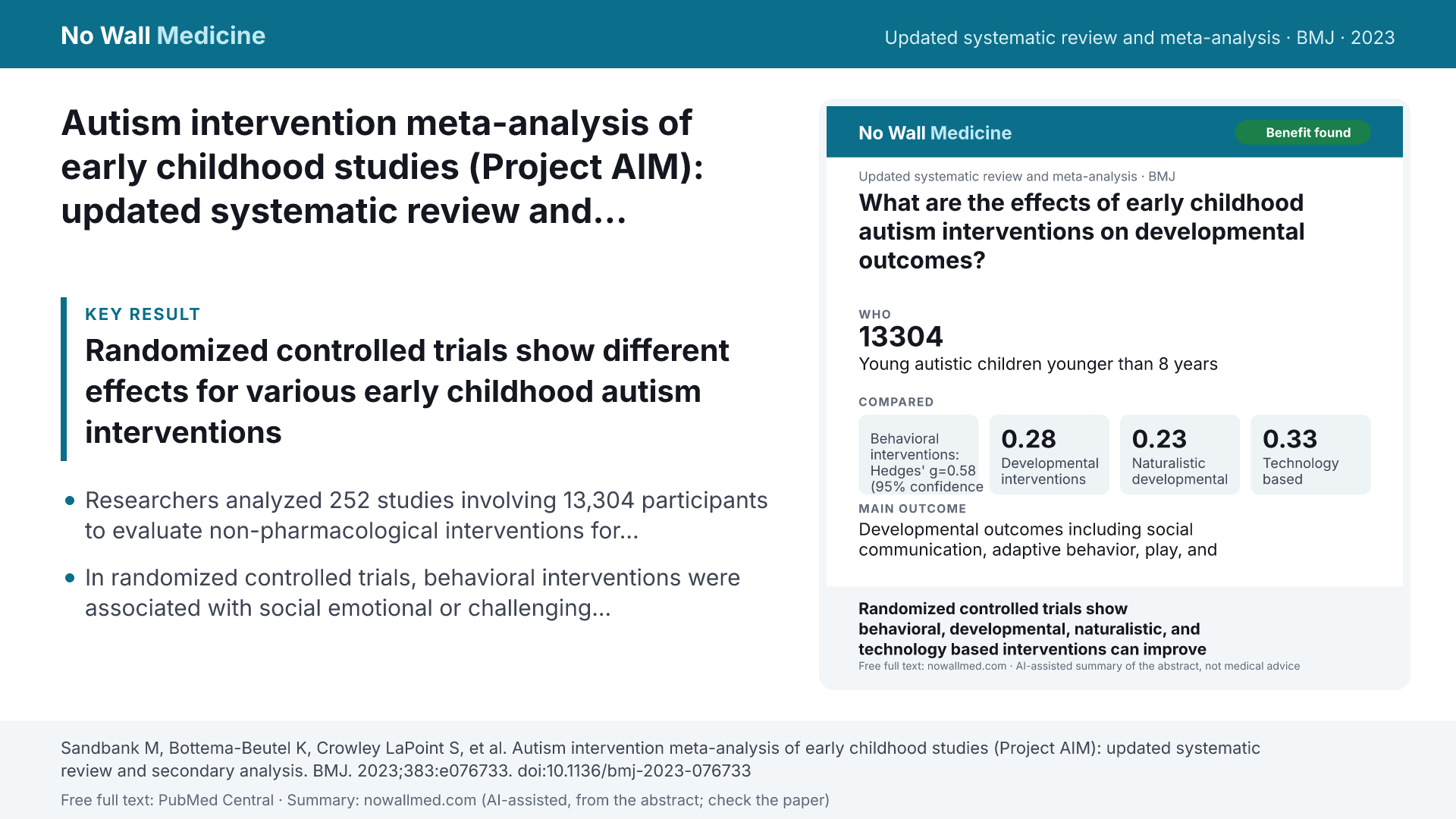
Randomized controlled trials show different effects for various early childhood autism interventions
Autism intervention meta-analysis of early childhood studies (Project AIM): updated systematic review and secondary analysis
Updated systematic review and meta-analysisBenefit found
What are the effects of early childhood autism interventions on developmental outcomes?
Who
13304
Young autistic children younger than 8 years
Compared
Behavioral interventions: Hedges' g=0.58 (95% confidence interval 0.11 to 1.06)
0.28Developmental interventions (95% confidence interval 0.12 to 0.44)
0.23Naturalistic developmental behavioral interventions (95% confidence interval 0.02 to 0.43)
0.33Technology based interventions (95% confidence interval 0.02 to 0.64)
Main outcome
Developmental outcomes including social communication, adaptive behavior, play, and language
Bottom line: Randomized controlled trials show behavioral, developmental, naturalistic, and technology based interventions can improve various developmental outcomes in young autistic children.
Limitation: Adverse events were poorly monitored, but possibly common.
BMJ · 2023-11-14Download image
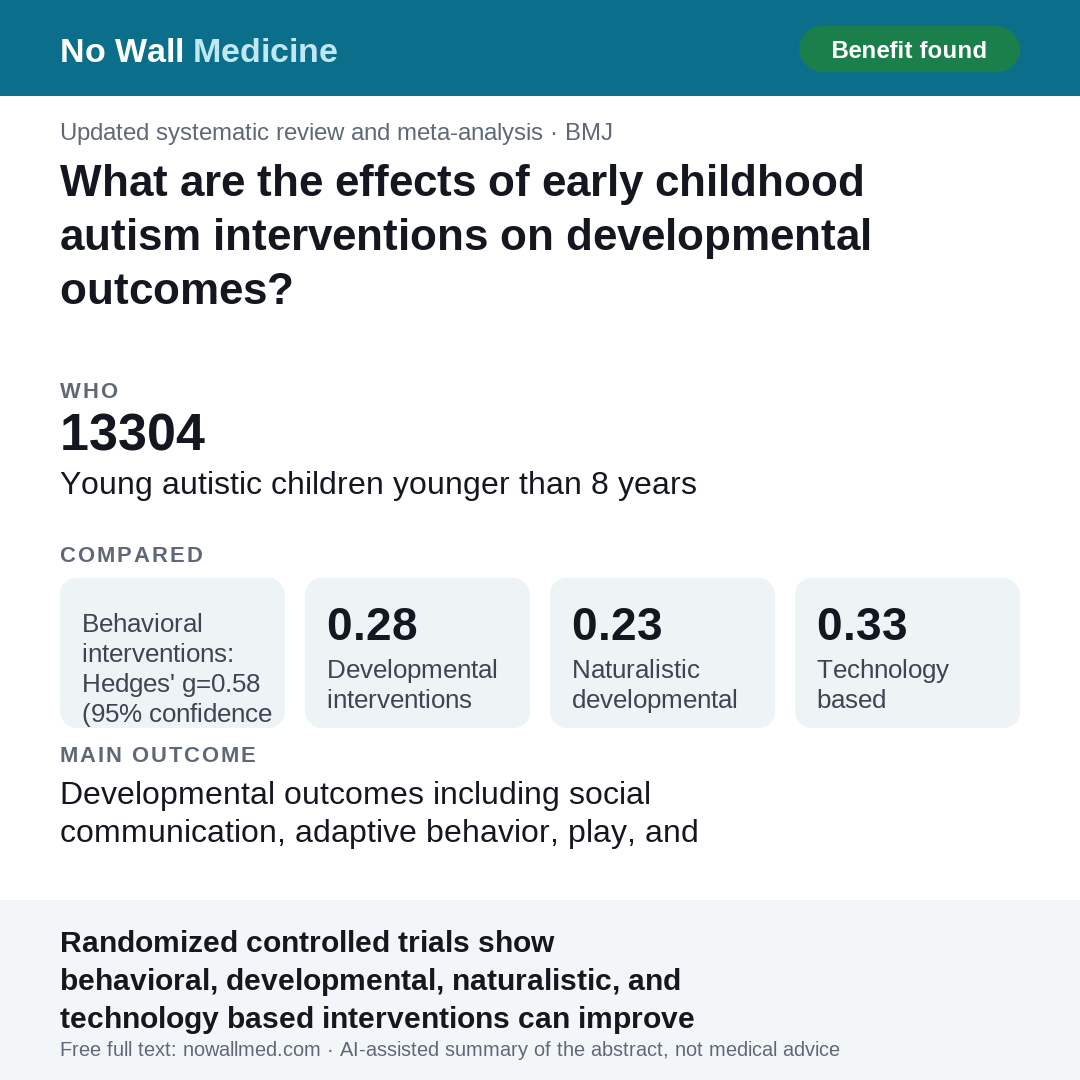
Clinical question: What are the effects of early childhood autism interventions on developmental outcomes?
Why it matters: The breadth and quality of evidence supporting commonly recommended early childhood autism interventions and their effects on developmental outcomes were not fully summarized.
Key points
- Researchers analyzed 252 studies involving 13,304 participants to evaluate non-pharmacological interventions for children younger than 8 years.
- In randomized controlled trials, behavioral interventions were associated with social emotional or challenging behavior outcomes (Hedges' g=0.58, 95% confidence interval 0.11 to 1.06).
- Naturalistic developmental behavioral interventions were associated with adaptive behavior (0.23, 95% confidence interval 0.02 to 0.43), language (0.16, 0.01 to 0.31), and social communication (0.35, 0.23 to 0.47).
Limitation the authors note: Adverse events were poorly monitored, but possibly common.
Headline and key points written with AI from the paper’s abstract, with every number checked against it. Read the paper before relying on them.
Was this summary helpful?
Abstract
Objective
To summarize the breadth and quality of evidence supporting commonly recommended early childhood autism interventions and their estimated effects on developmental outcomes. Design
Updated systematic review and meta-analysis (autism intervention meta-analysis; Project AIM). Data sources
A search was conducted in November 2021 (updating a search done in November 2017) of the following databases and registers: Academic Search Complete, CINAHL Plus with full text, Education Source, Educational Administration Abstracts, ERIC, Medline, ProQuest Dissertations and Theses, PsycINFO, Psychology and Behavioral Sciences Collection, and SocINDEX with full text, Trials, and ClinicalTrials.gov. Eligibility criteria for selecting studies
Any controlled group study testing the effects of any non-pharmacological intervention on any outcome in young autistic children younger than 8 years. Review methods
Newly identified studies were integrated into the previous dataset and were coded for participant, intervention, and outcome characteristics. Interventions were categorized by type of approach (such as behavioral, developmental, naturalistic developmental behavioral intervention, and technology based), and outcomes were categorized by domain (such as social communication, adaptive behavior, play, and language). Risks of bias were evaluated following guidance from Cochrane. Effects were estimated for all intervention and outcome types with sufficient contributing data, stratified by risk of bias, using robust variance estimation to account for intercorrelation of effects within studies and subgroups. Results
The search yielded 289 reports of 252 studies, representing 13 304 participants and effects for 3291 outcomes. When contributing effects were restricted to those from randomized controlled trials, significant summary effects were estimated for behavioral interventions on social emotional or challenging behavior outcomes (Hedges' g=0.58, 95% confidence interval 0.11 to 1.06; P=0.02), developmental interventions on social communication (0.28, 0.12 to 0.44; P=0.003); naturalistic developmental behavioral interventions on adaptive behavior (0.23, 0.02 to 0.43; P=0.03), language (0.16, 0.01 to 0.31; P=0.04), play (0.19, 0.02 to 0.36; P=0.03), social communication (0.35, 0.23 to 0.47; P<0.001), and measures of diagnostic characteristics of autism (0.38, 0.17 to 0.59; P=0.002); and technology based interventions on social communication (0.33, 0.02 to 0.64; P=0.04) and social emotional or challenging behavior outcomes (0.57, 0.04 to 1.09; P=0.04). When effects were further restricted to exclude caregiver or teacher report outcomes, significant effects were estimated only for developmental interventions on social communication (0.31, 0.13 to 0.49; P=0.003) and naturalistic developmental behavioral interventions on social communication (0.36, 0.23 to 0.49; P<0.001) and measures of diagnostic characteristics of autism (0.44, 0.20 to 0.68; P=0.002). When effects were then restricted to exclude those at high risk of detection bias, only one significant summary effect was estimated-naturalistic developmental behavioral interventions on measures of diagnostic characteristics of autism (0.30, 0.03 to 0.57; P=0.03). Adverse events were poorly monitored, but possibly common. Conclusion
The available evidence on interventions to support young autistic children has approximately doubled in four years. Some evidence from randomized controlled trials shows that behavioral interventions improve caregiver perception of challenging behavior and child social emotional functioning, and that technology based interventions support proximal improvements in specific social communication and social emotional skills. Evidence also shows that developmental interventions improve social communication in interactions with caregivers, and naturalistic developmental behavioral interventions improve core challenges associated with autism, particularly difficulties with social communication. However, potential benefits of these interventions cannot be weighed against the potential for adverse effects owing to inadequate monitoring and reporting.
Abstract reproduced under the article’s CC BY NC licence.
Subject terms
Cite this article
Sandbank M, Bottema-Beutel K, Crowley LaPoint S, Feldman JI, Barrett DJ, Caldwell N. Autism intervention meta-analysis of early childhood studies (Project AIM): updated systematic review and secondary analysis. BMJ. 2023. doi:10.1136/bmj-2023-076733
Spotted a mistake? Suggest a correction