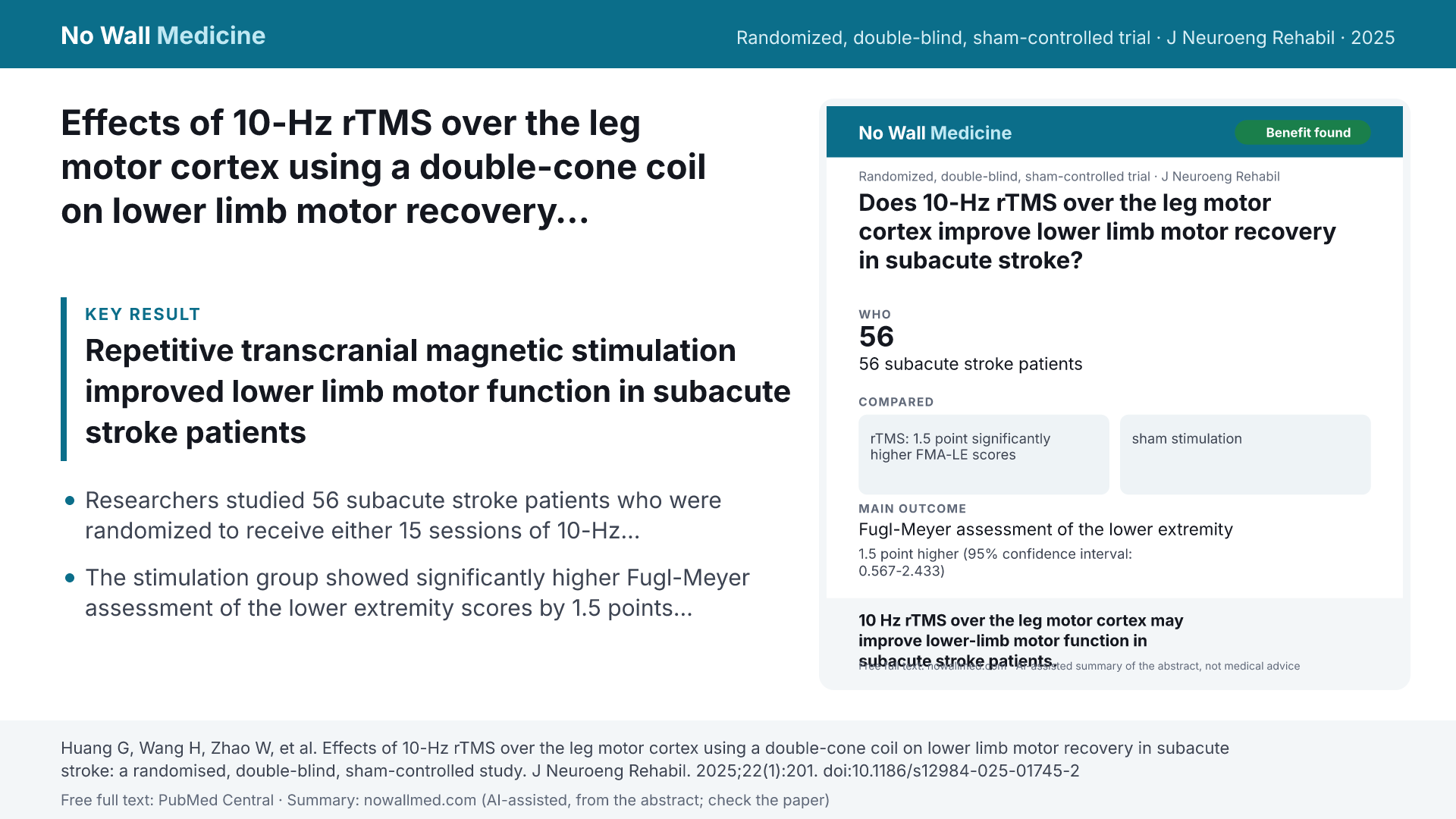
Effects of 10-Hz rTMS over the leg motor cortex using a double-cone coil on lower limb motor recovery in subacute stroke: a randomised, double-blind, sham-controlled study
Key result: Repetitive transcranial magnetic stimulation improved lower limb motor function in subacute stroke patients
Key points
- Researchers studied 56 subacute stroke patients who were randomized to receive either 15 sessions of 10-Hz repetitive transcranial magnetic stimulation or sham stimulation.
- The stimulation group showed significantly higher Fugl-Meyer assessment of the lower extremity scores by 1.5 points compared to the sham group.
- The stimulation group also showed superior results in Berg Balance Scale scores and balance assessments for sway area and sway length.
Why it matters: The efficacy and safety of using double-cone coils for deep repetitive transcranial magnetic stimulation to improve motor recovery in stroke patients remain underexplored.
Discussion prompts
- Would these patients look like yours? Who was left out?
- Is the main outcome one that matters to patients?
- Is the difference large enough to change what you do?
Cite: Huang G, Wang H, Zhao W, et al. Effects of 10-Hz rTMS over the leg motor cortex using a double-cone coil on lower limb motor recovery in subacute stroke: a randomised, double-blind, sham-controlled study. J Neuroeng Rehabil. 2025;22(1):201. doi:10.1186/s12984-025-01745-2
Free full text: PubMed Central · Summary and visual abstract: nowallmed.com/a/effects-of-10-hz-rtms-over-the-leg-motor-cortex-using-a-double-cone-j01u3j/ (AI-assisted from the abstract; check the paper before relying on it).