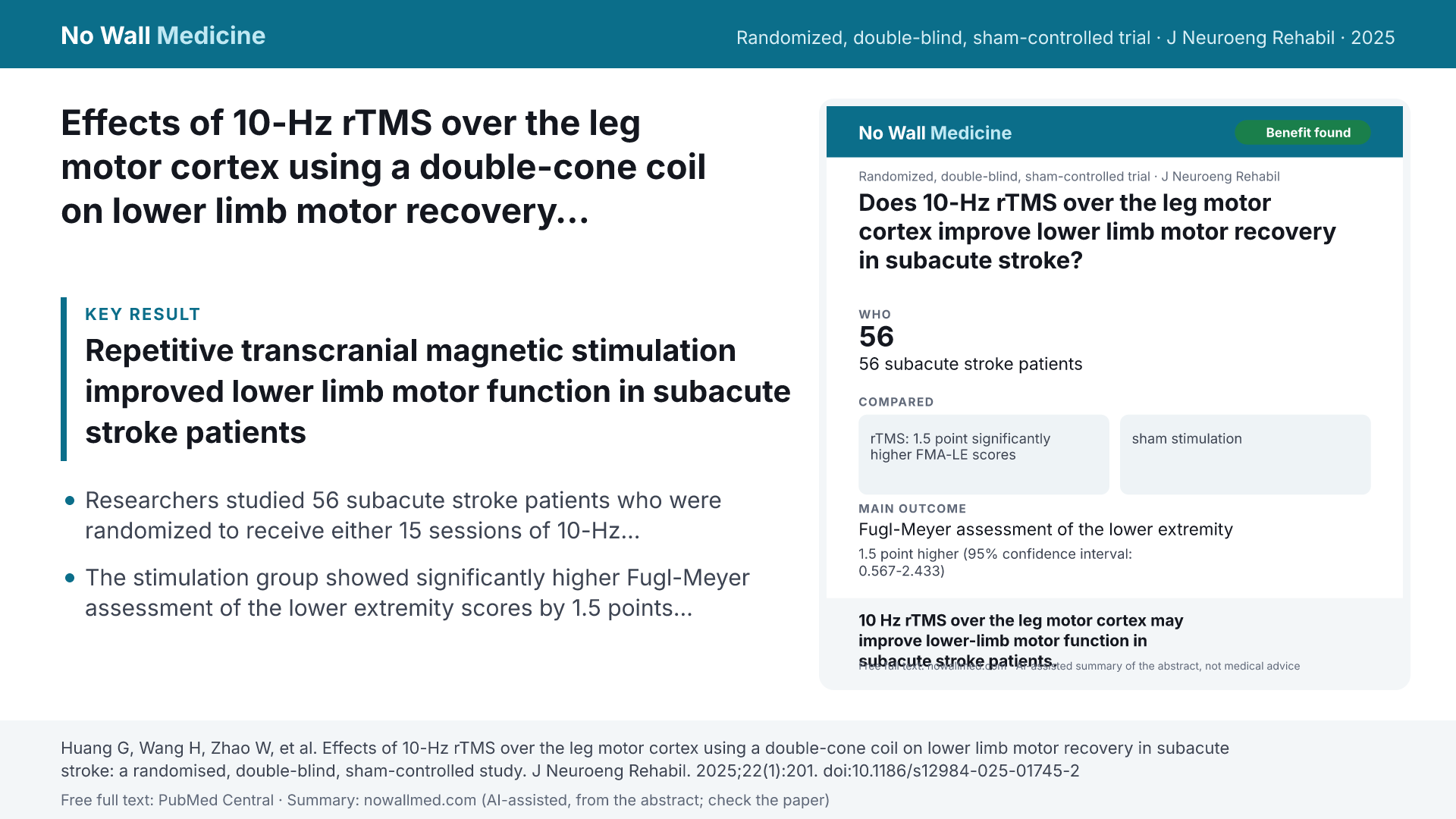
Repetitive transcranial magnetic stimulation improved lower limb motor function in subacute stroke patients
Effects of 10-Hz rTMS over the leg motor cortex using a double-cone coil on lower limb motor recovery in subacute stroke: a randomised, double-blind, sham-controlled study
Randomized, double-blind, sham-controlled trialBenefit found
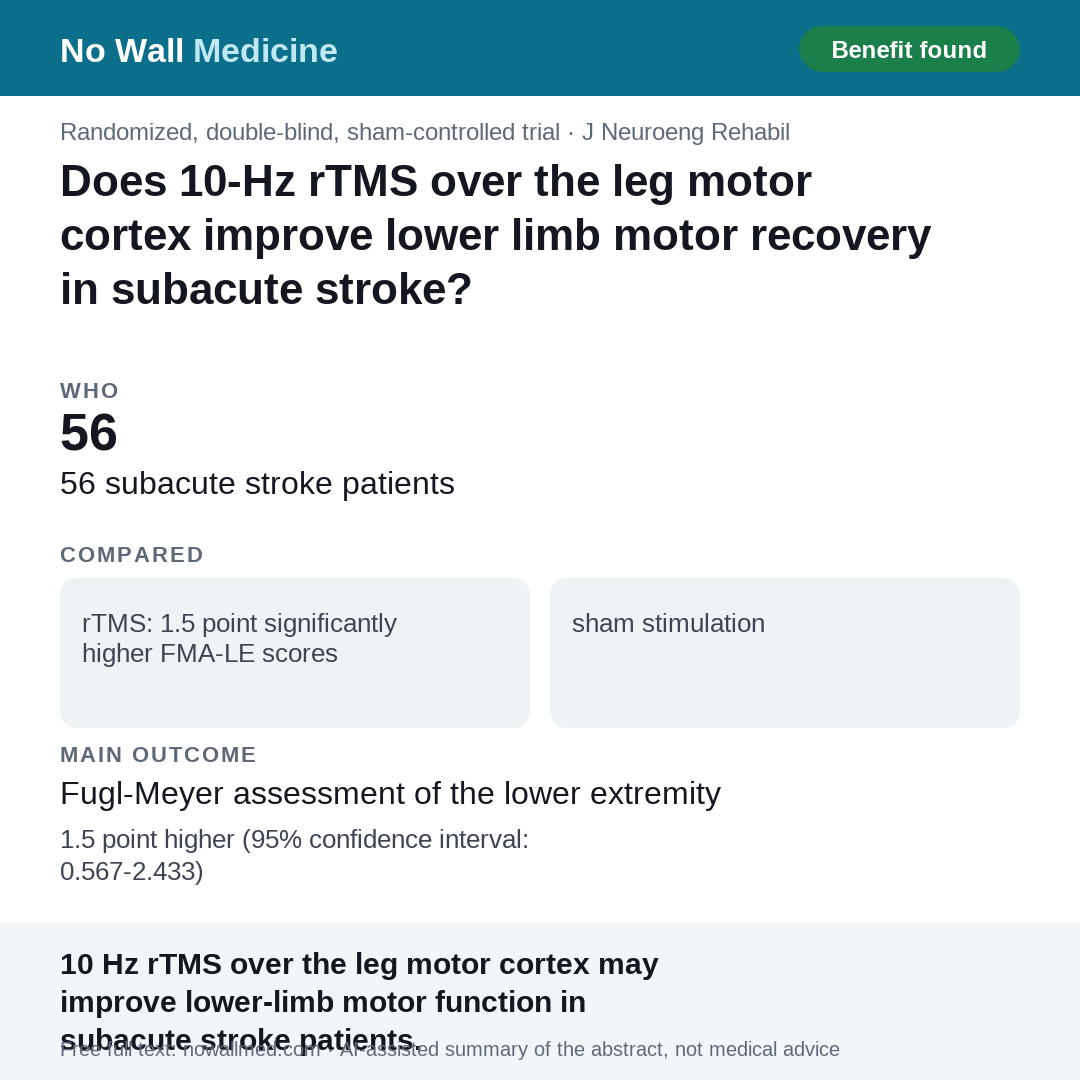
Does 10-Hz rTMS over the leg motor cortex improve lower limb motor recovery in subacute stroke?
Who
56
56 subacute stroke patients
Compared
rTMS: 1.5 point significantly higher FMA-LE scores
sham stimulation
Main outcome
Fugl-Meyer assessment of the lower extremity
Result: 1.5 point higher (95% confidence interval: 0.567-2.433)
Bottom line: 10 Hz rTMS over the leg motor cortex may improve lower-limb motor function in subacute stroke patients.
J Neuroeng Rehabil · 2025-09-29Download image
Clinical question: Does 10-Hz rTMS over the leg motor cortex improve lower limb motor recovery in subacute stroke?
Why it matters: The efficacy and safety of using double-cone coils for deep repetitive transcranial magnetic stimulation to improve motor recovery in stroke patients remain underexplored.
Key points
- Researchers studied 56 subacute stroke patients who were randomized to receive either 15 sessions of 10-Hz repetitive transcranial magnetic stimulation or sham stimulation.
- The stimulation group showed significantly higher Fugl-Meyer assessment of the lower extremity scores by 1.5 points compared to the sham group.
- The stimulation group also showed superior results in Berg Balance Scale scores and balance assessments for sway area and sway length.
Headline and key points written with AI from the paper’s abstract, with every number checked against it. Read the paper before relying on them.
Was this summary helpful?
Subject terms
Cite this article
Huang G, Wang H, Zhao W, et al. Effects of 10-Hz rTMS over the leg motor cortex using a double-cone coil on lower limb motor recovery in subacute stroke: a randomised, double-blind, sham-controlled study. J Neuroeng Rehabil. 2025. doi:10.1186/s12984-025-01745-2
Spotted a mistake? Suggest a correction