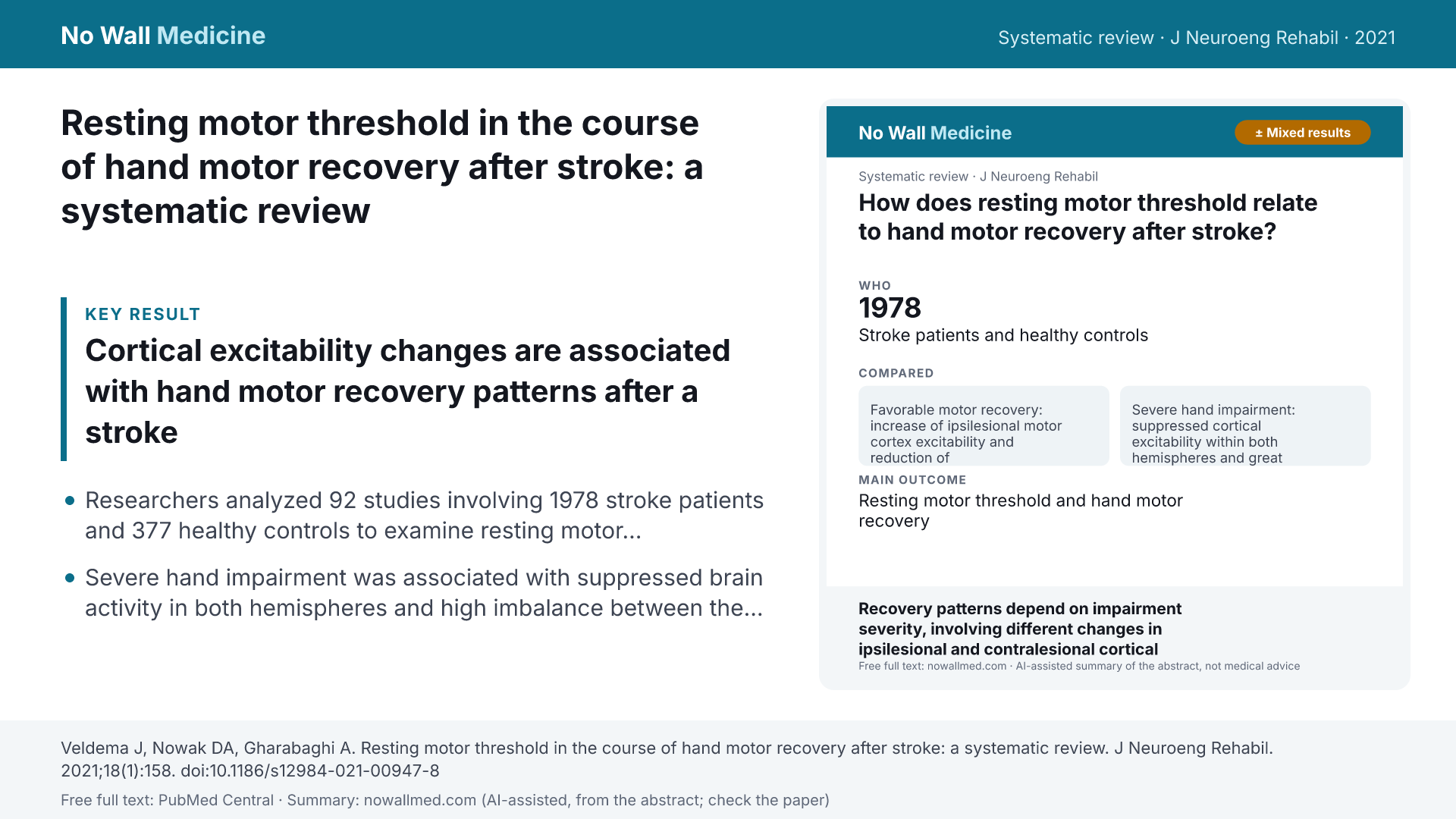
Cortical excitability changes are associated with hand motor recovery patterns after a stroke
Resting motor threshold in the course of hand motor recovery after stroke: a systematic review
Systematic reviewMixed results
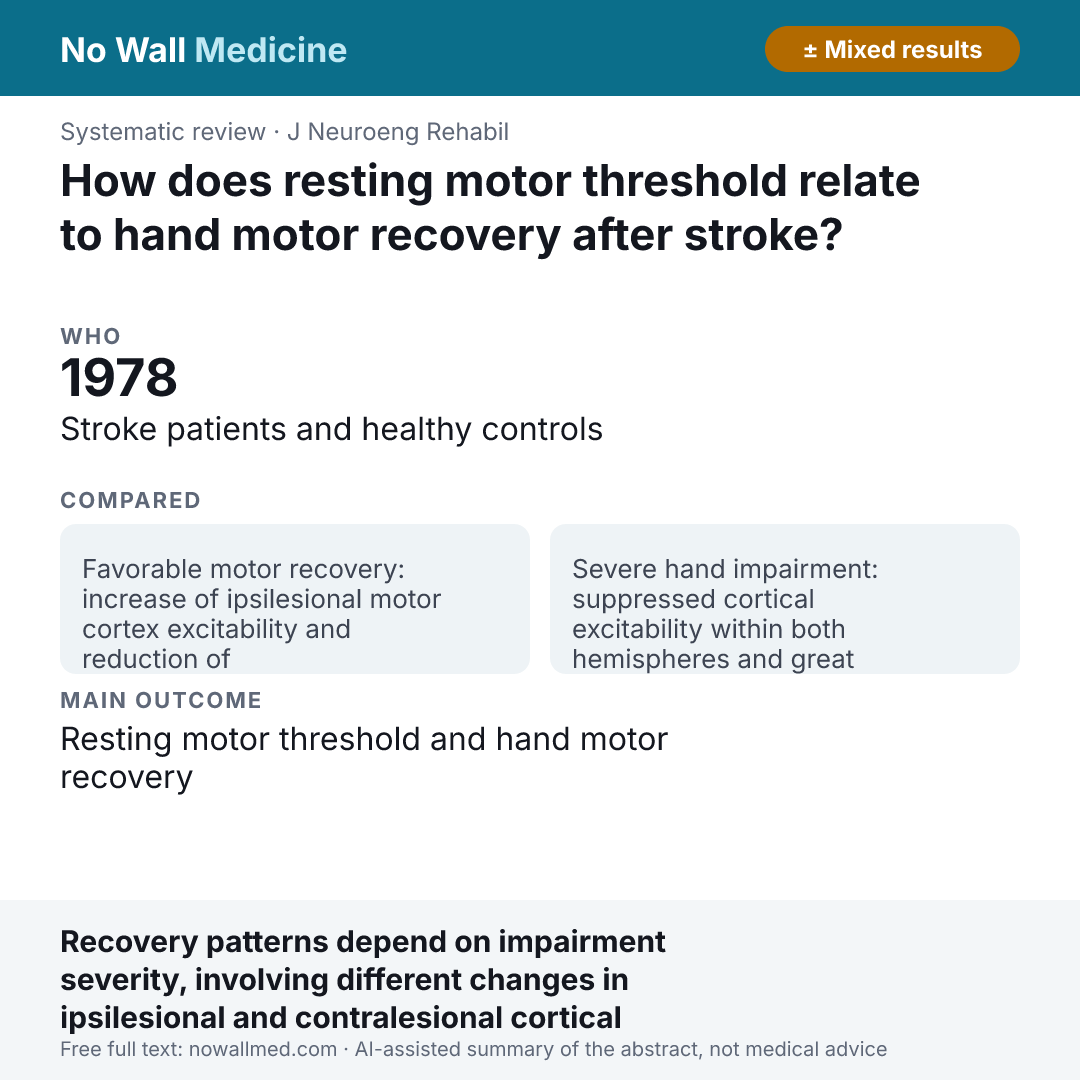
How does resting motor threshold relate to hand motor recovery after stroke?
Who
1978
Stroke patients and healthy controls
Compared
Favorable motor recovery: increase of ipsilesional motor cortex excitability and reduction of between-hemispheric imbalance
Severe hand impairment: suppressed cortical excitability within both hemispheres and great between-hemispheric imbalance
Main outcome
Resting motor threshold and hand motor recovery
Bottom line: Recovery patterns depend on impairment severity, involving different changes in ipsilesional and contralesional cortical excitability.
J Neuroeng Rehabil · 2021-11-03 · Save PNG
Clinical question: How does resting motor threshold relate to hand motor recovery after stroke?
Why it matters: The specific relationship between resting motor threshold changes and the level of motor impairment remains unclear for developing rehabilitation strategies.
Key points
- Researchers analyzed 92 studies involving 1978 stroke patients and 377 healthy controls to examine resting motor threshold, which measures brain activity levels.
- Severe hand impairment was associated with suppressed brain activity in both hemispheres and high imbalance between the two sides of the brain.
- Favorable recovery was associated with increased activity in the brain hemisphere on the side of the injury and reduced imbalance between hemispheres.
Headline and key points written with AI from the paper’s abstract, with every number checked against it. Read the paper before relying on them.
Was this summary helpful?
Subject terms
Headline, design, result, key points, caveat and citation as plain text.
Cite this article
Veldema J, Nowak DA, Gharabaghi A. Resting motor threshold in the course of hand motor recovery after stroke: a systematic review. J Neuroeng Rehabil. 2021;18(1):158. doi:10.1186/s12984-021-00947-8
Spotted a mistake? Suggest a correction