Six months of customized home exercise improved motor development in children with simple congenital heart disease
Effects of 6-month customized home-based exercise on motor development, bone strength, and parental stress in children with simple congenital heart disease: a single-blinded randomized clinical trial
Single-blinded randomized controlled trialBenefit found
Does 6-month customized home-based exercise improve motor development in children with simple congenital heart disease?
Who
183
Children aged 0-5 years with simple congenital heart disease
Compared
Customized home-based exercise: significantly increased motor quotient
Control treatment
Main outcome
Motor development (gross motor quotient, fine motor quotient, total motor quotient)
Bottom line: Six months of customized home-based exercise improved motor development and quality of life in children with simple congenital heart disease.
Limitation: The long-term effects of parent training in home-based exercise are unknown.
BMC Med · 2024-02-06Download image
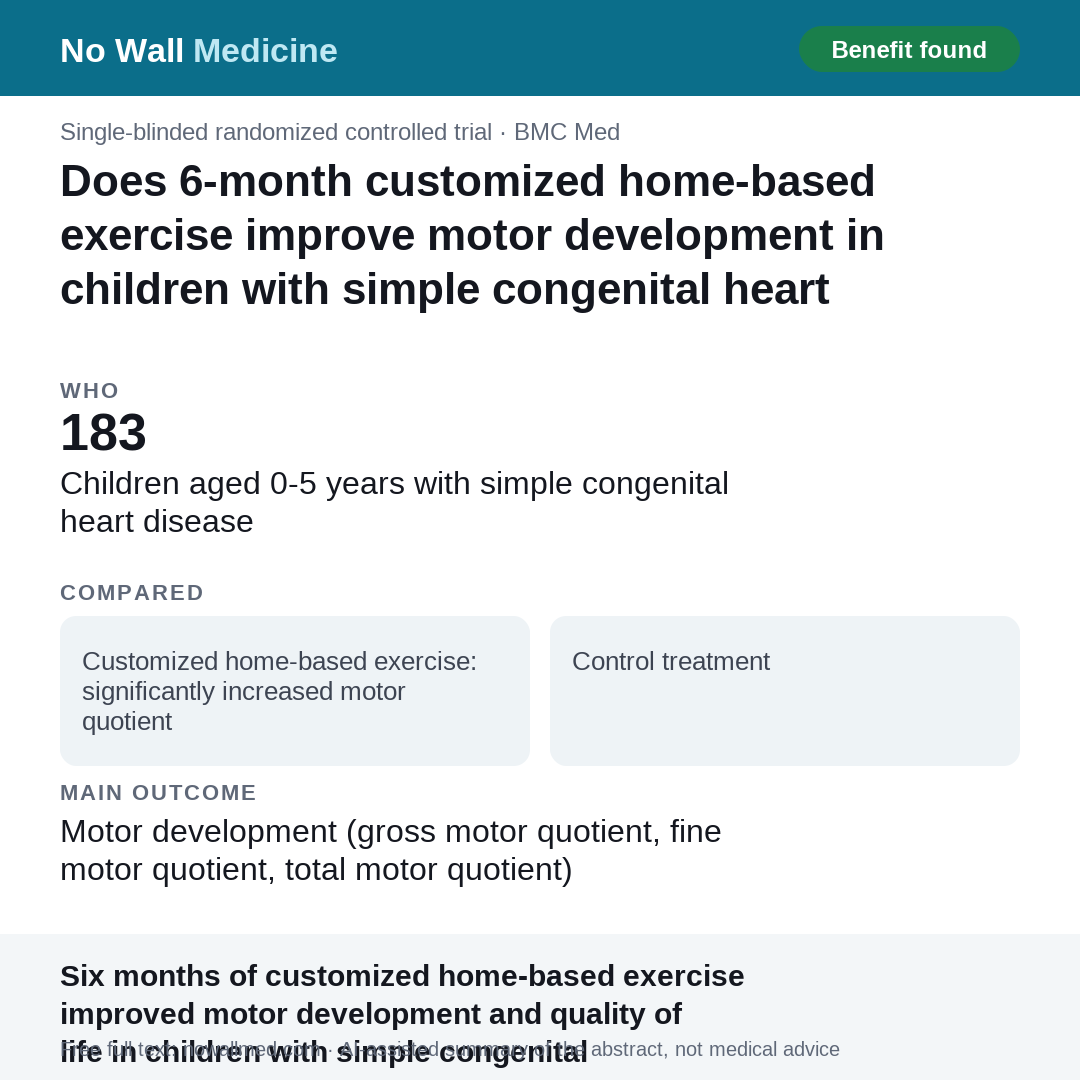
Clinical question: Does 6-month customized home-based exercise improve motor development in children with simple congenital heart disease?
Why it matters: It was unknown if customized home-based exercise could attenuate neurodevelopmental impairments and other noncardiac problems in children with congenital heart disease.
Key points
- Researchers randomized 192 children aged 0-5 years with simple congenital heart disease to either a 6-month customized home-based exercise program or home-based education.
- The exercise group showed significantly higher gross motor quotient (p < 0.0001), fine motor quotient (p = 0.02), and total motor quotient (p < 0.001) than the control group.
- The intervention was associated with improved height, weight, and body circumferences, but showed no significant improvements in bone strength or cardiac structure and function.
Headline and key points written with AI from the paper’s abstract, with every number checked against it. Read the paper before relying on them.
Was this summary helpful?
Subject terms
Cite this article
Du Q, Li X, Wang Z, Chen S, Zhang X, Liang J. Effects of 6-month customized home-based exercise on motor development, bone strength, and parental stress in children with simple congenital heart disease: a single-blinded randomized clinical trial. BMC Med. 2024. doi:10.1186/s12916-023-03242-6
Spotted a mistake? Suggest a correction
Top studies every Monday
The week’s key trials and guidelines in your specialties, plus any topics you follow. By email, free.
Get the weekly digest